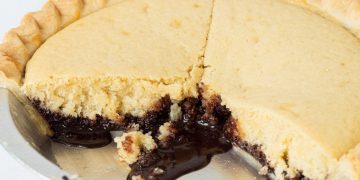




There is a moment, sometime in the first half of the twentieth century, when a Pennsylvania Dutch home cook looked at a pie pan, looked at a cake batter, and thought: why not both? The result was the Funny Cake — a dessert so gloriously illogical that food historians still do a small double-take when they encounter it. It is a cake baked inside a pie. It has a chocolate fudge layer that starts on top and sinks to the bottom during baking, creating its own sauce beneath a tender vanilla (or chocolate) crumb. It is neither entirely a cake nor entirely a pie, and that’s precisely the point.
The Funny Cake is funny because it defies category. And in Pennsylvania Dutch country, where thrift, ingenuity, and a deep respect for the pleasures of the table converge, defying category was never something to be ashamed of.

Where Pennsylvania Dutch Country Begins
To understand the Funny Cake, you have to understand the landscape it comes from. Pennsylvania Dutch Country — centered in Lancaster, Berks, Lebanon, and York counties in southeastern Pennsylvania — is a place where the past has never been entirely replaced by the present. The hex signs still spin on barn doors. The roadside stands still sell shoofly pie and apple butter in mason jars. On summer Saturdays, community fire halls host “chicken and waffle” dinners that draw hundreds of locals who eat exactly what their grandparents ate at the same tables.
The term “Pennsylvania Dutch” is itself a small etymological joke: the word “Dutch” is a corruption of “Deutsch,” meaning German. These were not Dutch settlers from the Netherlands but German-speaking immigrants — Amish, Mennonite, Lutheran, Reformed — who began arriving in William Penn’s tolerant colony in the late 1600s and early 1700s. They brought with them a food culture shaped by centuries of Central European peasant cooking: hearty, resourceful, deeply satisfying, and unapologetically sweet.
The Pennsylvania Dutch kitchen became famous for its “seven sweets and seven sours” tradition — a table practice requiring that any proper meal include seven sweet dishes (jams, jellies, fruit preserves, sweet pickles, candied vegetables) and seven sour ones (pickled beets, chowchow, vinegar-based slaws). Dessert, in this context, was not an afterthought. It was a cultural statement.
The Genius of the Funny Cake
The Funny Cake belongs to a category of Pennsylvania Dutch baking that might be called “impossible construction” — desserts that seem, on paper, to contradict themselves. Shoofly pie has a wet bottom or dry bottom depending on recipe variation. Schnitz und Knepp straddles the line between soup, stew, and dumpling dish. The Montgomery Pie features a lemon custard that separates into layers as it bakes. These are not accidents. They are the result of cooks who understood their ingredients deeply enough to manipulate physics.
The Funny Cake works like this: you prepare a standard pie crust and line your pan. You pour in a thin chocolate syrup — sugar, cocoa, water, sometimes vanilla. Then you pour a simple cake batter directly on top of the chocolate. Into the oven it goes. During baking, the cake batter rises and sets into a light, springy crumb. The chocolate syrup, meanwhile, sinks through the batter and pools at the bottom, creating a layer of dense, fudgy chocolate sauce beneath a pale cake, all encased in a flaky pastry shell.
The result is three textures in one slice: crisp and buttery pastry, soft vanilla cake, and thick chocolate fudge — each layer distinct, each layer playing off the others.
It is, in the most literal sense, greater than the sum of its parts.
The Recipe in Its Natural Habitat
Ask five Pennsylvania Dutch grandmothers for their Funny Cake recipe and you will get five variations. Some use lard in the crust; some use shortening; a modernized few use butter. Some families make theirs with a white cake layer and pure chocolate bottom, so the contrast is dramatic. Others make a chocolate cake batter poured over the chocolate syrup, producing something that is chocolate throughout — rich, dark, unapologetically indulgent.
The chocolate sauce layer varies too. Older recipes call for simple cocoa powder stirred into water and sugar, producing a thin syrup that migrates beautifully during baking. Some cooks add a tablespoon of butter to the syrup for extra richness. Some add a splash of brewed coffee, which deepens the chocolate flavor without making the cake taste remotely like coffee. A few adventurous bakers add a pinch of cinnamon or nutmeg — small gestures toward the spiced baking tradition common throughout Pennsylvania Dutch country.
What rarely varies is the pie pan. The Funny Cake is always baked in a pie pan, never a round cake pan, never a springform. The pie pan is essential: it gives you that sloped edge of pastry that cradles each slice, and it ensures the right depth-to-diameter ratio for the layers to form properly. Bake it in a cake pan and the magic dissipates. You’ll get something decent, but you won’t get a Funny Cake.
A Classic Chocolate Funny Cake
For the crust:
- 1½ cups all-purpose flour
- ½ teaspoon salt
- ½ cup lard or shortening (or cold butter)
- 4–5 tablespoons ice water
For the chocolate layer:
- ½ cup granulated sugar
- ¼ cup unsweetened cocoa powder
- ½ cup water
- 1 teaspoon vanilla extract
- 1 tablespoon butter (optional but recommended)
For the cake layer:
- ½ cup granulated sugar
- 3 tablespoons softened butter
- 1 egg
- ½ cup whole milk
- 1 cup all-purpose flour
- 1½ teaspoons baking powder
- ¼ teaspoon salt
- 1 teaspoon vanilla extract
Make the crust first: cut the fat into the flour and salt until the mixture resembles coarse crumbs, then add ice water a tablespoon at a time until the dough just comes together. Wrap and chill for thirty minutes, then roll out and fit into a 9-inch pie pan. Crimp the edges, but don’t pre-bake.
Make the chocolate layer by combining sugar, cocoa, and water in a small saucepan over medium heat. Stir until the sugar dissolves and the mixture is smooth. Remove from heat, add vanilla and butter. Let it cool slightly.
Make the cake batter: cream butter and sugar together until light. Add the egg and vanilla. Alternately add the flour mixture (flour, baking powder, salt) and the milk, beginning and ending with flour. Don’t overmix.
Pour the chocolate syrup into the unbaked pie crust. Pour the cake batter directly over it — gently, evenly. Bake at 350°F for 40–45 minutes, until the cake is set and a toothpick comes out clean from the cake layer. The chocolate will have sunk. Let it cool completely before slicing, or the chocolate layer won’t have set into its fudgy final consistency.
Why It’s Called Funny
The name has sparked gentle debate among food writers and local historians for decades. The most obvious explanation is purely descriptive: the cake is funny — peculiar, odd, amusing — because it starts upside down and ends right-side up. The chocolate goes in on top and ends up on the bottom. The batter goes in on the bottom and rises to the top. There’s something inherently comic about that, a kind of culinary pratfall that always lands.
A second theory holds that “funny” is a Pennsylvania Dutch corruption of a German word, though linguistic historians haven’t settled on a consensus candidate. The Pennsylvania Dutch dialect — a German-English creole that’s still spoken by some Amish and Old Order Mennonite communities — is full of words that sound like English while meaning something slightly different.
A third, more pragmatic theory: the cake is funny because it was funny to explain. Before the era of food photography and cooking videos, a cook describing this recipe to a neighbor would inevitably get a skeptical look. You pour the chocolate on the bottom? No, on top. And it sinks? Yes, it sinks. And then it turns into fudge? Yes. That sounds wrong. That’s why it’s funny.
Whatever the etymology, the name stuck, and it stuck hard. Cookbooks from Lancaster County dating to the 1930s and 1940s list it exactly as it’s still known today.
Funny Cake in Pennsylvania Dutch Food Culture
The Funny Cake did not exist in isolation. It was part of a rich ecosystem of Pennsylvania Dutch baking that included shoofly pie (molasses custard in a pastry shell), fastnachts (fried doughnuts eaten on Shrove Tuesday), schnecken (cinnamon-honey pecan rolls), and lebkuchen (spiced honey cookies descended directly from medieval German confections). These weren’t just recipes — they were calendar markers, community touchstones, ways of moving through the year.
Funny Cake was the everyday dessert, the thing that appeared at church potlucks and school fundraisers, at farm auctions and family reunions. It wasn’t precious or ceremonial the way shoofly pie could be. It was a workhorse dessert: fast to make, forgiving in execution, beloved by children and adults with equal fervor.
The pie crust shell gave it a portability that pure cakes lacked. You could cut it into neat wedges, stack them on a plate, carry them across a parking lot to a potluck table without them crumbling or sliding. The crust became a structural element as much as a flavor component.
It also extended beautifully. One recipe made two pies, not one — the standard Pennsylvania Dutch instinct toward abundance. If you were making pastry, you made enough for the week. If you were mixing cake batter, you made enough for company. The Funny Cake, by nature of its design, always made sense in multiples.
The Texture That Makes It Memorable
Much of what distinguishes the Funny Cake from any other chocolate-and-cake combination is the textural experience of eating it. Food writing has a tendency to over-intellectualize texture, but here it genuinely matters, because the three layers of a properly made Funny Cake behave differently in the mouth at every stage of a single bite.
The crust — if made with lard, which produces the most authentically Pennsylvania Dutch result — is shattery and savory in a way that butter crusts aren’t quite. It breaks cleanly under a fork and provides a counterpoint to the sweetness above it. Then comes the fudge layer: dense, almost candy-like in spots, viscous in others, intensely chocolate without being bitter. This layer is thin but heavy, the gravitational anchor of the whole dessert.
Above it sits the cake itself, which in a well-made Funny Cake should be moist but not wet, light but not insubstantial. It’s a simple vanilla crumb — the flavor profile is deliberately understated to let the chocolate do its work. The vanilla is a frame, not a statement.
Eaten together in one forkful, the three layers produce a sensation that’s hard to achieve with any other dessert architecture. You get sweetness, richness, and buttery savoriness in a single bite, without any one element overwhelming the others. This is either culinary accident or culinary genius, and after nearly a century of the recipe’s documented existence, it seems appropriate to credit it as the latter.
Regional Variations and Modern Interpretations
Like any living folk recipe, the Funny Cake has evolved. Modern Pennsylvania Dutch cookbooks and food bloggers have explored variations that would have puzzled a 1920s Mennonite kitchen but would have been immediately recognized in spirit — because they follow the same improvisational logic.
Peanut Butter Funny Cake adds a swirl of peanut butter to the chocolate layer before pouring in the batter, creating a Reese’s-inflected version that has its own devoted following in the Lancaster area.
Mocha Funny Cake incorporates espresso powder into both the chocolate layer and the cake batter, producing something darker and more sophisticated — a dessert that wouldn’t be out of place in a Philadelphia restaurant, while retaining its rural Pennsylvania DNA.
Brown Butter Funny Cake browns the butter for the cake batter first, adding a nutty depth that plays beautifully against the chocolate. This is a small technique with an outsized flavor impact.
Spiced Chocolate Funny Cake leans into the Pennsylvania Dutch spice tradition, adding cinnamon, clove, and ginger to the chocolate layer — a version that tastes almost like a chocolate shoofly hybrid and is extraordinary served warm.
Some contemporary bakers have experimented with gluten-free versions using almond flour in the crust and a rice flour-based cake batter, finding that the structure of the Funny Cake translates well to alternative flours because the separate layers provide structural support for each other.
The Funny Cake as Cultural Artifact
It would be a mistake to treat the Funny Cake as merely a charming regional curiosity. It is that, certainly — but it is also a document of a particular American food culture at a particular historical moment, when resourcefulness was not a trend but a necessity, when the distinction between a cake and a pie was less important than using what you had, when baking was an act of both love and practicality performed simultaneously.
The Pennsylvania Dutch community — and especially the Amish and Mennonite communities within it — has maintained a food culture that the broader American mainstream largely abandoned in the postwar decades. While the rest of the country moved toward convenience foods and processed baking mixes, Lancaster County kept making pastry from scratch, kept putting up preserves, kept baking things that required real knowledge of how ingredients behave.
The Funny Cake is a beneficiary of that continuity. Because it was never modernized out of existence, never replaced by a boxed mix version or a convenience-store approximation, it has arrived in the twenty-first century essentially intact. The recipe in a 2024 Lancaster County cookbook is not dramatically different from the one a farmwife wrote in her handwritten recipe journal in 1938. That kind of culinary continuity is increasingly rare, and it should be recognized as the form of cultural preservation it actually is.
Where to Find It Today
The Funny Cake is not difficult to find in its home territory. Lancaster Central Market — one of the oldest continuously operating farmers markets in the United States, operating since the 1730s — has vendors selling Funny Cakes alongside shoofly pies and whoopie pies. Bird-in-Hand Bakery in Lancaster County is a reliable source. Roadside farm stands throughout the area often sell them seasonally.
Outside Pennsylvania, the Funny Cake is largely unknown. It doesn’t appear on most national dessert menus, hasn’t been adopted by the artisan bakery movement in any significant way, and rarely comes up in mainstream food media. It is, in this respect, genuinely regional — one of the last desserts in American baking that remains almost entirely where it originated.
That specificity is part of its appeal. Visiting Lancaster County and eating a proper Funny Cake at a church fundraiser or a farmhouse table is a different experience from reading about it online. The context — the quilts on the walls, the community around you, the sense of a food tradition that has survived intact — is part of the flavor.
Why the Funny Cake Deserves a Wider Audience
American dessert culture is not short on chocolate options. Brownies, lava cakes, chocolate mousse, flourless chocolate torte, devil’s food cake with ganache frosting — the repertoire is extensive and well-executed. What the Funny Cake offers that none of these do is its particular combination of pie crust, fudge layer, and simple cake in a single unpretentious slice.
It also offers something increasingly rare in contemporary baking: surprise. The first time someone encounters a Funny Cake without knowing what it is, they bite into what looks like a modest, unassuming pie and find a layer of chocolate fudge they weren’t expecting. That surprise is the dessert’s best trick, and it never gets old no matter how many times you’ve encountered it.
For home bakers, the Funny Cake is a genuinely achievable project. It requires no special equipment beyond a standard pie pan. It uses pantry staples. It comes together in under an hour of active work. And it produces a result that looks and tastes far more impressive than the effort would suggest — a quality that the Pennsylvania Dutch understood intrinsically and built into most of their best recipes.
The Last Slice
The Funny Cake endures because it is, at its core, a great idea executed with simplicity. It combines three of the things people most reliably love in a single dessert: pastry, chocolate, and cake. It does so through a process that feels almost like a magic trick — the chocolate you pour in on top is waiting for you on the bottom when you cut the first slice. It connects you to a specific place and a specific people and a specific way of feeding each other that has not been lost.
In an era when food trends arrive and vanish in the span of a few Instagram cycles, there is something deeply satisfying about a dessert that has been essentially unchanged for a century, that is still being made in farmhouse kitchens by people who learned the recipe from someone who learned it from someone else, that still shows up on potluck tables and church suppers and family reunion spreads without anyone needing to explain what it is.
The Funny Cake is funny. It’s also, in the most fundamental sense, exactly what food is supposed to be: nourishing, unpretentious, connected to place, and made with care.
Some recipes don’t need to be improved. They just need to be remembered.
Pennsylvania Dutch chocolate funny cake remains one of the great underappreciated regional desserts in American baking — a living tradition from a community that never stopped doing things the right way.