



Philadelphia has a complicated, fascinating relationship with height. For over a century, an unspoken but ironclad rule governed the city’s skyline: nothing could rise above the brim of William Penn’s hat atop City Hall. The man who founded Pennsylvania in 1682 stood — in bronze effigy — as the city’s ceiling. It wasn’t law. It was just understood.
Then, in 1987, One Liberty Place shattered that agreement. Literally. The building’s spire punched past Penn’s hat, and the city held its breath. And then… Philadelphia kept building upward. Today, the skyline is a vertical timeline of ambition, economics, and the eternal human instinct to go higher.
What follows is a building-by-building account of Philadelphia’s most extraordinary vertical achievements — towers that define the city’s identity from 30,000 feet above, and from the corner of 15th and Market Street.

The Tallest of Them All: Comcast Technology Center
1800 Arch Street | 1,121 feet | 60 floors
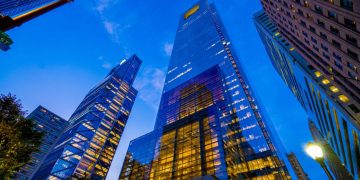
The Comcast Technology Center doesn’t just own Philadelphia’s skyline — it dominates it. Standing at 1,121 feet, it surpasses its nearest competitor by nearly 250 feet, an extraordinary margin in a city that spent most of its history afraid of altitude.
Designed by Foster + Partners, the British architecture firm behind landmarks like 30 St Mary Axe in London, the building opened in 2018 and serves as the second global headquarters for Comcast Corporation, one of the world’s largest media and technology companies. The building is as much a city within a city as it is an office tower: it contains the Four Seasons Hotel Philadelphia on its upper floors, making it one of the highest-positioned luxury hotels in the Western Hemisphere.
The glass curtain wall reacts to Philadelphia’s moody light in remarkable ways. On overcast mornings, the tower disappears into gray. On clear evenings, it catches the sunset and holds it. Foster + Partners described the project as a “vertical campus,” and walking through its lower floors — with its food market, public spaces, and cascading atrium — you understand exactly what they meant.
The building earned LEED Platinum certification, a meaningful achievement for a structure of this scale, and it redefined what Philadelphia’s skyline could look like in the 21st century.
The Original Rule-Breaker: One Liberty Place
1650 Market Street | 945 feet | 61 floors
If the Comcast Technology Center is the current champion, One Liberty Place is the original rebel. Completed in 1987 and designed by Helmut Jahn, the building’s gleaming Art Deco-inspired spire was the first in Philadelphia’s modern era to exceed the height of William Penn’s statue. The city had maintained its unwritten “Gentleman’s Agreement” for decades — and Jahn simply decided it didn’t apply to him.
The building is visually arresting. Its octagonal crown, illuminated blue at night, is one of the most recognizable silhouettes in American architecture. The glass and steel facade reflects the sky in ways that make it look almost translucent at certain hours. At 945 feet, it remained Philadelphia’s tallest building for nearly two decades, until its younger sibling arrived.
Some Philadelphians genuinely believed the building brought bad luck. The Philadelphia Phillies, Eagles, Flyers, and 76ers all went without a major championship for over two decades after Penn’s hat was violated — a stretch fans called “the Curse of Billy Penn.” The Eagles broke it in 2018, the same year the Comcast Technology Center was topped out. Whether there’s poetic justice in that, or merely coincidence, depends entirely on your sports allegiances.
One Liberty Place also contains the Liberty Place retail complex on its lower floors and houses major financial and legal firms throughout its tower floors.
The Quieter Giant: Two Liberty Place
1601 Chestnut Street | 848 feet | 58 floors
Completed in 1990, Three years after its more celebrated neighbor, Two Liberty Place is the definition of distinguished restraint. Designed by the same Helmut Jahn, it shares One Liberty’s pointed crown and Art Deco DNA, but steps back just enough to let its sibling have the spotlight.
At 848 feet, it is Philadelphia’s third-tallest building and forms, together with One Liberty Place, one of the most instantly recognizable pairs of towers in American urban architecture. The two buildings flank Market Street like architectural sentinels, their crowns lit up against the night sky in a way that has become the defining image of Philadelphia after dark.
Two Liberty is primarily office space, housing major legal and financial tenants, and includes direct connections to the underground concourse that runs through Center City. It’s a building that rewards sustained attention — its geometry, particularly around the mid-floors where the octagonal plan begins to taper, is surprisingly sophisticated.
The Workhorse of the Skyline: Comcast Center
1701 John F. Kennedy Boulevard | 975 feet | 57 floors
Before Comcast built its technology tower, it built this one. The Comcast Center, completed in 2008 and designed by Robert A.M. Stern Architects, was for a decade the tallest building in Philadelphia, rising to 975 feet and displacing One Liberty Place in the process.
This is a building that earned its reputation as the city’s de facto flagship. Its glass curtain wall — the largest in the world at the time of construction — gives it an almost mirror-like quality on clear days, reflecting the older architectural fabric of Center City back at itself. The lobby is famous for its “Winter Garden” public space and a massive digital media installation called “The Comcast Experience,” a 2,000 square-foot LED screen that plays a continuous visual program visible from the street.
Stern’s design is more restrained and less theatrical than Jahn’s Liberty towers, but it’s an exceptionally well-proportioned building. At street level, it contributes enormously to the life of JFK Boulevard — there are restaurants, retail spaces, and a genuine sense that the ground floor of a supertall tower actually wants pedestrians nearby.
The View From BNY Mellon Center
1735 Market Street | 792 feet | 54 floors
Completed in 1990 and designed by Kohn Pedersen Fox — the firm behind some of the world’s most admired skyscrapers — BNY Mellon Center (formerly known as Mellon Bank Center) is one of the finest pieces of corporate architecture in Philadelphia. At 792 feet, it may not be the tallest, but it is widely considered one of the most beautifully resolved office towers in the city.
The building’s distinguishing feature is its crown: a stepped, illuminated top that creates a distinctive profile in the skyline, particularly when lit at night. The material palette — polished granite at the base, transitioning to glass as the tower rises — gives it a sense of geological progression, as if the building is literally growing out of the earth.
KPF’s design philosophy here was to create something that belonged specifically in Philadelphia, that engaged with the street and with the city’s existing architectural character. Whether they achieved it is a matter of personal taste, but the building has aged gracefully, which is more than can be said for many of its contemporaries.
The Civic Anchor: One and Two PNC Plaza
1600 Market Street | 739 feet | 45 floors
Not every skyscraper aspires to be the tallest. Some aspire to be the most useful. One PNC Plaza, completed in 1972 and designed by Wallace Harrison — the architect who worked on Rockefeller Center and the United Nations headquarters — was built with a civic ambition that most corporate towers abandon entirely.
The building’s prominent position on Market Street, its relatively modest height by today’s standards, and its direct relationship to the subway concourse below make it a genuinely functional piece of urban infrastructure as much as a real estate investment. It may lack the drama of the Liberty towers, but Philadelphia would be worse without it.
The Residential Revolution: W/Element Hotel & Residences
1441 Chestnut Street | 710 feet | 48 floors
The story of Philadelphia’s skyline in the 2020s is substantially the story of residential and mixed-use towers changing the character of Center City. One of the most significant examples is the W/Element Hotel and Residences tower, a project that brought significant new residential density to the core of the city’s downtown.
Mixed-use towers of this kind — combining hotel rooms, residential condominiums, and ground-floor retail in a single structure — have become increasingly common in American cities, but Philadelphia has embraced the model with particular enthusiasm. They reflect a fundamental shift in how urban centers think about density: rather than reserving the core for offices that empty out at 6 p.m., the city is increasingly building neighborhoods that function around the clock.
The One That Started It All: Philadelphia City Hall
1400 John F. Kennedy Boulevard | 548 feet | Completed 1901
It would be an act of historical negligence to write about Philadelphia’s tallest buildings without pausing here. City Hall is not the tallest building in Philadelphia. It is not even close to the tallest building. But it is the most important building in the skyline’s story, because it set the ceiling that every other building on this list was either respecting or eventually violating.
Completed in 1901 after thirty years of construction — at one point it was the tallest building in the world — Philadelphia City Hall is a monument to Victorian civic ambition. Built in the French Second Empire style, it occupies an entire city block at the precise center of William Penn’s original grid. The bronze statue of Penn atop its tower stands 37 feet tall and, for nearly a century, was the psychological height limit of an entire city.
City Hall is a building that rewards patient attention. Its exterior walls are covered in thousands of pieces of sculptural ornament — allegorical figures, ornamental cartouches, grotesque masks — all executed in white marble and granite. No two sections of the facade are exactly alike. The building took so long to complete, and so many craftsmen worked on it over so many decades, that you can trace stylistic changes as your eye moves from base to crown.
The interior is equally extraordinary. Alexander Milne Calder — the grandfather of mobile artist Alexander Calder — spent decades producing the sculptural program for the building. The result is one of the most ambitious works of public art in American history.
Bell Atlantic Tower: The Forgotten Excellence
1717 Arch Street | 739 feet | 53 floors
Completed in 1991 and designed by The Kling-Lindquist Partnership, the Bell Atlantic Tower (now known as the Verizon Tower) represents something interesting in the Philadelphia skyline: a building that is genuinely excellent and almost entirely overlooked.
Standing at 739 feet and sharing a height ranking with One PNC Plaza, the tower’s distinguishing feature is its crown — an illuminated geometric top that adds a quietly dramatic presence to the skyline at night. The building occupies a prominent position on Arch Street and serves primarily as office space, housing large corporate and technology tenants.
Its relative anonymity in discussions of Philadelphia architecture may have something to do with timing — it arrived in the early 1990s, after the Liberty towers had already established the terms of conversation, and slightly before the skyline debates of the mid-2000s renewed public interest in the city’s vertical development. But architects and urban designers who look carefully at it tend to find more to admire than the building’s modest reputation suggests.
What’s Coming: The Next Generation
Philadelphia’s skyline is not finished being built. Several major projects are in various stages of planning and construction that will add significantly to the city’s vertical inventory.
The market for supertall residential towers in Center City has strengthened considerably since 2015, driven by a combination of population growth, strong demand for luxury rental product, and a tax incentive structure that made large-scale residential development economically viable. The result is a pipeline of significant projects that will alter the skyline over the next decade.
Developers and architects are increasingly looking at sites along the Market-Frankford corridor and around 30th Street Station — particularly in the context of the ongoing Schuylkill Yards development project on the western edge of Center City — as opportunities for density that Philadelphia has not previously accommodated. If even a portion of what is currently planned comes to fruition, the city’s skyline in 2035 may look substantially different from today’s.
The Architecture of Aspiration
There is something worth saying about what a skyline communicates about a city. Philadelphia’s is honest in ways that some American skylines are not. The cluster of towers along Market Street tells a clear story: this is where the money lives, this is where the corporations planted their flags, this is where the transition from the gentlemen’s agreement to the age of the supertall played out in real time.
But it also tells a story about restraint, about a city that for most of its history looked at height with suspicion — as something that belonged in New York or Chicago, not in Penn’s greene countrie towne. That suspicion produced a compact, walkable urban core that many American cities would envy. And then, once Philadelphia started building tall, it did so with a seriousness of architectural purpose that is genuinely impressive.
The best buildings in this skyline — the Liberty towers, the Comcast Technology Center, City Hall itself — are not just tall. They are made with intention. They were designed by architects who cared about what they looked like from the street and from thirty miles away on the New Jersey Turnpike. They were built by a city that, when it finally decided to reach the sky, chose to do it properly.
That matters. The skyline you see from the Ben Franklin Bridge on a clear morning — the Comcast tower rising above everything, Penn’s bronze hat somewhere far below, the pointed crowns of the Liberty towers catching the light — is not an accident. It is the product of a long, complicated conversation between a city and its own ambitions.
Philadelphia kept having that conversation, floor by floor, for over a century. It’s still having it. And it shows.
All heights cited reflect the architectural crown of each building, consistent with standard CTBUH (Council on Tall Buildings and Urban Habitat) measurement methodology. Floor counts and completion years are based on available public record at time of writing.