



There is a school in North Philadelphia, tucked into the Logan neighborhood at the corner of Ogontz and Olney Avenues, that has been quietly defying expectations since before the Civil War. It doesn’t have an Ivy League price tag. It doesn’t have ivy-covered dormitories or manicured lawns stretching out to a private chapel. What it has — and what no other high school in the United States possesses — is the legal authority to grant its graduates a Bachelor of Arts degree.
Yes, you read that correctly. A public high school. In Philadelphia. Handing out college degrees. Since 1849.
Central High School is the only high school in the United States with authority granted by an 1849 Act of Assembly of the Pennsylvania General Assembly to confer academic degrees upon its graduates. That single fact tells you everything you need to know about the ambition embedded in Central’s DNA. This is not a school that plays small.
The Address, The Building, and the Neighborhood That Shaped It All
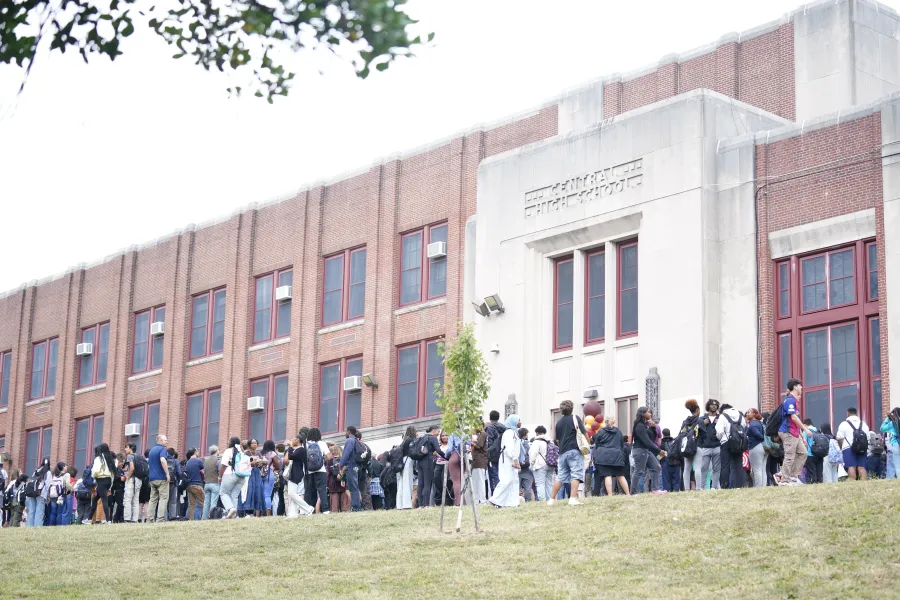
Central High School 1700 West Olney Avenue, Philadelphia, PA 19141 (Corner of Ogontz and Olney Avenues, Logan neighborhood, North Philadelphia)
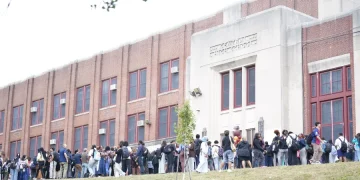
The school’s current home — its fourth building in nearly 190 years of existence — is an Art Deco landmark that has stood in the Logan section of North Philadelphia since 1939. The building itself is a statement. Walk up to it on a September morning and you see something that looks more like a government institution or a university annex than a standard public school. That is entirely intentional. Central was never designed to feel ordinary.
The school has changed buildings three times — in 1854, 1900, and 1939 — since it first opened, and is currently located in its fourth building at the corner of Ogontz and Olney Avenues. Each relocation reflected not decline but growth, ambition, and the city’s evolving investment in serious public education.
The school’s original location was far downtown, at Juniper and Market Streets — the very heart of what was then a young, rapidly expanding American city. The cornerstone for the new school building was laid on September 19, 1837, at the intersection of Juniper and Market Streets. Three stories tall, the building was shaped like a T and included an astronomical observatory. An astronomical observatory. At a public high school. In 1837. Again — this institution has always known who it is.
Founded Before Pennsylvania Had a Real Public School System
Central High School was founded in 1836 as “the crowning glory” of Philadelphia’s public school system, “the worthy apex to a noble pyramid,” and the first “high” school in the state. The language alone tells you how people felt about it. This wasn’t just a place to send teenagers while they waited to grow up. It was a declaration of civic values — proof that a democratic republic could invest in the minds of ordinary citizens and produce extraordinary results.
The founding was not without controversy. Because city voters only reluctantly had been convinced of the need for a high school, the curriculum was carefully and publicly geared to the needs of taxpayers. Central’s founders made an especially concerted effort to avoid educating students in the manner of private academies of the day, where classical languages and literature were of paramount importance. In other words, Central was built to be different from the elite prep schools that served Philadelphia’s wealthy families. It was built to serve everyone else.
The school formally opened on October 26, 1838, with a first class of sixty-three students. At the time of its dedication, Central was only the second public high school in the country and was open only to male students. Four professors, sixty-three students, and a city’s worth of skepticism. That’s where it began.
The Man Who Ran It First Was Benjamin Franklin’s Great-Grandson
If the founding of Central sounds like it had a certain pedigree, that’s because it did. In 1839, Alexander Dallas Bache, the great-grandson of Benjamin Franklin, was named as president of the school and selected many of the first faculty members. Some of the initial courses included natural history, French, drawing and writing, mathematics, Greek, Latin, and mental, moral, and political science.
The curriculum was deliberately broad and rigorous — nothing vocational or remedial about it. This was a school where working-class and middle-class boys were expected to engage with the full weight of human knowledge. The message, stated or not, was this: a student’s zip code does not determine his ceiling.
That philosophy has never left Central. Almost two centuries later, it remains the beating heart of what the school does.
The Degree-Granting Power: Still Unmatched in America
An Act of Assembly in 1849 granted the school the power to confer academic degrees in the arts upon graduates fulfilling degree requirements instead of an ordinary high school diploma. It is the only high school in the nation authorized to do so. The power to grant degrees also translates to the head of school being not a principal, but a president.
This is not a technicality or a historical footnote. Central graduates who meet the requirements leave high school with a Bachelor of Arts degree — not a diploma, a degree — without setting foot in a college classroom. That credential, recognized under Pennsylvania law, puts them in a category entirely their own.
The language of the 1849 Act itself is worth examining. It reads, in part: “The Controllers of the Public Schools of the First School District of Pennsylvania shall have and possess power to confer academic degrees in the arts upon graduates of the Central High School, in the City of Philadelphia, and the same and like power to confer degrees, honorary and otherwise, which is now possessed by the University of Pennsylvania.”
Not comparable to a university. Equal to one. That’s what the law says.
Katharine Davis is the 15th and current president of Central High School, and she administers a population of over 2,300 students and 100 faculty members.
A School That Counts Its Classes, Not Its Years
One of Central’s most distinctive traditions is one that outsiders often find disorienting at first: the school doesn’t identify graduating classes by year. It counts them numerically from the very first class.
Central, rather than using a general class year to identify its classes, uses the class graduating number system. This tradition started shortly after the school’s founding, when it was common to have two graduating classes per year — one in January and one in June.
So a student who graduated in recent years doesn’t say “I’m from the class of 2024.” They say they’re from the 283rd class. That number connects them to an unbroken chain that stretches back to 1842, when the very first group of Central students walked across a stage and into history. Every current student is part of that lineage, those sixty-three students who showed up to learn in 1838 included.
It’s the kind of tradition that sounds like a quirk until you realize what it actually does: it makes history feel personal. Every Central student knows they belong to something much larger than themselves.
Presidents, Visitors, and the School That Commanded National Attention
For a public school in an industrial city, Central has attracted a remarkable level of presidential attention. On June 24, 1847, the President of the United States, James K. Polk, with Vice-President George M. Dallas and Attorney General Nathan Clifford paid a visit to the school and addressed the students.
That wasn’t the last time a sitting president came to Olney Avenue’s predecessor addresses. President Theodore Roosevelt visited on the occasion of the formal dedication of the school’s third building in 1902 and addressed the students. Roosevelt began his address to the students with “Boys, it is perfectly easy to see from my reception that you feel happy over the football game yesterday” — the students cheered in response, as they were indeed excited.
Two sitting presidents. Multiple vice presidents. A school that drew the nation’s most powerful figures not as a charity obligation, but because Central had earned that kind of recognition through sheer academic seriousness.
The Gender Battle That Went to the Supreme Court
For most of its history, Central was an all-male institution. That changed — but not without a legal fight that reached the highest court in the land.
After 139 years as an all-male public high school, Central’s all-male policy was challenged by Susan Vorchheimer, who sought admission to Central. On August 7, 1975, U.S. District Court Judge Clarence C. Newcomer ruled that Central must admit academically qualified girls starting in the fall term of 1975. The case was appealed, wound its way through the federal courts, and eventually landed before the U.S. Supreme Court — which, in a rare 4-4 tie with one abstention in 1977, upheld the lower circuit court’s ruling allowing Central to remain single-sex.
It wasn’t until 1983 that the matter was finally resolved. The school moved to its current building in 1939 and began admitting female students in 1983. Judge William M. Marutani ruled the single-sex policy unconstitutional, the Board of Education declined to appeal, and Central became the co-educational institution it remains today.
The first women to walk those halls did so knowing the path had not been easy. Their persistence — and the persistence of the women who fought for them — is woven into the school’s story now, as permanent as any cornerstone.
The Alumni Who Changed the World (and the Country, and the Language)
Any list of Central’s notable graduates requires genuine editorial discipline. The school’s alumni roster reads less like a high school yearbook and more like a curriculum for a graduate seminar in American intellectual and civic life.
Noam Chomsky, linguist and political activist, was part of the 184th class. The man who fundamentally reshaped the field of linguistics and became one of the most-cited scholars in academic history learned to think at a public school in North Philadelphia. Let that settle.
Louis Kahn, one of the most celebrated architects of the twentieth century, is among the school’s alumni. His work — the Salk Institute, the Kimbell Art Museum, the Bangladesh National Assembly Building — defines monumental modern architecture, and he came from the same hallways where generations of Philadelphia teenagers have wrestled with algebra and history.
Philip Freelon, who served as lead architect for the Smithsonian National Museum of African American History and Culture, graduated from Central. The building on the National Mall that tells the story of Black America was designed by a man who first learned to think at 1700 W. Olney Avenue.
Richard P. Silverman, Chemistry Professor at Northwestern University, is a Central graduate and the researcher who invented Lyrica — one of the most widely prescribed medications in the world, treating epilepsy, fibromyalgia, and nerve pain in millions of patients globally. He learned chemistry at a public school in Logan.
Albert C. Barnes — whose Barnes Foundation houses one of the most significant collections of French art in the world — was part of the 92nd class. Barnes also worked alongside other scientists to develop an antiseptic used to treat blindness in infants.
Quiara Alegría Hudes, a member of the 254th class, co-wrote the musical “In the Heights” in collaboration with Lin-Manuel Miranda, marking one of the first Latin musicals on Broadway, and also won the Pulitzer Prize for her play “Water by the Spoonful.”
Alex Karp, CEO of Palantir Technologies — the data analytics company that now operates at the intersection of Silicon Valley and national security — is a Central alumnus.
Sgt. George Mitchell, a Tuskegee Airman and Congressional Gold Medal awardee, is also a Central graduate.
The breadth is staggering. Governors, federal judges, admirals, scientists, playwrights, artists, journalists, doctors, architects. The common thread is not wealth or privilege. It is what happens when rigorous expectations meet genuine opportunity — and Philadelphia, of all cities, has been doing that since 1838.
What It Takes to Get In: The Magnet School Reality
Central is not a neighborhood school. You can’t simply live nearby and walk through the door. Central is a magnet school in the Philadelphia public school district, and students come from all over the city and from many different backgrounds and ethnicities.
Admission requires academic achievement. Students must meet grade point average requirements and demonstrate performance on standardized assessments. The competition is real, the standards are high, and the school makes no apologies for that. Central’s founding premise — that a rigorous academic environment, open to any qualified student regardless of family income, is one of the most powerful tools a democratic society possesses — remains intact nearly two centuries after sixty-three teenagers walked into a building on Juniper Street and started something remarkable.
Central High School has been ranked the number two high school in Pennsylvania and number one in Philadelphia. The school was also named a 2024 National Blue Ribbon School awardee by the U.S. Department of Education — an honor it has now received multiple times across its history.
The Oldest Student Literary Magazine in America
Not everything at Central is about degrees and distinguished alumni. The school also carries something more intimate: a literary tradition that predates most American universities’ creative writing programs.
Student publications include “The Mirror,” the student literary and art magazine, which is described as the oldest high school publication in America, with issues going back to 1885. A high school literary magazine that has been publishing continuously since Grover Cleveland was president. That’s not a footnote — that’s a cultural institution.
The student newspaper, The Centralizer, has been running since 1923. The archives that house all of it — bound issues, commencement programs, faculty lecture notes going back to the 1850s, enrollment records, disciplinary logs — are kept at Barnwell Library, right inside the school at 1700 W. Olney Avenue.
Those archives, incidentally, contain a visitors’ book with the actual signatures of two U.S. presidents and several vice presidents. It’s the kind of document that belongs in a national museum. It lives in a high school library in North Philadelphia.
The School That Defies the Narrative About Public Education
There is a persistent and tiresome story told about urban public education in America — that it is broken, that it has failed, that the only real opportunities come from private schools or wealthy suburban districts with better tax bases. Central High School has been refuting that narrative for 188 years.
Central was arguably one of the most powerful engines of economic mobility in the city. It was the school that welcomed the sons — and eventually the daughters — of immigrants, of working-class families, of people who had no other path to the professions. It was the institution that told a kid from Kensington or Germantown or West Philly that their mind was worth developing, that their ambitions were legitimate, that the world had a place for them if they were willing to work for it.
That promise is older than most American institutions still operating. It was made in a building at 13th and Market Streets and honored through three subsequent addresses, two world wars, a civil rights movement, a Supreme Court case, and decades of budget fights in a city that has never had enough money to do everything it needs to do. Central survived all of it.
Visiting, Connecting, and Finding Out More
Central High School is located at 1700 West Olney Avenue, Philadelphia, PA 19141, in the Logan neighborhood of North Philadelphia. The school is accessible by SEPTA via the Broad Street Line (Olney Station) and multiple bus routes serving the Ogontz and Olney corridor.
The Archives of the Associated Alumni of the Central High School of Philadelphia are housed in Barnwell Library on campus. For inquiries about the archives, you can reach them at 215-276-5262 or via email at centralhigharchives@gmail.com.
The Associated Alumni of Central High School (AACHS) maintains an active presence and supports current students through the Bridge Leadership Program, the Alumni Hall of Fame, and the ongoing “Leading the Way” campus expansion campaign. Their work is a reminder that Central is not simply a building or an institution — it is a community that spans nearly two centuries of Philadelphia life.
A Final Thought: The Worthy Apex
When Central’s founders reached for language to describe what they were building in 1836, they called it “the worthy apex to a noble pyramid.” Nearly two centuries later, that phrase still holds. The pyramid hasn’t crumbled. The apex hasn’t been replaced. The school at the corner of Ogontz and Olney Avenues is still doing what it was chartered to do: taking students from across one of America’s most complex cities and giving them the tools to go anywhere, do anything, and change the world.
No other high school in the United States can grant a Bachelor of Arts degree. No other high school in America has been doing this since 1838. No other high school has this particular combination of democratic idealism, academic rigor, and documented results that stretches from Noam Chomsky’s linguistics to Louis Kahn’s architecture to a Pulitzer Prize to the walls of the Smithsonian.
Central High School is not a hidden gem. It is one of the great educational institutions in American history — and it happens to be a free public school in North Philadelphia.
It always has been.
Central High School | 1700 West Olney Avenue, Philadelphia, PA 19141 | centralhs.philasd.org