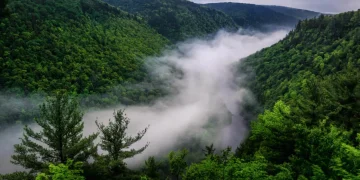




Pennsylvania doesn’t always get the recognition it deserves as a destination for natural beauty. Sandwiched between the glamorous coastlines of the Atlantic and the dramatic peaks of the Rockies, the Keystone State quietly harbors some of the most spectacular geological formations, waterways, and wilderness areas in the eastern United States. From ancient rock formations that predate the dinosaurs to waterfalls that inspired American art, Pennsylvania’s landscape tells a story millions of years in the making.
The state’s geography spans from the shores of Lake Erie in the northwest to the rolling Piedmont in the southeast, encompassing the folded ridges of the Appalachians and the dissected plateau of the Alleghenies. This diverse topography has created environments where rare ecosystems thrive, where geological processes have carved extraordinary features into the bedrock, and where visitors can witness natural phenomena that exist nowhere else on Earth.
Ricketts Glen State Park and Its 22 Named Waterfalls
Located in the Endless Mountains region of northeastern Pennsylvania, Ricketts Glen State Park protects one of the most magnificent waterfall concentrations in the eastern United States. The Falls Trail system guides hikers past 22 named waterfalls along Kitchen Creek and its tributaries, with the tallest—Ganoga Falls—plunging 94 feet into the gorge below.
The waterfalls exist because Kitchen Creek flows over the Allegheny Front, a major escarpment where harder caprock layers protect softer underlying sedimentary rocks from erosion. As the creek cascades downward through nearly 1,000 feet of elevation change over just a few miles, it encounters these alternating hard and soft layers, creating the stair-step series of falls that make the park famous.
The Glens Natural Area, where most of the waterfalls are located, contains stands of old-growth forest that somehow escaped the logging boom of the late 19th and early 20th centuries. Some of the hemlocks and white pines here are more than 500 years old, their massive trunks and dense canopy creating a cathedral-like atmosphere along the trail. These ancient trees provide critical habitat for species that require mature forest conditions, including various wood warblers, flying squirrels, and salamanders found nowhere else in the park.
The 7.2-mile Falls Trail Loop ranks among the most challenging day hikes in Pennsylvania. The trail descends steeply into the gorge, then climbs back out on the opposite side, requiring hikers to navigate hundreds of stone steps, some worn smooth by decades of foot traffic. The difficulty is amplified by the trail’s popularity—on peak fall foliage weekends, thousands of visitors attempt the loop, creating congestion at the most photographed falls.
Seasonal variation dramatically alters the character of the waterfalls. Spring snowmelt and early summer rains swell the creek, sending torrents of water thundering over the falls with enough force to create mist clouds visible from hundreds of feet away. By late summer, many of the smaller falls dwindle to trickles, though the major cascades maintain impressive flow even during dry periods. Winter transforms the gorge into a frozen wonderland where ice formations grow dozens of feet thick, encasing the waterfalls in crystalline sculptures.
Pine Creek Gorge: Pennsylvania’s Grand Canyon
The 47-mile stretch of Pine Creek Gorge that cuts through Tioga County earned its “Grand Canyon of Pennsylvania” nickname honestly. The gorge reaches depths of nearly 1,500 feet, with steep-walled sides exposing layers of sedimentary rock deposited during the Devonian and Carboniferous periods, roughly 300 to 400 million years ago.
The gorge’s formation began during the last ice age when glaciers diverted Pine Creek from its original course, forcing it to cut a new channel through the resistant rock of the Allegheny Plateau. As the glaciers retreated, massive volumes of meltwater accelerated the erosion process, carving the deep gorge in just a few thousand years—a blink of an eye in geological terms.
Two state parks—Leonard Harrison and Colton Point—offer overlook access to the gorge rim, providing expansive views across the canyon. The vista from Leonard Harrison’s main overlook reveals the sinuous curves of Pine Creek far below, flanked by forested slopes that blaze with color each autumn. On clear days, visibility extends for miles down the canyon, revealing the full scale of this geological wonder.

Within the gorge itself, Pine Creek flows through a designated National Natural Landmark, its waters supporting a recovering trout fishery and providing habitat for river otters, bald eagles, and great blue herons. The 62-mile Pine Creek Rail Trail follows the old rail bed of the Jersey Shore, Pine Creek and Buffalo Railway, offering one of the finest rail-trail experiences in the United States. Cyclists, hikers, and cross-country skiers use the trail to access the remote interior of the gorge, where civilization seems to disappear entirely.
The gorge’s microclimate supports plant communities typically found much farther north. Ice caves and shaded north-facing slopes remain cool enough year-round to harbor boreal species at the southern edge of their range. Botanists have documented several rare fern species clinging to the gorge walls, sustained by seepage from underground springs.
McConnells Mill State Park and Slippery Rock Creek Gorge
McConnells Mill State Park preserves a rugged gorge where Slippery Rock Creek has carved through 400-million-year-old sandstone and shale, creating a landscape of massive boulders, churning rapids, and geological curiosities. The park’s namesake grist mill, built in 1852, still stands beside the creek, its weathered boards and massive water wheel serving as a reminder of the industrial heritage that once dominated this landscape.
The gorge formed along the edge of the most recent glacial advance during the Wisconsin glaciation. As glaciers blocked the creek’s original northward drainage, Slippery Rock Creek was forced to cut a new outlet to the south, eroding rapidly through the relatively soft sedimentary rock. The result is a 400-foot-deep gorge with dramatic rock formations and a wild, boulder-choked streambed.
Hell’s Hollow, a side canyon within the park, contains a 40-foot waterfall that plunges over a vertical sandstone cliff. The hollow’s steep walls and north-facing aspect keep temperatures cool even during summer, creating habitat for species more commonly found in higher elevation or more northern locations. The trail to Hell’s Hollow Falls crosses Slippery Rock Creek multiple times, requiring rock-hopping skills and waterproof footwear during high water periods.
Whitewater kayakers consider Slippery Rock Creek Gorge one of the premier advanced runs in Pennsylvania. The creek drops steeply through the gorge, creating Class III and IV rapids with names like “Laundry Chute” and “Breakneck Falls” that accurately convey their character. During spring runoff, the creek becomes a raging torrent, its chocolate-brown water surging over and around house-sized boulders.
Rock climbers have developed dozens of routes on the park’s sandstone cliffs, though the soft, friable nature of the rock requires careful route selection and skilled technique. The park’s most famous climbing area, the Breakneck Bridge cliffs, offers routes ranging from moderate face climbs to overhanging crack systems.
Hickory Run Boulder Field
Within Hickory Run State Park, visitors encounter one of the most unusual geological features in the eastern United States: a 15,500-square-foot boulder field devoid of vegetation. The expanse of rocks, ranging from softball-sized stones to car-sized boulders, stretches approximately 1,800 feet long and 400 feet wide, creating a landscape that seems transplanted from an arctic tundra.
The boulder field formed during the last ice age through a process called periglacial activity. Although glaciers didn’t directly override this location, the extreme cold of the periglacial environment subjected the bedrock to intense freeze-thaw cycles. Water seeped into cracks in the sandstone, froze, expanded, and eventually shattered the rock into fragments. Over thousands of years, this process broke down the bedrock into the angular boulders visible today.
What makes the boulder field truly remarkable is its continued existence as a barren landscape more than 10,000 years after the climate warmed. Soil and vegetation have reclaimed nearly every other periglacial boulder field in Pennsylvania, yet Hickory Run’s field remains stubbornly bare. Scientists attribute this persistence to the field’s unique hydrology—water drains so rapidly through the porous boulder matrix that no soil can accumulate, and the rocks’ unstable nature prevents plant roots from gaining purchase.
The National Park Service designated the boulder field a National Natural Landmark in 1967, recognizing its scientific importance as one of the finest examples of a relict periglacial feature. Geologists study the field to understand landscape evolution in formerly glaciated regions, while ecologists examine the specialized lichens and mosses that represent the only plant life capable of colonizing this harsh environment.
Walking across the boulder field requires careful attention. The angular rocks shift and tilt underfoot, and gaps between boulders can twist ankles or trap feet. Park regulations prohibit removing stones or disturbing the field’s delicate balance, though visitors are welcome to explore the designated trail that crosses the field’s southern edge.
The Loyalsock Creek Watershed and Old-Growth Forests
The Loyalsock State Forest in north-central Pennsylvania protects one of the largest remaining tracts of roadless wilderness in the state. The Loyalsock Creek winds through this rugged landscape, flowing through narrow gorges, over spectacular waterfalls, and past stands of old-growth forest that somehow survived Pennsylvania’s timber boom.
Several waterfalls along Loyalsock Creek and its tributaries rank among the state’s most impressive. Dry Run Falls plunges 23 feet into a deep plunge pool surrounded by vertical rock walls, while High Falls on Ketchum Run drops 40 feet in a series of cascades. These falls exist where tributaries carved their own channels faster than Loyalsock Creek lowered its main channel, creating “hanging valleys” where side streams plunge to meet the main creek.
The old-growth stands scattered throughout the watershed harbor eastern hemlocks, white pines, and hardwoods that predate European settlement. Some of these trees germinated when George Washington was president, growing slowly in the thin mountain soils. Their presence indicates this forest was too remote or too steep for loggers to profitably harvest—a fortunate accident of geography that preserved these ecological treasures.
Hikers seeking solitude find it along the 59.2-mile Loyalsock Trail, which traverses the watershed’s most rugged terrain. The trail climbs over numerous ridges, descends to creek crossings, and passes geological features like Natural Stone Bridge, where water erosion has carved a tunnel through solid rock. Some sections require scrambling over boulders or wading through streams, adding to the trail’s wilderness character.
The Loyalsock Creek supports healthy populations of native brook trout, the state fish of Pennsylvania. These fish require cold, clean water with high dissolved oxygen levels—conditions that exist only in streams flowing through intact forested watersheds. The presence of reproducing brook trout populations serves as an indicator of ecosystem health, confirming that despite two centuries of human activity in the region, the Loyalsock watershed retains much of its ecological integrity.
Delaware Water Gap
Where the Delaware River cuts through Kittatinny Ridge, it creates one of the most dramatic geological features in the Appalachian Mountains. The Delaware Water Gap rises 1,200 feet above the river, its forested slopes and rocky cliffs visible for miles in either direction. This water gap—where a river appears to flow directly through a mountain rather than around it—has puzzled observers for centuries.
Geologists now understand that the Delaware Water Gap represents an example of superposition, where a river established its course on younger rock layers that have since eroded away. As the region gradually uplifted, the river maintained its course by eroding downward through the resistant quartzite of Kittatinny Ridge at the same rate the land rose—a process that took millions of years.
The gap’s cliffs expose rock layers deposited during the Silurian period, approximately 430 million years ago, when this region lay beneath a shallow sea. The Shawangunk Formation quartzite that forms the ridge’s backbone originated as beach sands, later compressed and metamorphosed into one of the hardest rock types in the Appalachians. This resistance to erosion explains why Kittatinny Ridge remains prominent while softer surrounding rocks have worn down to valleys.
Both the Pennsylvania and New Jersey sides of the gap offer hiking trails that climb to spectacular overlook points. From these vantage points, the geometry of the gap becomes clear—the river flows almost perfectly perpendicular to the ridge’s strike, and the gap’s steep walls reveal the tilted rock layers like pages in an opened book.
The Delaware Water Gap National Recreation Area protects 70,000 acres along 40 miles of the Delaware River, encompassing the gap and the surrounding landscape. This protected corridor provides critical habitat for black bears, bobcats, and the hundreds of bird species that use the Delaware River valley as a migration corridor. Each spring and fall, thousands of raptors funnel through the gap, riding updrafts created by wind flowing over the ridge.
Bushkill Falls: The Niagara of Pennsylvania
In the Pocono Mountains of northeastern Pennsylvania, Bushkill Falls creates a spectacular display where Bushkill Creek plunges over a series of eight waterfalls. The main falls drops approximately 100 feet in a bridal veil cascade, its waters spreading across resistant sandstone ledges before plummeting into a gorge surrounded by towering hemlocks and rhododendrons.
Unlike Pennsylvania’s state parks, Bushkill Falls operates as a private tourist attraction, a status it has maintained since opening to visitors in 1904. The property’s owners have developed an extensive trail system with multiple loop options, allowing visitors to view some or all of the eight named falls depending on their time and fitness level. Wooden walkways, bridges, and staircases provide access to viewpoints that would otherwise require technical climbing skills.
The falls formed where Bushkill Creek crosses the Pocono Escarpment, a geological boundary where harder caprock overlies softer shale layers. As the creek erodes the soft underlying rock, it undercuts the harder cap layer, causing periodic collapse that maintains the vertical character of the falls. This same process occurs at waterfalls worldwide, slowly causing them to migrate upstream over geological time.
The gorge below the main falls supports a remarkably diverse plant community. The constant mist and spray create conditions similar to a temperate rainforest, allowing moisture-loving species like maidenhair fern, moss, and liverwort to thrive. During summer, rhododendrons bloom along the trails, their white and pink flowers contrasting with the dark hemlock canopy.
Seasonal changes transform the falls’ character throughout the year. Spring runoff swells Bushkill Creek, sending massive volumes of water over the falls with enough force to create a constant roar audible throughout the gorge. Summer reduces flow to more modest levels, though the falls never run dry. Autumn brings photographers seeking to capture the falls framed by fall foliage, while winter creates extraordinary ice formations when spray freezes on surrounding rocks and vegetation.
Experiencing Pennsylvania’s Natural Heritage
These seven natural wonders represent only a fraction of Pennsylvania’s geological and ecological treasures. The state contains more than 120 state parks, dozens of state forests, and numerous National Natural Landmarks, each protecting unique aspects of the commonwealth’s natural heritage. From the serpentine barrens of southeastern Pennsylvania with their specialized plant communities to the glacial potholes carved into bedrock throughout the northern tier, Pennsylvania rewards those willing to venture beyond the beaten path.
The Appalachian Trail crosses Pennsylvania for 232 miles, offering backpackers access to remote ridges and valleys. The Allegheny National Forest in northwestern Pennsylvania protects more than 500,000 acres of largely forested land, including designated wilderness areas where no motorized vehicles are permitted. The Poconos and the Endless Mountains harbor countless waterfalls, many known only to locals who guard their locations jealously.
Conservation organizations and government agencies continue working to protect and restore Pennsylvania’s natural landscapes. Stream restoration projects aim to improve water quality and fish habitat. Forest management seeks to maintain healthy, diverse woodland ecosystems while allowing sustainable timber harvest. Trail organizations recruit volunteers to maintain the thousands of miles of hiking trails that provide public access to natural areas.
Climate change poses new challenges for Pennsylvania’s ecosystems. Rising temperatures are shifting species distributions northward and upward in elevation, potentially disrupting long-established ecological relationships. More intense storms could increase erosion in sensitive areas like Pine Creek Gorge, while changing precipitation patterns might affect waterfall flows and stream ecosystems. Scientists monitor these changes, seeking to understand and mitigate impacts on the state’s natural heritage.
For those seeking connection with the natural world, Pennsylvania offers opportunities ranging from easy walks to multi-day wilderness expeditions. These seven natural wonders provide accessible starting points for exploration, each offering its own unique combination of geological spectacle, ecological richness, and scenic beauty. Whether standing at the base of a thundering waterfall, looking out across a mile-deep gorge, or walking across a field of ancient boulders, visitors encounter landscapes that inspire wonder and remind us of the powerful natural forces that continue to shape our world.