



There is a particular kind of stillness that settles over Bucks County, Pennsylvania in the early morning, when the mist sits low over the fields and the hardwood forests look exactly as they might have looked three hundred years ago. It is in this setting — not in the Kentucky wilderness, not along the Cumberland Gap, not in any of the dramatic landscapes we typically associate with his name — that Daniel Boone entered the world on November 2, 1734.
The Daniel Boone Homestead, located just outside Birdsboro in Berks County, Pennsylvania, is one of those American heritage sites that manages to be both modest and profound at the same time. It is not a reconstruction, not a theme park, not a Hollywood version of colonial life. It is an actual place where an actual family lived, worked, struggled, and ultimately moved on — and where the seeds of one of the most mythologized lives in American history were quietly, unremarkably planted.
To visit it is to understand something that the legends have always obscured: Daniel Boone was not born a frontiersman. He was born a Quaker farmer’s son in the Penn woods, and everything that came after grew from that beginning.
What You’re Actually Walking Into
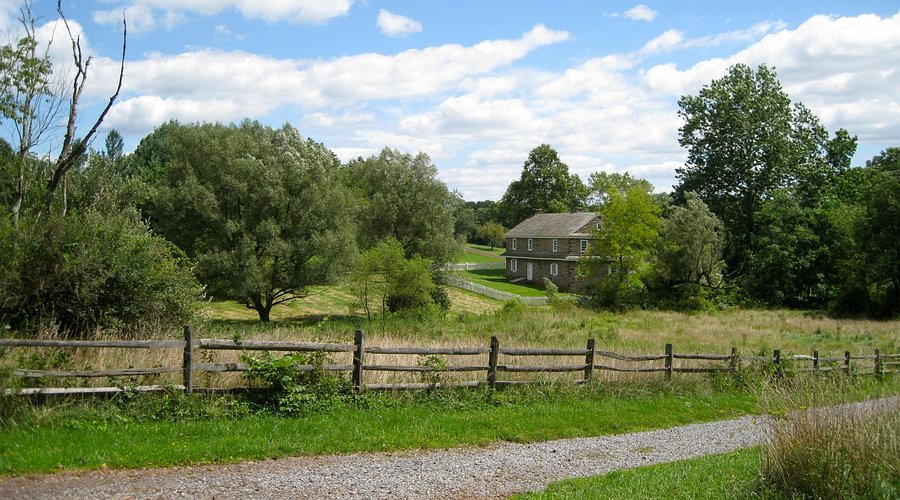
The Daniel Boone Homestead sits on approximately 579 acres of land managed by the Pennsylvania Historical and Museum Commission. It is not a single building frozen in amber — it is a working historic site that encompasses multiple structures spread across a landscape that feels genuinely rural even today.
The centerpiece is the Boone House itself, a two-story stone structure that was built and rebuilt over the generations. The original log cabin where Daniel was born no longer stands, but the stone house that replaced it — built largely by Daniel’s father, Squire Boone, and later expanded — does. Walking through it, you are not walking through a replica. You are walking through a building that the Boone family actually inhabited, that has walls that have absorbed Pennsylvania winters since the 1730s.
The site also includes a smokehouse, a blacksmith shop, a barn, and a visitor center that does an admirable job of separating historical fact from the romantic fiction that accumulated around Boone’s name in the two centuries following his death. There is a spring house. There are trails. There is a lake. What there is not, thankfully, is a gift shop selling coonskin caps to children who think that is what Boone actually wore (he preferred a beaver-felt hat, for the record — the coonskin cap was largely the invention of Hollywood and a 1950s television series).
The Family That Made the Man
To understand Daniel Boone, you have to understand Squire Boone, his father, and you have to understand Quaker Pennsylvania in the 1730s.
Squire Boone was an English immigrant who arrived in Pennsylvania around 1713, part of the wave of Quaker settlers who had followed William Penn’s promise of religious tolerance and available land. He was a weaver by trade, a farmer by necessity, and a man of strong religious conviction — all qualities that would, in complicated ways, shape his son.
The Boones were not wealthy. They were not prominent. They were a large family — Daniel was the sixth of eleven children — living in a community of other Quaker families in a landscape that was, by the 1730s and 1740s, not quite frontier but not quite settled either. The forests were vast. The Native American presence was real. The world beyond the farm was both dangerous and magnetic.
Daniel grew up in a household where practicality was valued above all else, where the land was not a backdrop but a central character in daily life, and where the skills of woodcraft — hunting, tracking, reading weather and terrain — were not hobbies but necessities. His mother, Sarah Morgan Boone, was Welsh-descended, and the family spoke both English and German with neighbors, a bilingualism that would later serve Daniel well in his dealings with diverse communities on the frontier.
What the homestead teaches, if you pay attention, is that Daniel Boone’s famous ease in the wilderness was not a miraculous gift. It was learned, practiced, and refined over years of growing up in a place where the woods were right there, just beyond the farm fence, and where a boy who was attentive could learn the language of the forest one season at a time.
A Community, Not Just a Cabin
One of the most important things the Daniel Boone Homestead communicates to attentive visitors is that the Boones did not live in isolation. The popular image of the lone frontiersman — solitary, self-sufficient, asking nothing of no one — is, frankly, a myth that would have baffled Daniel Boone himself.
The homestead was part of a tight-knit Quaker community centered on the Exeter Meeting House, which still stands nearby. Neighbors visited. Information was exchanged. Disputes were settled communally. Children were educated. The Meeting governed social life in ways that were simultaneously intimate and demanding.
Daniel’s relationship with the Quaker community was complicated. His parents faced expulsion from the Meeting — not once but twice — for allowing their children to marry outside the faith. This was no small matter. Quaker expulsion meant social and economic consequences that rippled through every aspect of daily life. And it may explain, at least in part, why the Boone family eventually pulled up stakes entirely and moved south to Virginia and then North Carolina, taking the adolescent Daniel with them.
That departure — which happened when Daniel was about fifteen or sixteen — is the true beginning of the legend. But the homestead is the story before the story, the place where the character was formed before the character became famous.
The Archaeology of Ordinary Life
What makes the Daniel Boone Homestead historically valuable extends well beyond the Boone family itself. The site has been the subject of archaeological investigation that has revealed layers of occupation and use going back far before the Boones arrived and continuing well after they left.
Evidence of Native American occupation predates the European settlement, a reminder that the land the Boones farmed was not empty wilderness claimed from nature — it was land with a human history stretching back thousands of years. The Lenape people knew this landscape intimately, and their presence shaped both the physical environment and the social world into which the Boones arrived.
After the Boones departed for the south around 1750, the property passed through several subsequent owners, each of whom left traces in the archaeological record. The blacksmith shop visible today dates to a later period. The stone house itself shows evidence of multiple construction phases. The landscape has been farmed, wooded, cleared, and farmed again.
This layering is actually one of the most intellectually honest things about the site. It does not pretend that history began and ended with one family. It presents the homestead as what it actually is: a place where human lives have intersected with a particular patch of Pennsylvania earth for centuries, each generation leaving something and taking something away.
The Problem With Legends — and Why This Place Matters
Daniel Boone is one of the most mythologized figures in American history, which is saying something in a country that has never been shy about turning real people into symbols.
By the time of his death in 1820, the process was already well underway. John Filson’s 1784 book, which included an appendix titled “The Adventures of Col. Daniel Boon,” essentially invented the template for the American frontier hero — rugged, eloquent, philosophically at peace with nature, always moving westward toward freedom. Byron referenced him in Don Juan. James Fenimore Cooper’s Natty Bumppo was modeled partly on him. The legend grew and grew, accumulating detail and drama with each retelling, until the actual human being was buried under layers of American self-mythology.
The Daniel Boone Homestead is one of the few places where that process runs in reverse.
Here, you encounter not the myth but the conditions that produced the man. A two-story stone farmhouse. A spring for water. A smokehouse for preserving meat. A community of farmers bound by shared faith and proximity. A forest that was genuinely wild and genuinely close. These are not dramatic elements. They do not make for good cinema. But they explain things that the legend never bothers to explain — like why a Quaker farmer’s son from Pennsylvania became the person who spent his life pushing further west, always seeking land and space and something that settled civilization never quite provided.
It is possible, standing on the homestead grounds, to understand Boone’s famous restlessness not as a personality quirk or a mythic destiny but as a response to very specific pressures: a crowded household, a community that made demands, a landscape that was filling up with people, and a set of skills that were only fully useful in the places where fewer people went.
What the Programs and Events Reveal
The Daniel Boone Homestead is not a static museum. It operates as a living history site, which means that on the right weekend, you can watch a blacksmith work the forge, observe period-accurate cooking over an open hearth, or attend a demonstration of 18th-century farming techniques that would have been thoroughly familiar to the Boone family.
These programs serve a purpose beyond entertainment. They force a kind of physical reckoning with the difficulty of colonial life that photographs and text panels simply cannot replicate. Watching someone butcher a hog using period tools, or witnessing the amount of labor required to produce a single yard of woven cloth, rewrites your understanding of what daily existence meant for ordinary families in 18th-century Pennsylvania.
The homestead also hosts events tied to the agricultural calendar — sheep shearing, harvest demonstrations, maple sugaring — that connect visitors to the rhythms that governed life before industrialization. For families with children, these events are genuinely educational in the best sense: they produce knowledge through experience rather than through passive absorption.
Special programs occasionally focus on the site’s broader history, including its Native American past and the lives of the various families who owned and worked the land after the Boones left. These programs reflect a commendable commitment to telling a complete history rather than a selective one.
Getting There and What to Expect
The Daniel Boone Homestead is located at 400 Daniel Boone Road, Birdsboro, Pennsylvania 19508, approximately six miles east of Reading and roughly an hour’s drive from Philadelphia. For a heritage site of this significance, it is surprisingly accessible, though it exists in the category of places that rewards intentional planning rather than spontaneous visits.
The grounds are open year-round, though the house and outbuildings have seasonal hours that change depending on staffing and programming schedules. Checking the Pennsylvania Historical and Museum Commission’s website before visiting is advisable, particularly for visitors traveling from a distance. The site charges a modest admission fee for guided house tours, which are genuinely worthwhile — a self-guided walk of the grounds alone misses too much context.
The landscape itself invites longer stays than many visitors anticipate. The lake is peaceful. The trails are well-maintained. The view from the upper portions of the property, looking out over the fields and woods of Berks County, is the kind of view that makes it easy to understand why Quaker settlers chose this particular corner of Pennsylvania in the early 18th century. It is, by any measure, beautiful country.
Visitors with an interest in regional history would do well to combine a trip to the homestead with visits to the Berks County Heritage Center or the Reading Public Museum, both of which provide broader context for the colonial Pennsylvania world in which the Boone family lived.
The Larger Meaning — Roots and the Roads They Produce
There is a temptation, when visiting sites associated with famous Americans, to focus entirely on what those Americans became rather than on what they were before they became it. The Daniel Boone Homestead resists that temptation, or at least provides the materials with which a thoughtful visitor can resist it on their own.
What Daniel Boone became — explorer, surveyor, militia officer, legislator, land speculator, unwilling symbol of American westward expansion — is well documented and widely celebrated. What the homestead offers is the prologue to all of that: the specific place, the specific community, the specific economic and social conditions that shaped a person capable of becoming all those things.
And there is something genuinely instructive about spending time in that prologue. American culture tends toward the dramatic and the exceptional. We celebrate arrival, transformation, triumph. We are less interested in origins, formation, the slow work of becoming. But the Daniel Boone Homestead is a place that insists on the importance of where you come from, of how the character is assembled in the years before the legend begins.
Boone spent perhaps fifteen years in this Pennsylvania landscape. Those years left marks that persisted for the remaining sixty-five years of his life: a comfort with forests, a self-sufficiency that never tipped into true isolation, a gift for navigating between different cultures that his Quaker upbringing in a multilingual community had cultivated in him, a restlessness that was perhaps less personality than response to the specific pressures of a particular time and place.
Why This Site Deserves More Visitors Than It Gets
The Daniel Boone Homestead receives fewer visitors annually than its historical significance warrants. This is not unusual for Pennsylvania heritage sites, which compete for attention with Philadelphia’s Revolutionary War landmarks and Gettysburg’s Civil War battlefield in a state rich with American history.
But the homestead offers something that neither Philadelphia nor Gettysburg quite provides: intimacy. The scale is human. The history is domestic. You can stand in the room where Daniel Boone was born (or where the cabin that preceded the current structure once stood) and feel the smallness of it, the ordinariness of it, the way that famous lives begin in ordinary places.
That ordinariness is not a disappointment. It is, if you approach it correctly, the most interesting thing about the site. It is the place that complicates the legend, that restores the human being to the mythology, that insists on the continuity between the Pennsylvania farm boy and the Kentucky explorer who became, whether he wanted to or not, one of the defining figures of American westward expansion.
History sites are valuable in proportion to how much they make visitors think, and the Daniel Boone Homestead, quietly and without spectacle, makes visitors think quite a lot.
Before You Go
A few practical notes for the serious visitor:
The grounds are walkable but extensive — comfortable footwear is recommended, particularly if you plan to use the trails. The site is dog-friendly on the grounds, though not inside the buildings. Parking is free and adequate for typical visitor volumes.
Photography is generally permitted throughout the site, and the property offers exceptional light in the late afternoon, when the stone buildings and autumn-colored hills of Berks County produce the kind of images that require no filters.
Most importantly: go with patience and curiosity rather than a checklist mentality. The Daniel Boone Homestead rewards visitors who slow down, who read the interpretive panels carefully, who ask the staff questions, who sit for a moment by the lake and consider what it means that a famous life began here, in this quiet corner of Pennsylvania, in a log cabin that no longer stands but whose absence says more, perhaps, than its presence ever could.
The legend can wait. The place is here.