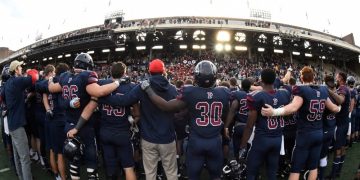




The story of American collegiate athletics cannot be told without dedicating significant chapters to the University of Pennsylvania Quakers. This Philadelphia-based powerhouse has been shaping the landscape of college sports since before the turn of the twentieth century, building a legacy that spans nearly 150 years of competition, innovation, and achievement. From hosting the first televised football game to producing Olympic champions and NFL Hall of Famers, the Quakers have earned their place among the most historically significant athletic programs in the nation.

Origins of the Quaker Identity
The nickname “Quakers” emerged organically during the late nineteenth century, reflecting Philadelphia’s deep historical ties to the Religious Society of Friends. William Penn, the prominent Quaker who founded the Commonwealth of Pennsylvania in 1681, established the colony as a refuge for those seeking religious freedom. Though the University of Pennsylvania itself has never maintained formal affiliation with the Quaker faith—distinguishing it from early American colleges with explicit religious connections—the nickname endures as a nod to regional heritage.
Local sportswriters began using the term to describe Penn’s athletic teams as the university rose to prominence in intercollegiate competition during the 1880s and 1890s. Philadelphia was widely known as the “Quaker City,” making the association natural and almost inevitable. Much like how “Ivy League” originated in New York sports journalism as a reference to the vine-covered campuses of northeastern colleges, “Quakers” stuck through repetition and eventual acceptance.
The mascot that represents Penn athletics today is not a live animal but a costumed human figure simply called “The Quaker.” This approach reflects values central to Quaker principles—peace, integrity, and community—while avoiding the complications that come with maintaining live mascots. Over the decades, the mascot has undergone various redesigns, including notable refurbishments in 2004 and 2006 that sparked campus debate about its appearance and character.
Franklin Field—The Cathedral of College Football History
No examination of Penn athletics can proceed without acknowledging Franklin Field, the oldest continuously operating college football stadium in the United States. Named after Benjamin Franklin, who helped establish the university, this historic venue opened its original wooden structure on April 20, 1895, initially serving as the home of the Penn Relay Carnival.
The stadium’s significance extends far beyond its age. Franklin Field hosted the first radio broadcast of a college football game and later witnessed the first televised collegiate football game in American history. These milestones helped transform college football from a regional pastime into national entertainment. When Fenway Park opened in Boston in 1912, Franklin Field had already been hosting competition for seventeen years.
The venue’s importance to Philadelphia professional sports is equally substantial. The Philadelphia Eagles called Franklin Field home from 1958 to 1970, winning their third NFL championship there in 1960. The stadium’s double-decker horseshoe design, which took its current shape in 1922, offers varied vantage points throughout the facility. Some seats provide stunning views of the Philadelphia skyline alongside the action on the field.
Each April, Franklin Field transforms into the epicenter of American track and field when it hosts the Penn Relays. As the oldest and largest track and field competition in the United States, the Relays have attracted thousands of athletes, fans, and coaches from around the world since 1895. The annual event represents a pilgrimage for the track community and a celebration of athletic achievement that predates most modern sports institutions.
Football—Seven National Championships and Counting
Penn bills itself as “college football’s most historic program,” a claim supported by remarkable statistics and achievements. The Quakers played their first game in 1876 and have since competed in more than 1,400 games—the most of any school in any division. The program claims seven national championships, placing it among the elite historically successful football programs in the country.
During a golden era spanning 1894 to 1924, Penn football achieved dominance that few programs have matched. Under coach George Woodruff, who would later be inducted into the College Football Hall of Fame, the Quakers won their first national title in 1894 with a perfect 12-0 record. The team’s defense was suffocating, holding opponents to an average of just 1.6 points per game while the offense averaged more than thirty points.
The dynasty continued through the turn of the century. Penn repeated as national champions in 1895, going 14-0 and recording ten shutouts. The 1897 squad finished an unprecedented 15-0. Three more national championships followed in 1904, 1907, and 1908, establishing Penn as the preeminent football power of the early twentieth century. The program’s seventh national title came in 1924.
Penn’s football heritage includes remarkable individual achievements. John Heisman, the namesake of college football’s most prestigious individual trophy, attended the university. Eighteen former players have been inducted into the College Football Hall of Fame, tying Penn with programs like Alabama for fourteenth most all-time. Chuck Bednarik, selected first overall in the 1949 NFL Draft, went on to become an NFL Hall of Famer and one of professional football’s legendary figures.
The Rose Bowl appearance in 1917 demonstrated Penn’s national stature, though the Quakers fell short in that contest. More recently, Kevin Stefanski developed his football acumen at Penn before becoming head coach of the Cleveland Browns, while Justin Watson has won three Super Bowl championships as a wide receiver with the Kansas City Chiefs.
Since joining the Ivy League as a founding member in 1956, Penn has captured eighteen conference championships—tied for the most in league history. The program has compiled the most outright Ivy titles with thirteen and the most undefeated conference seasons with eight. A remarkable twenty-game Ivy League winning streak from 2001 to 2004 remains the conference’s longest in history.
The Palestra—The Cathedral of College Basketball
If Franklin Field represents the soul of college football history, the Palestra embodies the spirit of college basketball’s past. Opened on January 1, 1927, this red-brick building on Penn’s campus has been called “the most important building in the history of college basketball” and is said to have “changed the entire history of the sport for which it was built.”
The name derives from ancient Greek—palæstra referred to a rectangular gymnasium where athletes competed before audiences. Dr. William Bates, a professor of Greek studies, recommended the term when the building was under construction. What emerged was a venue that would host more regular-season or postseason NCAA men’s basketball games, more visiting teams, and more NCAA tournaments than any other American arena.
The Palestra’s intimate design places fans remarkably close to the action. Bleachers extend right to the floor with no barrier separating spectators from players. The steep seating and vaulted ceilings create an atmosphere that amplifies crowd noise and emotion. When the Palestra opened, it could seat approximately 10,000 fans, making it one of the largest indoor sporting venues on Earth at the time. Today’s capacity stands at 8,725 for basketball.
For years, the Palestra served as the exclusive home of the Philadelphia Big Five—Penn, Temple, Saint Joseph’s, La Salle, and Villanova. These five universities formed a profit-sharing league in the mid-1950s, creating inner-city basketball rivalries that captured Philadelphia’s imagination. The intensity of Big Five competition became legendary, rivaling and often surpassing traditional rivalries like Army-Navy or Harvard-Yale in local passion and national attention.
A $2 million renovation in 2000 added a museum celebrating the history of Philadelphia basketball throughout the building’s main concourse. Life-sized images of legendary players who competed there—from LaSalle’s Tom Gola to Princeton’s Bill Bradley to Temple’s Mark Macon—line the hallways. The Pennsylvania Historical and Museum Commission unveiled a historic marker outside the Palestra in December 2022, formally recognizing its significance to American sports history.
Basketball Excellence Across Eras
Penn basketball has produced moments of genuine magic across its long history. The program was retrospectively recognized as the pre-NCAA tournament national champion for both the 1919-20 and 1920-21 seasons. The 1919-20 team finished with a perfect 19-0 regular-season record, then defeated the University of Chicago two games to one in a best-of-three tournament to claim the national championship.
The most celebrated moment in Penn basketball history came during the 1978-79 season when the Quakers advanced to the NCAA tournament Final Four. Tony Price led a squad that stunned the nation with upset victories over Iona, North Carolina, Syracuse, and St. John’s. The improbable run ended in Salt Lake City against Earvin “Magic” Johnson and Michigan State, where the Quakers fell 101-67 in the national semifinals. Penn remains the last Ivy League team to reach both the Elite Eight and Final Four of the NCAA tournament.
The program has appeared in the NCAA tournament 24 times, and its list of accomplished coaches includes Chuck Daly, who led Penn to three consecutive Ivy titles from 1971 to 1973 before going on to coach the Detroit Pistons to back-to-back NBA championships. Fran Dunphy amassed 467 wins during his tenure from 1989 to 2006, securing eight Ivy titles and five NCAA tournament appearances, including a Sweet 16 run in 1996.
Ibrahim Jaaber exemplified Penn basketball excellence in the 2000s, earning three-time Ivy League Player of the Year honors (2004, 2006, 2007) and becoming the only four-time First-Team All-Ivy selection in program history. He also won two Ivy League Defensive Player of the Year awards, demonstrating dominance on both ends of the court.
Rowing—A Tradition Dating to 1854
Penn’s connection to rowing predates the Civil War. Crew at the university traces back to at least 1854 with the founding of the University Barge Club. Ellis Ward served as Penn’s first intercollegiate crew coach from 1879 through 1912, guiding the Red and Blue to 65 victories in approximately 150 races.
Ward coached Penn’s eight-oared boat to the finals of the Grand Challenge Cup at the Henley Royal Regatta, though they fell to the legendary Leander Club in that championship race. In 1955, the Penn men’s heavyweight crew accomplished what only four American university crews have achieved—winning the Grand Challenge Cup at Henley, rowing’s most prestigious and oldest trophy.
The program has produced numerous Olympic athletes and coaches, including John B. Kelly Jr., Joe Burk, Rusty Callow, Harry Parker, and Ted Nash. Today, Penn hosts both heavyweight and lightweight men’s teams competing in the Eastern Sprints League, operating out of College Boat Club on Boathouse Row, Philadelphia’s iconic rowing center along the Schuylkill River.
Olympic Glory and Individual Excellence
Penn’s athletic history includes remarkable individual achievements that transcend team sports. Alvin Kraenzlein, who graduated in 1900, revolutionized track and field by pioneering the straight-leg hurdling technique. His innovation led to extraordinary success, including seven All-American selections and three national records during his time at Penn.
Kraenzlein’s crowning achievement came at the 1900 Paris Olympics, where he captured gold medals in four events: the 60-meter dash, the 110-meter hurdles, the 200-meter hurdles, and the broad jump. No track and field athlete has ever matched his feat of winning four individual gold medals at a single Olympic Games.
More recently, Nia Akins established herself as one of the most accomplished runners in program history before graduating in 2020. She holds eight program records, with the 800 meters as her signature event. Her time of 2:00.71 ranks as the second-fastest in NCAA history. In a dominant stretch from 2018-19, Akins demonstrated that Penn could produce world-class athletes even while competing at the Ivy League level.
Beyond Football and Basketball
Penn sponsors 33 varsity sports, competing at the NCAA Division I level across all programs. The school has won four NCAA national championships in fencing—three in men’s competition and one in women’s—demonstrating excellence in sports that rarely capture national headlines but demand exceptional skill and dedication.
Wrestling at Penn dates to 1905, when the university helped found the Eastern Intercollegiate Wrestling Association alongside Princeton, Yale, and Columbia. The Quakers have won Ivy League titles in 2001, 2004, 2014, 2016, and 2017. Nick Valenti became the all-time winningest wrestler in program history and won back-to-back national championships in 2006 and 2007, earning three first-team All-Ivy selections along the way.
Men’s lacrosse at Penn traces to the 1880s, making it one of the oldest programs in the nation. The Quakers have won 18 Ivy League championships—the most in conference history—and reached the NCAA Final Four in 2011. Baseball has similarly flourished, with the program making its first NCAA Championship bid since 1995 in recent years and becoming the first Ivy League team to start postseason play with two consecutive victories since the NCAA implemented four-team regionals in 1999.
Penn women’s soccer has captured four Ivy League regular-season titles and earned four NCAA Tournament appearances. Field hockey standout Beth Staver became Penn’s first great female athlete in the years following Title IX’s passage, earning All-American honors in both lacrosse and field hockey before captaining the U.S. women’s national field hockey Olympic team twice.
The Ivy League Model
Penn joined the Ivy League as a founding member in 1956, transitioning from its status as a major independent in football. The conference’s distinctive model prohibits athletic scholarships, requiring all financial aid to be need-based. This policy fundamentally shapes recruitment and the student-athlete experience, emphasizing academic achievement alongside athletic competition.
The Quakers have thrived within this framework. Combining Eastern Intercollegiate League and Ivy championships, Penn leads all conference members with 39 total titles—ahead of Princeton’s 32, Columbia’s 14, and Yale’s 13. The rivalry with Princeton remains Penn’s most significant conference competition, with both programs tied for the most Ivy League regular-season championships at 26 each.
Penn athletes commonly transition to successful careers outside sports after graduation. The university’s academic reputation and the demands of balancing rigorous coursework with varsity competition prepare student-athletes for professional achievement. Finance, medicine, law, and business leadership are common destinations for former Quakers, though some continue in athletics as coaches, administrators, or media analysts.
Looking Forward
The Penn Quakers enter each new season carrying the weight of extraordinary history and the expectations that come with it. Franklin Field and the Palestra continue hosting competition, their aged brick and concrete serving as daily reminders of achievements past while providing stages for accomplishments yet to come.
The program faces challenges familiar to all Ivy League athletics—competing for elite talent without athletic scholarships, balancing rigorous academics with athletic demands, and maintaining facilities that can rival those of better-funded programs. Yet Penn has demonstrated repeatedly that excellence remains achievable within these constraints.
What distinguishes the Quakers is not merely their collection of championships, records, and Hall of Fame inductees. It is the continuity of competition—nearly 150 years of athletes donning red and blue, competing in the same venues where their predecessors made history, upholding standards established by generations of Quakers before them.
The University of Pennsylvania Quakers represent something increasingly rare in American collegiate athletics: a program that honors its past while remaining genuinely competitive in the present. From Franklin Field’s weathered grandstands to the Palestra’s intimate hardwood, from the Schuylkill River’s early morning rowing practices to the thunder of the Penn Relays, the Quaker athletic tradition endures—a living monument to what college sports can achieve when history, excellence, and institutional commitment converge.