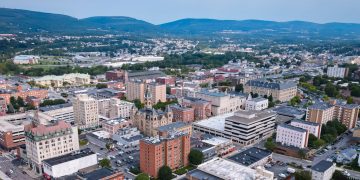




The nickname sits there in the city’s identity like an old photograph—”The Electric City.” Ask most Americans under forty where they’ve heard of Scranton, Pennsylvania, and they’ll mention a certain mockumentary about paper sales. But the story behind that electrified moniker runs deeper than pop culture references, threading through seams of anthracite coal, immigrant dreams, and the relentless transformation of American industry.

The Black Diamond Foundation
Scranton didn’t choose coal. Coal chose Scranton.
The Lackawanna Valley, where the city sprawls across northeastern Pennsylvania, sits atop one of the world’s richest deposits of anthracite coal—a hard, clean-burning variety that made the region’s fortune and defined its character for more than a century. Unlike the softer bituminous coal found elsewhere, anthracite burns hotter and cleaner, producing minimal smoke. This made it ideal for heating homes and powering the industrial revolution’s insatiable machinery.
The Lackawanna River carved this valley over millennia, unknowingly exposing the geological treasure that would attract entrepreneurs, laborers, and fortune-seekers from across the Atlantic. By the 1840s, the Scranton family—George and Selden Scranton, along with their associate William Henry—recognized the valley’s potential. They established iron furnaces that used local anthracite, proving that this hard coal could smelt iron just as effectively as charcoal or bituminous coal. The city that grew around their ventures took their name in 1851.
The marriage of iron and coal proved extraordinarily productive. Scranton’s blast furnaces roared to life, feeding the expanding railroad networks that were stitching together a continental nation. The Delaware, Lackawanna & Western Railroad made Scranton its headquarters, transforming the city into a critical node in America’s industrial lattice.
Descending Into Darkness
The mines themselves were monuments to human ambition and desperation.
Shafts plunged hundreds of feet beneath Scranton’s streets and surrounding hills, creating an inverted city of tunnels, chambers, and passages. Miners worked in near-total darkness, their headlamps cutting feeble circles of light through the coal dust that hung in the air like black fog. The temperature underground remained constant—cold in summer, relatively warm in winter—but always damp, always oppressive.
The work demanded everything from those who performed it. Miners swung pickaxes for ten to twelve hours daily, their bodies contorted into positions that would cripple them over time. They blasted rock with dynamite, loaded coal into cars, and reinforced tunnels with timber—all while knowing that cave-ins, explosions, and floods could erase their lives in seconds.
Children as young as eight worked in the breakers—massive industrial structures where coal was sorted and processed. These “breaker boys” sat hunched over conveyor belts, picking slate and debris from the coal as it rumbled past. The work destroyed their hands, blackened their lungs, and stole their childhoods. Photographs from the era show their faces—prematurely aged, eyes hard with experience no child should possess.
The accident reports read like dispatches from a war zone. In 1869, the Avondale Mine disaster killed 110 men and boys when fire broke out in the shaft, cutting off the only exit and suffocating everyone below. The tragedy shocked the nation and led to Pennsylvania’s first mine safety laws, requiring at least two exits for every mine. But legislation couldn’t eliminate the danger inherent in extracting coal from deep within the earth.
The Immigrant Tapestry
Scranton’s coal drew workers from across Europe and beyond, creating a cultural mosaic that still defines the city’s neighborhoods.
Welsh miners arrived first, bringing expertise in coal extraction and a tradition of male voice choirs that echoed through the valleys. Irish laborers followed, fleeing famine and finding familiar hardship in Pennsylvania’s mines. Germans contributed their engineering skills and brewing traditions. Italians established communities in North Scranton and the Plot section, bringing Mediterranean foodways that still flavor the city’s cuisine.
Eastern European immigrants—Poles, Lithuanians, Ukrainians, Slovaks—poured into Scranton in the late nineteenth and early twentieth centuries. They settled in neighborhoods like Minooka and the Hill Section, building churches with onion domes and establishing social clubs that preserved their languages and customs. These communities weren’t merely transplanted villages; they were new creations, forged in the crucible of industrial labor and American possibility.
The linguistic cacophony of Scranton’s streets reflected this diversity. A single block might feature Polish grocery stores, Italian bakeries, Irish taverns, and German butcher shops. Catholic churches proliferated, each serving specific ethnic communities with masses in their native tongues. The religious architecture alone told Scranton’s immigration story—Gothic spires reached skyward from Irish parishes, Byzantine domes crowned Ukrainian churches, and Romanesque structures marked German and Polish congregations.
This diversity created tension alongside community. Ethnic rivalries flared. Different groups competed for jobs, housing, and status. Mine owners sometimes exploited these divisions, playing one ethnic group against another to suppress wages and prevent unionization. Yet shared labor and shared danger also built bonds across ethnic lines. Underground, nationality mattered less than competence and courage.
Labor’s Battleground
The coal fields became a proving ground for American labor movements.
Miners faced not just physical danger but economic exploitation. They were typically paid by the ton, not by the hour, incentivizing dangerous speed. Company stores extended credit, trapping workers in cycles of debt. Housing provided by mining companies came with strings attached—lose your job, lose your home. The power imbalance between capital and labor was stark and often brutal.
The Molly Maguires—a secret society allegedly composed of Irish miners—fought back through sabotage, intimidation, and violence in the 1860s and 1870s. Whether they were righteous resisters or criminal terrorists remains debated, but their story illustrates the desperation and rage that simmered in Pennsylvania’s coal regions. Twenty members were hanged following controversial trials that relied heavily on testimony from a Pinkerton detective who had infiltrated the organization.
More organized resistance came through unions. The United Mine Workers of America, founded in 1890, fought for better wages, safer conditions, and recognition. The anthracite coal strikes of 1900 and 1902 brought national attention to miners’ conditions. The 1902 strike particularly rattled the nation—it lasted more than five months, threatened the winter heating supply for major cities, and required President Theodore Roosevelt’s personal intervention to resolve. Roosevelt’s mediation marked an unprecedented federal involvement in labor disputes and represented a partial victory for organized labor.
These struggles weren’t bloodless negotiations. Strikes meant hunger for families dependent on mining income. Violence erupted between strikers and strikebreakers, between miners and company guards. The coal companies wielded economic and political power, controlling local government, law enforcement, and media. Yet slowly, persistently, miners won concessions that improved their lives and established precedents for labor rights nationwide.
Illuminating the Night
The “Electric City” nickname emerged from a specific technological achievement that symbolized Scranton’s progressive spirit.
On November 2, 1886, Scranton became one of the first cities in the United States to have electric streetcars, powered by the Dickson Manufacturing Company’s innovative system. Electric trolleys replaced horse-drawn cars, demonstrating that this new technology could reliably serve a city’s transportation needs. The electric streetcars ran along lines connecting different neighborhoods and stretching into surrounding communities, creating a transportation network that shaped the city’s development.
The symbolism was potent. A city built on extracting fuel from the earth was illuminating itself with electricity, pointing toward a future beyond the mines. Electric lights began replacing gas lamps. Electric power drove machinery with greater efficiency than steam. The Electric City nickname captured both pride in technological adoption and hope for continued prosperity.
Yet the irony ran deep. Coal, extracted from beneath Scranton’s streets, generated much of the electricity powering this transformation. The city’s identity as Electric City was built literally on coal mining heritage. This wasn’t a rejection of coal but rather its evolution—from fuel burned directly in furnaces and homes to fuel burned in power plants to generate electricity.
The streetcar system itself reshaped urban life. Workers could live farther from the mines and factories, enabling residential neighborhoods to develop with some distance from industrial pollution. The trolleys connected previously isolated communities, facilitating commerce and social interaction. They represented modernity, progress, and civic ambition—qualities Scranton wanted to project to the world.
The Decline and Its Echoes
All boom economies eventually face reckoning.
Anthracite coal production peaked in Pennsylvania around 1917, when the region produced nearly 100 million tons annually. But multiple forces conspired against continued dominance. Oil and natural gas emerged as competing fuels for heating and power generation. The anthracite seams, after decades of intensive extraction, grew harder and more expensive to access. Labor costs rose. Alternative fuels proved cheaper and easier to transport.
The Great Depression devastated Scranton. Mine closures accelerated. Unemployment soared. The city that had grown explosively in the late nineteenth century began contracting. World War II provided temporary respite, but the post-war period brought continued decline. By the 1950s and 1960s, most major mining operations had ceased.
The physical scars remain visible. Culm banks—massive piles of coal waste—still dominate the landscape around Scranton, monuments to extraction. Some streets occasionally collapse into abandoned mine shafts beneath them. Underground mine fires, ignited decades ago, continue burning in some locations, inaccessible and inextinguishable. The region struggles with mine water pollution, as abandoned mines fill with acidic water that eventually seeps into streams and rivers.
The economic scars cut deeper. Scranton’s population, which peaked above 140,000 in 1930, declined to under 75,000 by the early 2010s before modestly recovering. The city has grappled with fiscal crisis, including a 2012 bankruptcy that reduced city employees’ pay to minimum wage. Once-grand downtown buildings stood empty for decades. The children and grandchildren of miners left for opportunities elsewhere, draining the city of youth and energy.
Preserving Memory
Scranton has worked to transform its coal mining heritage from burden to asset.
The Lackawanna Coal Mine Tour descends 300 feet underground into a former mine, allowing visitors to experience something of what miners faced. The tour guides, many of them former miners or descendants of miners, share stories that blend technical information with personal history. Standing in those damp, dark passages, the abstraction of “coal mining” becomes viscerally real.
The Steamtown National Historic Site preserves railroad history, celebrating the iron horses that coal powered and that made Scranton prosperous. The Pennsylvania Anthracite Heritage Museum documents the immigrant experience and labor history. These institutions recognize that Scranton’s story matters not just locally but nationally—it’s a story about industrial capitalism, immigration, labor rights, and economic transformation that played out across America.
The Scranton Cultural Center, housed in the restored Masonic Temple, hosts performances and events, demonstrating that culture and arts can thrive in post-industrial cities. The Electric City Trolley Museum operates vintage streetcars, keeping that technological heritage alive. These efforts represent conscious choices to honor the past while building different futures.
Neighborhoods retain their ethnic character, though diluted by time and assimilation. Italian festivals still draw crowds. Polish churches continue serving descendants of immigrant coal miners. The cultural legacy proves more durable than the economic base that created it.
Contemporary Identity
Modern Scranton exists in dialogue with its history.
The University of Scranton brings students and intellectual energy to the city. The Geisinger Commonwealth School of Medicine trains future physicians. These institutions represent economic diversification, though they can’t fully replace the industrial employment that once sustained the region.
The city’s cameo in popular culture—primarily through “The Office”—brought unexpected attention. Fans make pilgrimages to locations mentioned in the show, supporting tourism and small businesses. This seems almost surreal given Scranton’s serious, industrious heritage, but it represents a form of economic adaptation.
The question facing Scranton and similar post-industrial cities is fundamental: How do communities built around specific industries survive when those industries disappear? The answer isn’t simple or singular. It involves cultivating healthcare, education, and service sectors. It requires investing in infrastructure and amenities that attract residents and businesses. It means honestly confronting the challenges of population loss, aging infrastructure, and fiscal constraints while maintaining civic pride and hope.
Scranton’s coal mining heritage isn’t ancient history. Men and women still alive remember working underground. Their children grew up in households shaped by mining culture—its dangers, its solidarities, its values. The built environment reflects coal money and coal labor. The very land bears coal’s imprint.
The Electric City Today
Walking through Scranton today means navigating layers of history.
The courthouse square retains its architectural dignity. Mansions on Clay Avenue, built by coal barons, stand as testaments to the wealth extracted from beneath the earth. The restored Radisson Lackawanna Station Hotel, in the former Delaware, Lackawanna & Western Railroad station, blends historic grandeur with modern hospitality. These landmarks speak to ambition and achievement.
But other buildings tell different stories. Empty storefronts punctuate downtown streets. Some neighborhoods show visible decay. The challenges of post-industrial transition remain unfinished business.
Yet Scranton endures. The people who stayed or returned demonstrate loyalty to place that transcends economic logic. They maintain communities, raise families, and work toward renewal. The city has survived harder times than these—the dangers of the mines, the labor battles, the Great Depression, the economic collapse of the coal industry.
The Electric City nickname still fits, though its meaning has evolved. It no longer primarily celebrates streetcar technology or progressive infrastructure. Instead, it represents resilience—a city that powered America’s industrial growth, that electrified itself literally and metaphorically, that continues illuminating despite diminished circumstances.
Scranton’s coal mining heritage isn’t a quaint historical footnote. It’s the foundation upon which everything else rests. The city exists because coal existed. The people came for coal. The wealth, the culture, the conflicts, the achievements—all ultimately trace back to those black seams beneath the earth.
The mines are mostly closed now, the coal largely depleted or too expensive to extract. But Scranton remains, transformed but recognizable, diminished but determined. The Electric City still shines, its light fueled now not by coal but by the stubborn persistence of communities that refuse to disappear, that insist their story matters, that remember where they came from even as they struggle toward what comes next.