



Philadelphia’s 30th Street Station does not whisper. It announces itself. Rising from the west bank of the Schuylkill River like a temple to the ambitions of a nation that once believed in going places, the station is a limestone colossus with a soul. Walk through its bronze doors for the first time and something happens to you — your pace slows, your chin lifts, and for a moment the noise of travel dissolves into something closer to awe.
This is not an accident of architecture. It is a building that was designed to make you feel small in the best possible sense — to remind you that your journey, however routine, is part of something larger. And in 2026, as train travel continues its American renaissance, 30th Street Station is once again at the center of the story.
Whether you are passing through Philadelphia on an Amtrak corridor route, arriving for the first time, or a daily commuter who has spent years barely glancing up at the ceiling — this guide is your complete companion to one of the most remarkable transit hubs in the United States.
A Building With a Story Worth Knowing
The History Behind the Columns
Construction of 30th Street Station began in 1929, the year the stock market collapsed and the American Dream took its most dramatic detour. The Pennsylvania Railroad, undeterred by economic catastrophe, pressed on. The station opened fully in 1933, designed by the Chicago architectural firm Graham, Anderson, Probst & White — the same practice behind the Merchandise Mart in Chicago and the Wrigley Building.
The building belongs to the Classical Revival tradition, but calling it merely classical undersells it. The exterior is defined by its immense Corinthian columns — twelve of them — each standing 71 feet tall. The Indiana limestone facade stretches 640 feet along 30th Street, a sheer wall of civic confidence from an era when railroads were the arteries of national life.
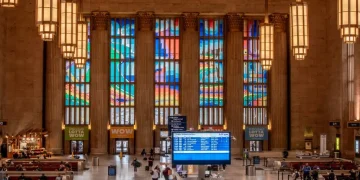
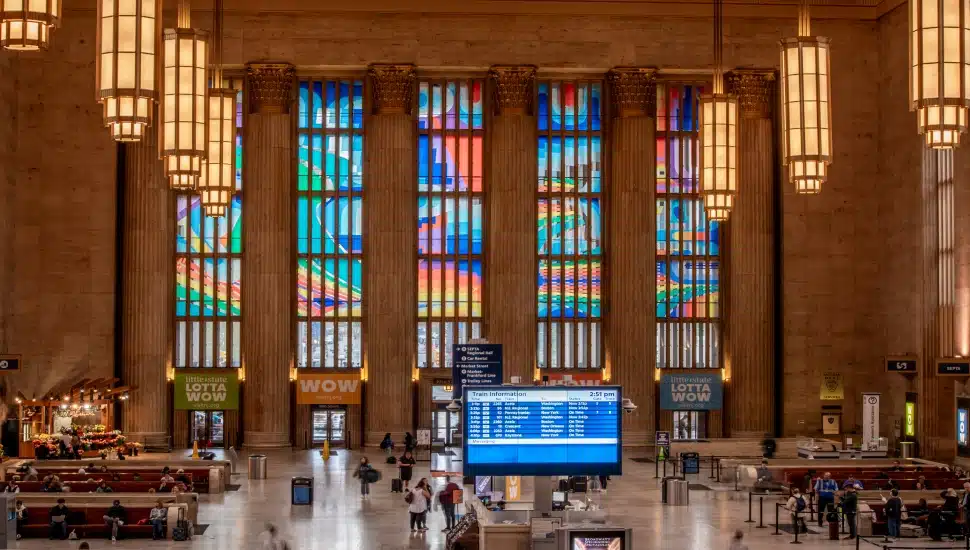
Inside, the main waiting room — properly called the Main Hall — rises 95 feet from floor to coffered ceiling. The room spans 300 feet in length, flanked by enormous arched windows that pour natural light across the marble floors in long afternoon rectangles. On busy travel days, this room hums. On quiet mornings, it echoes.
The station was designated a National Historic Landmark in 1978 and is listed on the National Register of Historic Places. It is, in the parlance of preservation circles, irreplaceable.
The Pennsylvania Railroad Angel
Before you leave the Main Hall, find the Pennsylvania Railroad War Memorial. Mounted high on the south wall, it is a bronze sculpture by Walker Hancock, unveiled in 1952, honoring the 1,307 Pennsylvania Railroad employees who died in World War II. An archangel — massive, muscular, luminous in gilded bronze — lifts a fallen soldier from the ground.
It is unexpectedly moving. Commuters walk beneath it every day without stopping. You should stop. The memorial won the American Academy of Arts and Letters award in 1952 and remains one of the most significant public sculptures in Philadelphia.
Getting to 30th Street Station
By Train, Naturally
30th Street Station serves as a major stop on Amtrak’s Northeast Corridor, the busiest passenger rail line in North America. High-speed Acela trains and standard Northeast Regional trains connect Philadelphia to New York Penn Station (approximately 70–95 minutes), Washington D.C. Union Station (approximately 100–135 minutes), and Boston South Station (approximately 4–5 hours).
The station also sits on Amtrak’s Keystone Service corridor, with regular daily departures to Harrisburg, PA, with stops across Pennsylvania including Lancaster — a route that slips through genuinely beautiful countryside west of the city.
Long-distance routes also pass through. The Crescent, the Cardinal, and the Palmetto all make stops here, connecting Philadelphia to the Deep South, Chicago via the Capitol Limited, and the broader national Amtrak network. If you are thinking about a true long-haul journey, 30th Street is your launchpad.
SEPTA Regional Rail
Philadelphia’s regional commuter rail system — SEPTA — operates several lines directly through 30th Street Station. The station is a stop on the Market-Frankford Line (SEPTA’s subway) at the adjacent 30th Street station, and Regional Rail lines including the Paoli/Thorndale, Malvern, Airport, Wilmington/Newark, Trenton, and West Trenton lines all serve the station.
For visitors arriving from Philadelphia International Airport (PHL), the SEPTA Airport Line runs directly to 30th Street in approximately 25 minutes with no transfers — one of the city’s most underutilized travel bargains.
By Car and Rideshare
The station is located at 2955 Market Street in West Philadelphia, just across the Schuylkill River from Center City. By car, it is accessible via I-76 (the Schuylkill Expressway), with exits near South Street Bridge and Market Street Bridge.
Rideshare pickup and dropoff zones are clearly marked on the Market Street side of the building. During peak hours — particularly Friday afternoons and Sunday evenings — these zones can back up. Build a few extra minutes into your departure time.
Paid parking is available in the station’s own garage on Arch Street, as well as in several nearby surface lots. Rates vary by duration. For short-term drop-offs, the kiss-and-ride loop on Market Street is your most efficient option.
On Foot and by Bike
30th Street Station sits at the gateway of University City, one of Philadelphia’s most walkable neighborhoods. The University of Pennsylvania campus is a short 10-minute walk east, and Drexel University is even closer. The station connects directly to the Schuylkill River Trail, a beautiful multi-use path that runs north and south along the river — a fact that makes this one of the few major American train stations where you can arrive by bicycle without any awkwardness.
Indego, Philadelphia’s bike-share system, has docking stations directly adjacent to the station.
Inside the Station — What to Expect
Ticketing and the Amtrak Experience
The Amtrak ticketing area is located on the ground floor, accessible from the main entrance on 30th Street. Self-service kiosks handle the majority of ticket transactions quickly and efficiently — Amtrak’s app integration with these kiosks has improved significantly, and QR code scanning for mobile tickets is reliable.
For more complex itineraries, multi-leg journeys, or group travel, the staffed ticket windows provide full-service assistance. Wait times are generally short outside of holiday travel windows (Thanksgiving, Christmas, July Fourth, Memorial Day, and Labor Day weekends are the predictable pressure points).
Accessible services are robust at 30th Street. Red Cap service — Amtrak’s free luggage assistance for passengers who need help — is available and should be requested in advance through Amtrak’s accessibility desk or when booking. The station is fully ADA-compliant with elevators serving all levels.
The Waiting Room and Concourse
The Main Hall doubles as the primary waiting area, lined with wooden benches that have supported generations of travelers. The benches are not plush, but they are handsome, and the room itself is compensation enough for any lack of cushioning.
Amtrak’s Metropolitan Lounge — the premium lounge available to sleeping car passengers and select business class travelers — is located on the upper mezzanine level. It offers comfortable seating, complimentary snacks, beverages, and Wi-Fi. For those who travel regularly on overnight Amtrak routes, it is a genuine perk worth factoring into booking decisions.
The station board — the classic departures and arrivals display — is mounted in the Main Hall. Despite the proliferation of phone-based travel apps, there is something genuinely useful about a shared display board. Everyone in the room is looking at the same information. It is one of the quiet social functions of great train stations that often goes unnoticed.
Dining and Food Options
30th Street Station is not a food hall destination in the way that New York’s Grand Central has become, but it has improved considerably in recent years.
Saladworks offers customizable salads and grain bowls near the main concourse — a reliable choice for travelers who want something fresh and reasonably substantive before boarding.
The Metropolitan Bakery kiosk, operated by Philadelphia’s beloved artisan bakery, is the best quick food option in the station. Their pastries, sandwiches, and coffee are legitimate — not airport-grade approximations of food.
Dunkin’ and Auntie Anne’s pretzels cover the comfort-food and caffeine categories that are obligatory in any American transit hub.
For a proper sit-down meal before or after travel, the immediate neighborhood offers considerably better options. Dock Street Brewery is a short walk away. White Dog Café, a Philadelphia institution, is accessible by a brief rideshare hop. If you have 45 minutes before your train, leaving the station to eat is almost always the right call.
Shopping and Amenities
The retail footprint inside 30th Street Station is modest by the standards of a major American transit hub. A newsstand carries newspapers, magazines, snacks, and travel essentials. A pharmacy kiosk stocks over-the-counter medications and travel-size toiletries. There is an ATM near the main concourse.
Storage lockers are available for travelers who need to stow bags between trains or during a layover in the city. Rates are coin-operated and vary by locker size.
Free Wi-Fi is available throughout the station. The signal is reliable in the Main Hall and concourse areas. In some lower-level areas near the platform tunnels, coverage degrades — download your entertainment before you descend.
Platform Access and Boarding
How the Platform System Works
Unlike some major American stations where passengers wait in open air or on visible platforms, 30th Street Station uses a gated, tunnel-based boarding system. Platforms are accessed via a descending ramp and stairway system on the lower level.
Track assignments are typically posted on the departures board 15–20 minutes before departure. For Acela trains and Northeast Regional services, this window can be shorter during busy periods. Experienced travelers at 30th Street learn to position themselves near the appropriate stairs in advance, rather than scrambling when the track is announced.
Platform signage has been updated in recent years and is clearer than it was a decade ago, though the physical layout can still feel labyrinthine during a first visit. The key orienting detail: Northbound trains (toward New York and Boston) and Southbound trains (toward Washington) board from different platform areas. When in doubt, ask a station employee — they are generally present and helpful.
Amtrak’s Acela vs. Northeast Regional — Does It Matter Here?
Both Acela and Northeast Regional trains serve 30th Street, and the platform experience is broadly similar. The real difference is felt in travel time and onboard comfort. Acela is faster between Philadelphia and New York (approximately 70 minutes versus 90–95 minutes on the Regional) and offers business-class seating as the standard cabin.
For Philadelphia-specific trips — say, a day trip to New York — the Acela premium is often worth it purely for the time savings and onboard experience. The Northeast Regional is a perfectly good train and significantly cheaper; on the Philadelphia-to-Washington corridor, the time difference shrinks enough that the Regional becomes the obvious value choice for most travelers.
The Neighborhood — 30th Street Station’s Surroundings
University City
The station anchors the eastern edge of University City, Philadelphia’s major academic and medical district. The University of Pennsylvania, Drexel University, the Children’s Hospital of Philadelphia, Penn Medicine, and the Wistar Institute all cluster within walking distance. The neighborhood is dense with coffee shops, bookstores, ethnic restaurants, and the particular energy of a place where a substantial share of the population is always either studying, teaching, or doing research.
For travelers who have time to explore before or after their train, University City rewards wandering. Locust Walk on the Penn campus is one of the more handsome pedestrian corridors in the region. The Penn Museum (University of Pennsylvania Museum of Archaeology and Anthropology) is legitimately world-class — one of the great under-visited museums in the American Northeast.
The Schuylkill River Trail
The station’s position on the Schuylkill River is one of its genuine pleasures as a transit experience. The Schuylkill Banks riverfront park and trail system begin essentially at the station’s doorstep. Heading north, the trail connects to Fairmount Park, one of the largest urban park systems in the United States. Heading south, it links toward South Philadelphia’s waterfront.
On a clear day — and Philadelphia has more of those than its reputation suggests — the view of the river from the station’s approaches is unexpectedly lovely. The boathouses of Boathouse Row, a string of ornate Victorian boat clubs that serve as the home base of Philadelphia’s competitive rowing culture, are visible from the Market Street bridge just north of the station.
Getting into Center City
Center City Philadelphia is across the Schuylkill from 30th Street Station — closer than it feels on a map. The Market-Frankford Line subway runs from the 30th Street SEPTA stop directly into downtown, reaching City Hall in approximately 10 minutes. Taxis and rideshares are plentiful at the station exit. On foot, the Market Street Bridge crossing takes about 15 minutes and offers a good view of the river; the South Street Bridge is another option with pleasant pedestrian infrastructure.
Tips for First-Time Visitors
Arrive Early, But Not Frantically Early
Amtrak’s boarding process at 30th Street does not require the kind of theatrical advance arrival that air travel demands. For most corridor trains, arriving 20–30 minutes before departure is comfortable. For long-distance trains where you are traveling with checked baggage, 45 minutes gives you appropriate margin.
Arrive too early and you will simply be waiting in the Main Hall — which is not the worst fate, admittedly, but it is time you could spend at one of the neighborhood’s better coffee shops.
Know the Rush Hours
Peak congestion at 30th Street follows predictable patterns. Weekday morning rush (7–9 a.m.) and evening rush (5–7 p.m.) see the highest volume of SEPTA commuters. Friday afternoons from roughly noon through 6 p.m. are consistently the busiest Amtrak periods. Sunday evenings, particularly in summer and fall, see heavy northbound traffic as weekend visitors return to New York.
If you have flexibility in your travel timing, midday departures on Tuesday, Wednesday, and Thursday are the station at its calmest and most pleasant.
The App Matters
Amtrak’s mobile app has matured considerably. Mobile ticketing is reliable and ticket agents will scan QR codes without friction. The app also provides real-time train status updates — useful in winter months when Northeast Corridor delays are a recurring fact of life. Set push notifications for your train on travel days.
Checked Baggage Has Limits
Not all 30th Street departures offer checked baggage service. Corridor services — Acela and Northeast Regional — do not check bags. You carry on everything you bring. This is worth knowing before you arrive with three large suitcases expecting porters. Long-distance services do offer checked baggage with standard Amtrak policies.
Accessibility at 30th Street Station
30th Street Station has made significant accessibility investments over the past decade. All primary areas — ticketing, waiting room, concourse, platforms — are elevator-accessible. Tactile paving guides assist visually impaired travelers. Accessible restrooms are located on multiple levels.
Red Cap service remains one of Amtrak’s best accessibility features: trained staff members meet passengers curbside and assist with luggage, navigate the station, and ensure boarding. This service requires advance request (call 1-800-USA-RAIL or request at the accessibility desk) and is free of charge.
The station’s auditory announcement system covers the Main Hall effectively. Platform announcements can be harder to hear in the lower tunnel areas — for travelers who rely on auditory cues, developing the habit of double-checking with staff before descending to the platform is a sensible precaution.
30th Street Station and the Future of Rail Travel
Philadelphia’s 30th Street Station is not resting. Amtrak’s ongoing Northeast Corridor improvements — part of the broader infrastructure investment program funded through federal legislation — include planned upgrades to the Philadelphia area rail network that will affect service frequency, capacity, and travel times over the coming decade.
Discussion has also continued around the Gateway Program, which aims to expand rail capacity between Philadelphia and New York by constructing new Hudson River tunnels. If completed, this infrastructure investment would meaningfully change the volume and frequency of trains passing through 30th Street.
Locally, ongoing development in University City and along the Schuylkill waterfront continues to position the station as an anchor for one of Philadelphia’s most dynamic districts. Several mixed-use development projects within walking distance of the station are reshaping the immediate neighborhood’s commercial and residential character.
The station itself has been the subject of preservation and renovation discussions for years. The challenge with any structure of this scale and age is the perpetual tension between authentic restoration and practical modernization. The Main Hall’s bones are sound. The question is always how to bring the surrounding infrastructure up to 21st-century standards without diminishing what makes the place singular.
Why This Station Deserves Your Attention
There is a particular kind of traveler who moves through transit hubs on autopilot — eyes down, earbuds in, focused only on the gate or the platform. That traveler misses what 30th Street has to offer.
The station is one of those rare public spaces that still performs the civic function that its architects intended: to make ordinary people feel, for a moment, that their movement through the world is dignified and consequential. The ceiling is 95 feet high because someone believed you deserved 95 feet of ceiling. The columns are 71 feet tall because someone thought your arrival warranted columns.
American rail travel is in a period of genuine renewal. Ridership on the Northeast Corridor has recovered and grown. A new generation of travelers who are skeptical of the environmental cost of air travel, the indignity of airport security theater, and the sprawling inefficiency of car dependency has rediscovered the train as a serious option.
30th Street Station is ready for them. It has always been ready. It was built for the long haul.
Philadelphia’s 30th Street Station is located at 2955 Market Street, Philadelphia, PA 19104. The station operates 24 hours and is served by Amtrak and SEPTA. For Amtrak reservations and schedules, visit amtrak.com or call 1-800-USA-RAIL.