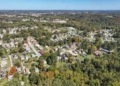

Deep inside the Allegheny National Forest, fifty miles from the nearest traffic light, a fifty-acre dune rises fifty feet above the surrounding hardwood canopy. White quartz sand, fine as flour, spills over the ridge crest and glows under August sun like misplaced ocean beach. No signs mark the trailhead. No brochures mention it. Google Maps labels the spot “Minister Creek Campground” and nothing more. Yet the dune exists, anchored by beach grass and jack pine, ringed by sugar maples that have no business growing next to something that belongs on Lake Michigan’s shoreline. Locals call it simply “the sand hill.” Outsiders usually react with the same two words: “In Pennsylvania?”

How a Glacier Dropped an Ocean Beach in the Middle of Nowhere
Twelve thousand years ago, Glacial Lake Watt covered most of northwest Pennsylvania under hundreds of feet of meltwater. When the ice dam finally burst near Jamestown, New York, a wall of water scoured the plateau and dumped an unknown volume of pure quartz sand on a south-facing ridge above the Tionesta Creek watershed. The flood lasted days, maybe weeks. When it ended, the dune remained—an orphan of the Pleistocene stranded 1,800 feet above sea level and 250 miles from the nearest saltwater.
Wind shaped it for centuries, pushing the crest southward until pitch pines and beach grass took hold. Fire, lightning, and porcupines kept the center open. Today the dune is stable, but every spring the prevailing westerlies still move a few tons of sand over the lip and into the forest below, creating slow-motion avalanches that bury saplings and leave pale scars visible from airplane windows.
Finding the Dune Without Losing Your Mind
Forest Road 236 leaves Route 666 (yes, really) just south of Sheffield. The pavement ends after four miles, replaced by gravel sharp enough to slice sidewalls. High-clearance vehicles are wise; Subaru loyalty is tested here. At mile marker 9.7, a brown campground sign points right toward Minister Creek. Take the left fork instead—an unsigned double-track that climbs through hemlock and disappears under goldenrod.
Park at the obvious widening where ATVers have spun donuts into the moss. From there, everything is on foot. The trail isn’t blazed, but generations of boot prints have worn a trench through the fern. Twenty minutes of steady climbing brings you to a sandstone ledge. Step over it and the forest floor turns to sugar. Trees give way to open sand. The ridge falls away on three sides. On calm evenings the horizon stretches thirty miles across unbroken green, broken only by the silver ribbon of Tionesta Creek glinting far below.
Seasons on the Dune
Summer
Temperatures on the sand surface reach 120 °F by mid-afternoon. Heat shimmers distort the treetops and turn distant ridges into melting mirages. Cicadas scream from the surrounding forest, but the dune itself stays eerily quiet—no leaves to rustle, no underbrush for birds to hop through. Pitcher plants and sundews grow in the wet swales where snowmelt lingers longest; their sticky traps glisten with doomed ants. By dusk the sand radiates the day’s heat like a brick oven. Lie on your back and the stored warmth seeps through a sleeping pad for hours. The Milky Way appears close enough to touch.
Autumn
First hard frost paints the beach grass bronze. Sugar maples on the perimeter explode into color while the dune stays pale, creating a perfect negative space in the landscape. Wind picks up in October, sculpting ripples sharp enough to cut bare feet. Sand moves in visible sheets across the crest, hissing like dry snow. On ridge-top campsites, tents must be anchored with eighteen-inch stakes or they migrate downhill overnight.
Winter
Snow sticks to the forest but slides off the dune’s steep face almost as fast as it falls. The result: a white sea of trees surrounding a naked tan island. Cross-country skiers climb the back side on skins, then rocket down the 35-degree slope at speeds that would terrify coastal dune skiers used to gentler angles. Tracks last only until the next gust.
Spring
Lady slippers and trailing arbutus bloom in the sandy duff at the edges. Black bears emerge hungry and make straight for the dune’s ant colonies, leaving claw marks and craters the size of kiddie pools. Thunderstorms turn the sand into cement for exactly thirty minutes—long enough to walk barefoot without sinking—then it reverts to quicksand until the sun bakes it dry again.
Camping on Top of the World (Sort Of)
No permits are required. No fees are collected. The entire dune is National Forest land open to dispersed camping. Most people choose the eastern bench where a stand of red pines offers wind protection and flat ground. Dig a cathole at least 200 feet from the crest—sand percolates fast and the water table is closer than you think.
Sunset from the highest point is worth every mosquito bite on the hike in. The dune faces due west; on clear evenings the sun drops straight into the Allegheny Plateau, igniting the sand until it glows orange-pink. Coyotes start yipping in the valley exactly four minutes after the last light leaves the ridge. If you’re lucky, a whip-poor-will answers from the darkness below.
Fires are technically legal but practically difficult—there’s nothing to burn except pitch pine twigs that snap off in windstorms. Bring a stove or plan on cold dinners. The sand holds heat so well that a single candle lantern inside a tent turns it into a sauna.
Flora and Fauna That Shouldn’t Exist Here
Beach grass (Ammophila breviligulata) grows in perfect rows along the crest, identical to the dunes at Presque Isle. Botanists argue over whether seed blew in naturally or was planted by homesick CCC boys in the 1930s. Either way, it’s the only population in Pennsylvania more than a hundred miles from Lake Erie.
Prairie warblers—birds of coastal dunes and pine barrens—nest here every May, singing from the tops of stunted jack pines. Timber rattlesnakes occasionally cross the warm sand on their way between denning sites, though sightings are rare and usually involve someone stepping on a sun-warmed log that turns out to be alive.
Ant lions dig their conical pits along the trail edges. Stand still long enough and you can watch one flip an escaping ant back into the trap with a flick of sand. At night, wolf spiders the size of half-dollars patrol the open patches, eyes glowing green in headlamp light.
The Human History Nobody Wrote Down
Pottery shards and fire-cracked rock turn up when wind scours the blowouts—evidence of Archaic-period camps 6,000 years old. Later, Seneca hunters used the dune as a landmark; the ridge is clearly visible from the Cornplanter Grant lands downstream on the Allegheny River.
Logging companies ignored the area in the 1880s—the sand supported no marketable timber. Oil prospectors drilled a dry hole in 1912 and left behind a rusted cable-tool rig that’s now half-buried near the northern edge. During World War II the Army Air Corps briefly considered the dune as an emergency landing strip for gliders. Common sense prevailed.
In the 1970s, local kids built a rope swing off a lightning-scarred pine at the crest. The rope is long gone, but the limb still bears the groove. Someone carved “CLASS OF ’79” into the bark nearby; the letters have stretched into abstract art as the tree grew.
Photography and the Light That Breaks Cameras
Golden hour lasts forty-five minutes longer up here than in the valley. The sand reflects light upward, filling shadows and turning ordinary portraits into something luminous. Photographers who time their visit for the week after Labor Day—when the surrounding forest turns but the dune stays pale—capture images that get accused of being Photoshopped.
Night photography is ridiculous. With no light pollution for fifty miles in any direction, the dune regularly hits Bortle Class 1 or 2. The Milky Way reflects faintly off the sand, creating a double arch visible to the naked eye on moonless nights. Long-exposure shooters set up tracking mounts and leave shutters open for hours, collecting photons while coyotes trot past the tripod legs.
Dangers, Real and Imagined
Quicksand is mostly myth, but post-rain sand on the steep western face can slump without warning. In 1996 a teenager glissading down on a sled made of cardboard triggered a slab avalanche that carried him 300 vertical feet and buried him to the waist. He laughed about it later. Don’t be that kid.
Dehydration sneaks up fast. The dune is a desert in every sense except latitude. Carry twice the water you think you need.
Rattlesnakes, as mentioned. And yellow jackets nest in the sand like coastal hornets—stepping on a ground nest at speed is a quick way to learn new swear words.
Leaving No Trace on a Canvas That Records Everything
Footprints last for weeks. Tent outlines remain visible for months. A single piece of discarded tinfoil will glitter in the sun until the next Ice Age unless someone else packs it out.
The dune is fragile in the geological sense—another thousand years of wind could move it entirely off the ridge—but resilient in the ecological one. Plants adapted to coastal dunes thrive here with almost no help. Still, stay on existing paths through the wooded edges. Trampling the cryptobiotic crust (yes, it exists here too) sets succession back decades.
Why the Dune Matters
In a state defined by folded mountains and coal seams, the dune is an anomaly—an exclamation point written by a glacier that ran out of ink before it could explain itself. It forces visitors to reconcile two landscapes that shouldn’t coexist: the dark, damp, fern-choked Allegheny Plateau and the open, sun-blasted coast. Standing on the crest feels like straddling continents.
Most people who find it keep the location vague when they talk about it later. “Somewhere up near Tionesta,” they’ll say, or “off 666, but good luck.” The dune doesn’t need crowds. It has survived twelve millennia without help. Another century of quiet obscurity won’t hurt it.
Still, if you do go, time your visit for a windless night in August. Lie on the sand after the heat has bled into the sky. Watch Perseid meteors burn up overhead while the forest exhales cool air across your skin. Somewhere below, an owl asks its eternal question. The dune answers with silence so complete you can hear your own pulse.
That sound—the soft rush of blood through arteries—is the closest thing Pennsylvania has to surf.