



There are races you run, and there are races you experience. The Independence Blue Cross Broad Street Run is firmly in the second category. Every first Sunday in May, the long spine of Philadelphia — Broad Street — transforms into something that doesn’t quite have a name in the running world. It’s part festival, part civic ritual, part personal reckoning. Forty thousand people line up at the northern edge of the city and run ten miles south, straight through its beating heart, all the way to the Navy Yard at the Delaware River’s edge. It’s the largest, fastest, and most popular 10-mile race in the country.
That’s not marketing copy. That’s just a fact that Philadelphia has earned, year after year, since 1980.
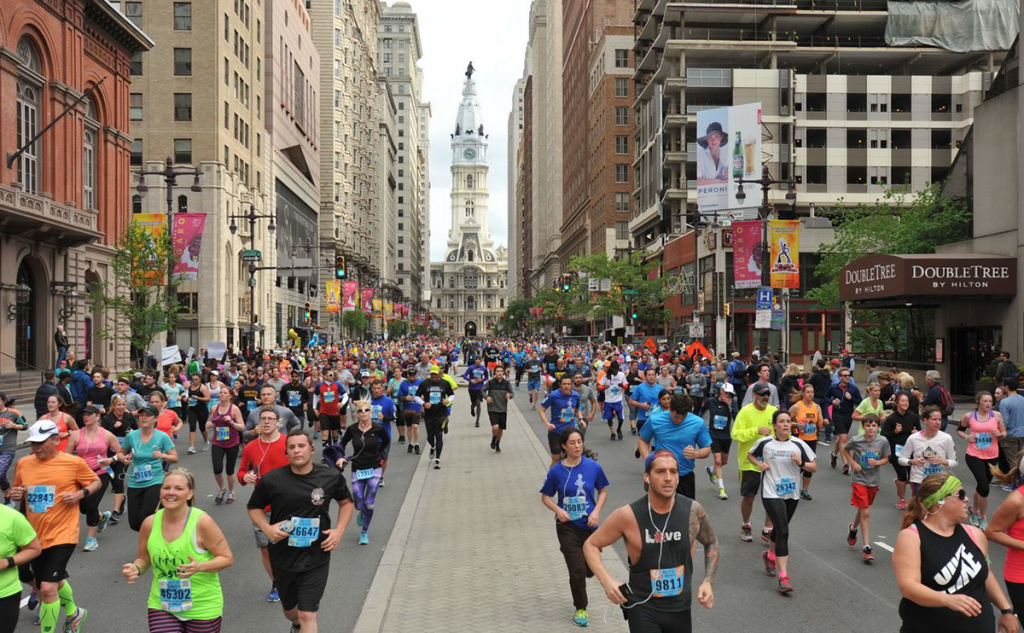
The Broad Street Run doesn’t have the mythological weight of Boston or the global spectacle of New York. It doesn’t need it. What it has is something more personal: a city that genuinely shows up for it. Spectators pack the sidewalks in Olney, in North Philly, through Center City, in South Philly, waving signs, holding out orange slices, blasting music from speakers propped in doorways. The race doesn’t just pass through Philadelphia’s neighborhoods — it connects them, one stride at a time.
Where It All Started: The History of the Broad Street Run
The Independence Blue Cross Broad Street Run launched in 1980, and that first race was a modest affair — just 1,454 men and 122 women crossing the finish line. The Philadelphia running scene was still young, still finding itself. The running boom of the late 1970s had lit a fuse across America, and Philly was catching the spark.
What happened over the next four decades is a story about a city falling in love with a race — and a race becoming inseparable from its city’s identity.
Participation rose steadily through the 1990s and exploded by the mid-2000s. By 2012, the race had reached a staggering 40,689 runners, a number that still stands as a benchmark for what a major American road race can look like at full volume. The logistics alone are extraordinary — 40,000 people moving through the arterial corridor of a major American city, with medical personnel, police, SEPTA coordination, and spectator management all working in precise choreography.
Since 2013, registration of single runners has been handled by a lottery, with about 40,000 entrants and roughly 35,000 runners finishing the race, the majority of them women. That demographic shift is worth sitting with. The Broad Street Run is not a race dominated by competitive male runners chasing finish times. It belongs, statistically and culturally, to women — to casual runners, to charity fundraisers, to people running their first road race, to mothers and daughters running together, to coworkers who made a New Year’s bet they’re now too stubborn to lose.
The race that began in 1980 with just 1,500 participants now anticipates another sellout in 2026, its 47th year. That trajectory — from a few hundred runners on a spring morning to a civic institution — tells you everything about what this race has become.
The Course: Ten Miles That Tell Philadelphia’s Story
The Independence Blue Cross Broad Street Run course is a 10-mile, point-to-point course named one of the fastest 10-mile courses in the country by Runner’s World, running through the varied neighborhoods of Philadelphia along Broad Street.
That single sentence hides a world of detail. Let’s unpack it.
Point-to-point means you start in one place and end in another — no loops, no doubling back. You start at the northern end of Broad Street, near Central High School in the Logan neighborhood, and you run south. Due south. Broad Street is one of the longest straight urban roads in America, and the race exploits that geography beautifully. Due in part to its nearly flat, slightly downhill route, it has become a favorite in the running community for those working to establish personal best times.
That gentle, almost imperceptible grade going south is the course’s secret weapon. Runners often don’t realize they’re aided by elevation until they check their splits and wonder why mile 6 felt faster than it should have. The course rewards honest pacing — go out too fast and the back half will teach you a lesson, but run it smart and you’ll find yourself cruising through South Philly feeling like you still have something in the tank.
The course stretches south along Broad Street, with runners passing Temple University, Roman Catholic High School for Boys, Philadelphia City Hall, the Pennsylvania Academy of the Fine Arts, and the Kimmel Center. The race finishes at the Navy Yard in South Philadelphia.
The landmarks list sounds like a tour brochure, but experiencing them mid-race is different. City Hall, with its massive statue of William Penn perched on top, appears in the middle distance around mile 5. It’s a psychological landmark as much as a geographic one — you see it, you know you’re halfway, you know the course is tilting in your favor. The neighborhoods change character every half mile or so, from the tight row houses of North Philadelphia to the broader commercial corridors of Center City to the quieter residential streets of South Philly. The city reveals itself differently from the inside of a race than it does from a car or subway.
The 2026 race begins at the Central High School Athletic Field on Broad Street between Fisher Avenue and Somerville Avenue and finishes in the Navy Yard. The Navy Yard finish has become iconic in its own right — a former military installation converted into a mixed-use business campus, with a wide-open finish area that can accommodate the chaos and jubilation of tens of thousands of finishers crossing the line within a few hours.
Until 1989, the race ended with a lap around the field at JFK Stadium in South Philadelphia. After the stadium was condemned and demolished, the finish moved to FDR Park, and then to the Navy Yard, about a quarter mile beyond the front gates.
The Lottery: The Annual Drama of Getting In
Here’s the thing nobody tells you before you fall in love with the Broad Street Run: getting in is its own event. The race accommodates up to 40,000 runners, and participants are notified by email about whether they’ve secured a race bib. In 2026, registration opened February 1 and closed February 13 — two weeks to throw your name into a hat shared with hundreds of thousands of hopefuls.
The lottery system, in place since 2013, is both democratic and maddeningly arbitrary. You want in, you enter, and then you wait. Tenured runners — those who have competed in the run 10 or more times — and runners who deferred the previous year are eligible for guaranteed registration, a nod to the race’s long relationship with its most committed participants. There’s something right about that. The people who have shown up decade after decade, through cold Mays and rainy Mays and the years when everything felt hard, get a guaranteed spot. Loyalty earns its own reward.
For everyone else, it’s the lottery. And if you don’t get in via lottery, there are still options: running for a charity partner, or finding someone willing to transfer their bib. The race allows bib transfers, and runners who are accepted but cannot participate can log into their RunSignUp account to initiate a transfer.
Registration for the Blue Cross Broad Street Run is non-refundable, which means once you’re in, you’re in — financially, emotionally, and ideally physically. That non-refundable policy has a way of concentrating the mind during training.
The 2026 Race: A Historic Year for a Historic City
The 2026 Independence Blue Cross Broad Street Run takes on added significance as Philadelphia celebrates the 250th anniversary of American independence, bringing together neighbors, families, and visitors for a milestone year that places Philadelphia at the center of national commemoration.
There’s a certain poetry in that alignment. Philadelphia is where American independence was declared, where the Constitution was written, where the founding documents of the republic were debated and signed. A race that runs through the city’s spine, past its civic institutions, through its diverse neighborhoods — this year, that race carries a little extra weight.
Mayor Cherelle L. Parker noted that the race showcases how tradition, community, and celebration come together in a way only Philadelphia can deliver.
Taking place during Mental Health Awareness Month, the 2026 Broad Street Run calls on Philadelphians to pause, recharge, and recommit to personal and collective well-being. Scientific research underscores that running — across all distances and abilities — can improve mental health, moods, and emotional resilience.
That’s not just talking point fluff. Spend any time around the Broad Street Run community in the weeks before the race and you’ll hear it — people describing their training as the thing that got them through a hard winter, through a difficult diagnosis, through grief, through a job loss. Running does something to a person that’s hard to quantify but easy to feel. The Broad Street Run gives that something a deadline and a finish line.
The 2026 race begins on Sunday, May 3 at 7 a.m. Mark it.
Course Records and Elite Competition
The Broad Street Run has always attracted serious talent alongside its masses of recreational runners, and the course records reflect just how fast this route can be.
The men’s course record is held by Raymond Magut, who set it in 2023 with a time of 45:13. The women’s record belongs to Cynthia Limo, also set in 2023, at 50:54. In the non-binary division, Bryan Morseman set the record in 2025 at 52:18. In the wheelchair divisions, Tony Nogueira holds the Open Male record at 32:05, set in 2007, while Jessica Galli set the Open Female wheelchair record at 39:59 back in 2001.
Those wheelchair records deserve a moment of appreciation. The Broad Street Run’s history with wheelchair athletes is a long one, and the integration of wheelchair divisions into the race’s competitive structure reflects a broader commitment to inclusion that has defined the event’s character.
A $1,000 bonus awaits any runner who beats the existing course records, and age group awards go to the top five men and women in each division. The Independence Cup, engraved with the names of previous winners, is presented to the top male, female, and wheelchair division finishers.
The Richard Lagocki Memorial Awards — $250 each for Philadelphia residents who finish first in the Open Male, Open Female, Open Male Wheelchair, and Open Female Wheelchair divisions — recognize that local pride is real and worth honoring. There’s something satisfying about a race that sets aside prize money specifically for hometown runners.
Charity, Community, and What the Race Really Runs On
Strip away the timing chips, the corrals, the finisher medals, and the course records, and what remains at the core of the Broad Street Run is community. Participants can choose to run on behalf of charity partners, including the American Cancer Society, the American Association for Cancer Research, Students Run Philly Style, Back on My Feet, and the Fairmount Park Conservancy.
Each of those organizations tells a story about what Philadelphia values. Students Run Philly Style works with at-risk youth, using running as a vehicle for building discipline, health, and confidence. Back on My Feet uses running to support people experiencing homelessness, helping them rebuild structure and self-worth through early-morning miles. The Fairmount Park Conservancy maintains the green spaces that make a dense urban environment livable. These aren’t random charity pairings — they’re organizations that do the slow, unglamorous work of making a city better.
For many runners, the charity angle is the only way into the race — and it’s a meaningful one. Training for 10 miles while raising money for something you care about adds a dimension to every long run. The miles mean something beyond the finish time.
Supporters are encouraged to cheer on runners along the course and enjoy the finish-line celebration with a family-friendly play and activity zone. The spectator experience at the Broad Street Run is its own thing. Philadelphia fans — known across American sports for their passion, their volume, and their willingness to show up — translate that energy to race day. The crowds in North Philly can get genuinely loud. In South Philly, people drag lawn chairs onto the sidewalk and treat it like a block party. City Hall Plaza is electric. These aren’t passive spectators — they’re participants in their own right.
The Expo: Where Race Week Really Begins
Race week kicks off at the Pennsylvania Convention Center at 1101 Arch Street, with the Expo open Friday, May 1 from 11 a.m. to 7 p.m. and Saturday, May 2 from 9 a.m. to 6 p.m.
The expo is where the anticipation becomes real. Thousands of runners collect their bibs, browse the official merchandise, talk to vendors, and start doing that thing runners do two days before a race: obsessively checking the weather forecast, debating shoe choices, and reconsidering everything about their training. The Convention Center fills with a particular energy — nervous, excited, communal. Strangers compare goals. First-timers ask veterans for advice. Veterans pretend they’re not nervous.
Add-ons like the iTab — a small self-adhesive plate engraved with your name and finish time that fits into the back of your medal — give runners a way to commemorate the day beyond the medal itself. It’s a small touch, but it’s the kind of small touch that runners remember.
Getting There, Getting Around: Logistics That Actually Work
One of the underrated qualities of the Broad Street Run is its logistics. Running a 10-mile point-to-point race in the middle of a major American city is a coordination challenge, and Philadelphia has largely solved it.
The race recommends that runners park for free in the Sports Complex parking lots at Broad Street and Pattison Avenue and take the SEPTA Broad Street Line to the start area. This is genuinely good advice. The Broad Street Line runs directly along the race corridor, and on race morning, it’s packed with runners in their gear, already warmed up by the shared energy of the train car. There’s something charming about riding the subway to the start of a race — a city using its own infrastructure to move its runners.
EMTs, medical personnel, and Philadelphia Police are stationed along the route, with accommodations for wheelchair teams and spectators with disabilities. The medical infrastructure of the race has improved significantly over the years, with water stops, medical tents, and trained personnel positioned throughout the course.
Training for Broad Street: What Ten Miles Actually Demands
A 10-mile race occupies an interesting space in the distance hierarchy. It’s longer than a 10K — significantly so — but shorter than a half marathon. It rewards runners who’ve built a genuine aerobic base but doesn’t require the kind of extended long runs that half and full marathon training demands. For many runners, Broad Street is the perfect first “real” race: long enough to feel like an accomplishment, manageable enough to train for in a few months of consistent work.
Official training runs are offered at various locations around the Philadelphia area in the months before the race, giving registered runners a chance to build their mileage with community support. Running with other people who are training for the same goal changes the experience — the miles pass differently, the accountability is real, and you stop being someone who is thinking about running and become someone who runs.
The general consensus among experienced Broad Street runners is that you should be comfortable with runs of 7 to 8 miles before race day, and that your long run in the final weeks of training should touch or exceed 10 miles at least once. The race itself will carry you through the rest.
Why This Race Matters Beyond the Miles
The Broad Street Run is one of those rare sporting events that transcends sport. Yes, it’s a road race. Yes, there are course records and prize money and corrals organized by pace. But for the vast majority of its 40,000 participants, the finish time is secondary to the experience of being part of something larger than themselves.
Philadelphia is a city that has always identified with grit, with working-class perseverance, with the idea that showing up and grinding through is its own form of grace. The Broad Street Run embodies that. The elites who set records and the first-timers who walk the last two miles are part of the same event, sharing the same course, the same spectators, the same finisher’s medal.
All finishers receive a medal — not just the fast ones, not just the runners, not just the people who met some arbitrary qualifying standard. Everyone who gets to that Navy Yard finish line gets the medal. That’s the Broad Street Run’s quiet philosophy in a single policy: everyone who does the work gets the recognition.
In a running landscape increasingly dominated by destination marathons, glitzy expo experiences, and branded merchandise, the Broad Street Run remains something grounded. It’s organized by Philadelphia Parks and Recreation — a city department — not a corporate race production company. It runs through real neighborhoods, past real people’s homes, along a street that locals use every single day.
That’s rare. And that’s worth protecting.
2026 and Beyond: The Race Keeps Going
The 47th running of the Independence Blue Cross Broad Street Run takes place on Sunday, May 3, 2026, starting at 7 a.m. at Broad Street and Somerville Avenue and finishing at the Philadelphia Navy Yard.
Forty-seven years. In the race’s lifespan, Philadelphia has changed enormously — neighborhoods have risen and fallen and risen again, mayors have come and gone, the city’s demographics have shifted, industries have moved in and out. The Broad Street Run has absorbed all of it, reflecting the city it runs through in real time.
During the first two years, participants ran straight through the courtyard of City Hall; all races since have had runners diverted around the building. Even that small historical footnote says something — the race has always been willing to evolve while holding onto what makes it essential.
What makes it essential is the simplest thing in the world: a city, a street, ten miles, and the people willing to run them. Every year, Philadelphia lines both sides of Broad Street and watches its residents, its visitors, its neighbors, its strangers move from north to south in a single long procession. Every year, thousands of people cross a finish line they weren’t sure they could reach.
That’s it. That’s the whole thing. And somehow, that’s enough to fill 40,000 starting corrals and keep a 47-year tradition alive and growing.
The Broad Street Run doesn’t ask you to be fast. It doesn’t ask you to be experienced. It asks you to show up, put one foot in front of the other, and run the length of a city that, for one Sunday morning in May, is entirely yours.
The 2026 Independence Blue Cross Broad Street Run takes place on Sunday, May 3, 2026, starting at 7:00 a.m. at Broad Street and Somerville Avenue and finishing at the Philadelphia Navy Yard. For official race information, visit broadstreetrun.com.


