
The forests of south-central Pennsylvania don’t tend to make the glossy pages of travel magazines. They don’t get hashtagged into oblivion the way Yosemite or the Smokies do. And that, frankly, is part of what makes them so extraordinary. Stretching across more than 85,000 acres of rolling ridgelines, hidden hollows, and second-growth hardwoods, Michaux State Forest is the kind of place that rewards those who bother to look beyond the obvious. It is wild without being remote, historically rich without being pretentious, and endlessly varied in what it offers anyone willing to lace up a pair of boots and step off the pavement.
But Michaux is more than a pleasant weekend escape. It is, in many ways, the birthplace of professional forestry in the United States — a landscape that was once devastated so completely that it forced an entire state to rethink its relationship with the natural world. The story of how this forest came back from near-total destruction is as compelling as any trail you’ll walk through it.
A Name Rooted in Botanical History
The forest takes its name from André Michaux, a French botanist dispatched to the New World in 1785 by King Louis XVI and Queen Marie Antoinette. His mission was elegant in its simplicity: gather plants for the Royal Gardens in Paris. Michaux spent years traveling through the eastern half of North America, discovering, cataloging, and naming plant species with a meticulousness that earned him lasting respect in the scientific community.
He never set foot in the specific acreage that now bears his name. But the decision to honor him was deliberate. When Pennsylvania’s early conservationists carved this forest out of devastated industrial land at the turn of the twentieth century, they wanted a name that spoke to the value of understanding and preserving the natural world. André Michaux, the man who crossed an ocean to study American trees, was a fitting patron saint.
From Iron Furnaces to Barren Wasteland: The Destruction That Built a Forest
To understand what Michaux State Forest is today, you first have to understand what it was — and what was done to it.
In the eighteenth and nineteenth centuries, the South Mountain region of Pennsylvania was iron country. Companies like the Mont Alto Iron Company, the Pine Grove Furnace operation, and the Caledonia ironworks dominated the landscape. These weren’t small operations. They were hungry, industrial beasts that required staggering quantities of fuel to keep their furnaces burning.
That fuel came from the old-growth forests blanketing the ridges of Adams, Cumberland, Franklin, and York counties. Colliers — the men who made charcoal — would harvest vast swaths of timber, stack the logs into massive earthen kilns, and burn them slowly to produce the charcoal that iron production demanded. The scale of this deforestation was breathtaking. By the late 1800s, entire mountainsides had been stripped bare. The topsoil, no longer held in place by root systems, began to wash away. Streams silted up. Wildlife vanished.
What remained was a wasteland. And it would have stayed that way, too, if not for a handful of people who decided that enough was enough.
Joseph Rothrock and the Birth of Pennsylvania Forestry
The single most important figure in the creation of Michaux State Forest — and indeed, in the creation of Pennsylvania’s entire state forest system — was Joseph Rothrock. A physician, botanist, and Civil War veteran, Rothrock became increasingly alarmed at the rate at which Pennsylvania’s forests were being consumed. He understood something that many of his contemporaries did not: that forests don’t simply grow back on their own after the kind of catastrophic abuse the iron industry had inflicted. Without intervention, the barren hillsides of South Mountain would remain barren for generations.
Rothrock campaigned tirelessly for state-level forest management. In 1895, he was appointed the first commissioner of the Pennsylvania Department of Forests and Waters — the forerunner of today’s Department of Conservation and Natural Resources. Two years later, in 1897, the Pennsylvania General Assembly passed legislation authorizing the purchase of “unseated lands for forest reservations.” This was the legal foundation for the entire state forest system.
The iron companies, having exhausted the resources that made their land valuable, were more than happy to sell. The state began acquiring parcels throughout the South Mountain region, and the project of rebuilding an entire forest from scratch began in earnest.
A Forest of Firsts
Michaux State Forest didn’t just become part of the state forest system — it became its laboratory, its proving ground, its flagship. The list of firsts that took place within its boundaries is remarkable.
In 1902, the first state tree nursery in Pennsylvania was established at Mont Alto, where seedlings were grown by the millions to replant the devastated landscape. That same year, Rothrock opened the first forestry school in Pennsylvania — and only the second in the entire United States — at what is now Penn State Mont Alto. The school trained a generation of foresters who would go on to manage public lands across the country.
In 1905, the first wooden fire tower in Pennsylvania was erected in Michaux to help detect and combat wildfires in the recovering forest. By 1914, the first steel fire tower replaced it, a sign that the state was investing in the long-term protection of its newly reforested land.
And then there is the story of Ralph E. Brock. From 1906 to 1911, Brock supervised the seed nursery at Michaux State Forest, making him the first academically trained African American forester in the United States. His contribution to the early years of American forestry is a piece of history that deserves far more recognition than it typically receives.
These weren’t isolated achievements. Taken together, they established Michaux as what officials still call Pennsylvania’s “cradle of forestry” — the place where the modern science of forest management was born in the commonwealth.
The Forest Today: 85,000 Acres of Second-Growth Splendor
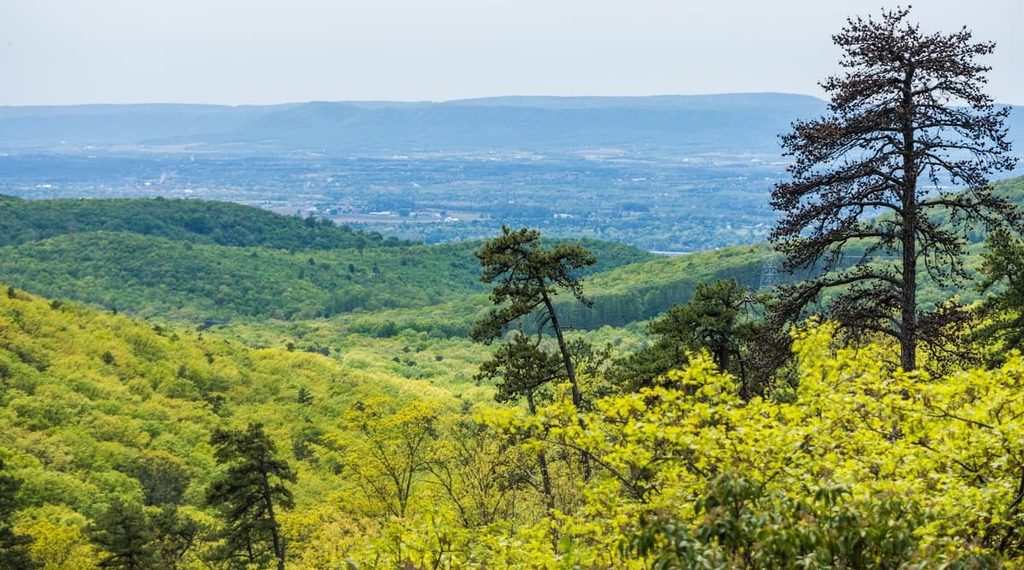
Walk through Michaux State Forest today, and you’ll find it hard to believe that this was once a denuded, eroded wasteland. The forest is now a thriving second-growth woodland, dominated by several species of oak along with hickory, maple, and other hardwoods characteristic of the Blue Ridge Mountains. The canopy is thick. The understory is lush. Streams run clear through valleys that were once choked with sediment.
The recovery hasn’t been uniform, though, and that’s part of what makes the forest so fascinating. Scattered throughout the woodland, you’ll come across large grassy meadows that seem strangely out of place among the dense trees. These are the old charcoal hearths — the spots where kilns burned for years, baking the soil so thoroughly that it has never fully recovered, even after more than a century. The trees simply cannot take root in these patches of scarred earth. They serve as quiet monuments to the industrial past, visual reminders of the price that was paid and the long, patient work of restoration that followed.
The forest spans parts of four counties — Adams, Cumberland, Franklin, and York — and encompasses three state parks within its boundaries: Caledonia State Park, Pine Grove Furnace State Park, and Mont Alto State Park. It also includes King’s Gap Environmental Education Center, a facility that has become a beloved resource for school groups, families, and anyone interested in learning about the ecology of the region.
Wildlife, Ecology, and the Quiet Drama of Regrowth
A forest that has been entirely clear-cut and allowed to regrow doesn’t look or behave quite the same as one that has stood undisturbed for centuries. Michaux is ecologically fascinating precisely because of its history. The dominant species here are oaks — red oak, white oak, chestnut oak — along with hickories, red maple, and tulip poplar, all characteristic of the Appalachian hardwood forests of the Blue Ridge. But the composition and age structure of the canopy reflect the fact that every tree here is, in geological terms, brand new. The oldest specimens date back only to the early twentieth century, when replanting efforts began in earnest.
This relatively uniform age structure has implications for wildlife. The forest supports healthy populations of white-tailed deer, black bear, wild turkey, and a host of smaller mammals and songbirds. Bear sightings are common enough that campers are reminded to store food appropriately, and turkey hunters have long considered Michaux prime territory. Raptors patrol the ridgelines, and the streams harbor native brook trout in their coldest, cleanest stretches.
The understory, meanwhile, is engaged in its own slow drama. Mountain laurel and rhododendron thicken along stream banks and shaded slopes. Ferns carpet the forest floor in spring and summer. And the work of the Bureau of Forestry — selective timber harvests, controlled burns, invasive species management — continues to shape the forest’s trajectory, nudging it toward the kind of structural diversity that supports the widest range of plant and animal life.
The forest holds dual certification from the Forest Stewardship Council and the Sustainable Forestry Initiative, ensuring that management practices meet the highest third-party standards for environmental stewardship. It is a working forest in the truest sense — producing timber, protecting watersheds, sheltering wildlife, and serving the public, all simultaneously.
On the Trail: Hiking Through History and Wilderness
The trail system in Michaux is extensive, well-maintained, and surprisingly varied for a forest that many Pennsylvanians have never heard of. The color-coded blaze system makes navigation straightforward: yellow and orange blazes mark hiking-only trails, red blazes indicate shared-use trails for hikers, bikers, and horseback riders, and blue blazes designate cross-country skiing trails or connector routes to the Appalachian Trail.
The Appalachian Trail itself cuts directly through Michaux State Forest, and several access points within the forest give hikers the chance to walk a stretch of this iconic 2,000-mile footpath without committing to a thru-hike. The symbolic halfway point of the AT is located nearby at Pine Grove Furnace State Park, a fact that draws a steady stream of thru-hikers every summer.
For those looking for something more contained, Pole Steeple is one of the most popular hikes in the forest. It’s a short but steep climb to a quartzite rock outcropping that offers sweeping views of the surrounding landscape, including Laurel Lake below. It’s the kind of hike that makes you feel like you’ve earned something, even though the round trip is less than two miles.
The Buck Ridge Trail offers a longer, more demanding experience, running six miles from Pine Grove Furnace to King’s Gap Environmental Education Center. The terrain is classic Pennsylvania — rocky, rooty, and occasionally punishing on the ankles, which is why AT thru-hikers have a saying about the state: “Where hiking boots go to die.” But the reward is a forest that feels genuinely untouched, with stretches of trail where the only sounds are birdsong and the crunch of leaves underfoot.
Sunset Rocks provides one of the best payoffs for the least amount of effort. A relatively easy climb of about 450 feet brings hikers to a rocky perch with outstanding westward views — spectacular during autumn, as the name suggests, but beautiful at any time of year.
For mountain bikers, Michaux is something of a legend. The Flat Rock Trail System alone encompasses over 38 miles of shared-use trails, and the forest is widely regarded as one of the premier mountain biking destinations in the Mid-Atlantic, with technical singletrack, steep climbs, and descents that test even experienced riders.
Beyond the Trails: Camping, Fishing, and Four-Season Recreation
Michaux State Forest offers free primitive camping with a permit from the district office — a rarity that budget-conscious outdoor enthusiasts should not overlook. The campsites are minimally developed by design. There are no electric hookups, no water spigots at most sites, and no dump stations. What you get instead is solitude, darkness, and the kind of quiet that has become genuinely hard to find in the eastern United States.
Fishing is another draw, particularly along Mountain Creek and in the waters around Pine Grove Furnace. Long Pine Run Reservoir, a 151-acre body of water that serves as the drinking water supply for the Borough of Chambersburg, offers scenic Beaver Trail hiking along its banks, though swimming and wading are prohibited to protect the water supply.
In winter, the forest transforms. Cross-country skiing trails, including the Smoke Zimmerman Ski Trails, crisscross the landscape, and snowmobile trails open when conditions allow. The ATV trail system, which covers roughly 35 miles, is popular during warmer months and offers a mix of easy and technical routes through some of the forest’s more remote terrain.
The 22-mile Michaux Auto Tour provides a self-guided driving experience through the forest’s back roads, passing historic sites, scenic overlooks, and quiet groves. It’s a particularly good option for visitors who want to absorb the forest at a slower pace or who have mobility limitations that make trail hiking difficult.
The Secret War: Camp Michaux and Its Hidden History
Buried within the forest’s boundaries lies one of the more unusual chapters in American military history. Camp Michaux served as a secret World War II prisoner-of-war interrogation facility, officially known as P.O. Box 651. The remote, heavily forested location made it ideal for the kind of clandestine intelligence work that required isolation and discretion. German prisoners — including submarine commanders, high-ranking officers, and scientists — were brought here for questioning, far from public view and far from the protections of the Geneva Conventions’ spirit, though technically within its letter.
Before the war, the site had served as a Civilian Conservation Corps camp during the Depression, and before that, it had been connected to the region’s long iron-making history. After the war, it briefly operated as a church camp before eventually being absorbed back into the state forest.
Today, the remnants of Camp Michaux are still visible — stone foundations, fragments of structures, and interpretive markers that tell the story of what happened in this unlikely corner of the Pennsylvania woods. Volunteers and historians have worked to preserve the site and make its story accessible to visitors. It’s a sobering addition to a visit, a place where the quietness of the surrounding woods takes on a different character when you consider the conversations that once took place here. It serves as a reminder that the history of Michaux extends well beyond iron furnaces and forestry schools — that these ridges and hollows have played roles in American life that few would ever guess.
Conservation in the Modern Era
The work of protecting and expanding Michaux State Forest didn’t end in the early twentieth century. In 2008, The Conservation Fund purchased a 2,500-acre parcel known as Tree Farm #1 from the Glatfelter Pulp Wood Company. This property, which borders Strawberry Hill Nature Preserve and lies within the viewshed of Gettysburg National Military Park, was transferred to the Pennsylvania DCNR in 2010 for incorporation into the state forest.
In 2015, a second acquisition added the 1,100-acre Eagle Rock property, bringing the total expansion to 3,600 acres. The funding for these acquisitions came from an impressive coalition of federal, state, and local sources, including the Land and Water Conservation Fund, the state’s Growing Greener program, the Richard King Mellon Foundation, and a bond initiative passed by Adams County residents with overwhelming public support.
These expansions didn’t just add acreage. They protected critical headwaters that supply drinking water to western Adams County, buffered the Appalachian Trail corridor from development, and maintained working-forest land that supports the local timber industry and more than a thousand jobs.
The forest now welcomes roughly 500,000 visitors annually and serves as the drinking water source for over 60,000 residents. A new visitor center and resource management office, planned for construction beginning as early as 2026, will serve as both a gateway to the forest and a teaching center for conservation history and natural resource stewardship.
Why Michaux Matters
There is a temptation, when writing about a state forest, to reduce it to a list of amenities — so many miles of trails, so many acres of timber, so many campgrounds and parking lots. Michaux State Forest resists that kind of treatment because it is, above all else, a story about resilience.
This is a landscape that was exploited to the point of ecological collapse, then painstakingly rebuilt over the course of a century by people who believed that public land was worth fighting for. The charcoal hearths that still dot the forest floor are not just curiosities. They are the scars that prove how bad things got, and the surrounding canopy of oaks and maples is living testimony to what can be achieved when a society commits to restoration rather than abandonment.
In an era when public lands face constant pressure from development, extraction, and budget cuts, Michaux stands as an argument for the long view. It took more than a hundred years for this forest to grow back. It will take continued vigilance and investment to ensure it remains healthy for the next hundred.
For the hiker, the mountain biker, the angler, the camper, the history enthusiast, the birder, or the person who simply needs to stand among tall trees and breathe, Michaux State Forest delivers. It is not the most famous forest in Pennsylvania. It is not the largest. But it may well be the most meaningful — a living monument to what happens when people decide that a ruined landscape deserves a second chance.
Planning Your Visit
Michaux State Forest is located in the South Mountain area of Adams, Cumberland, and Franklin counties in south-central Pennsylvania. The district office is at 10099 Lincoln Way East, Fayetteville, PA 17222, and can be reached at 717-352-2211. Camping permits, trail maps, and current conditions are available through the Pennsylvania Department of Conservation and Natural Resources. Cell phone service is limited throughout the forest, so plan accordingly, bring a paper map, and let someone know your itinerary before you head out.
The forest is open year-round, and each season offers a distinct experience — from the wildflowers of spring and the lush canopy of summer to the blazing foliage of autumn and the hushed, snow-covered stillness of winter. Whenever you go, you’ll be walking through more than just a forest. You’ll be walking through the story of how Pennsylvania learned to take care of its wild places.