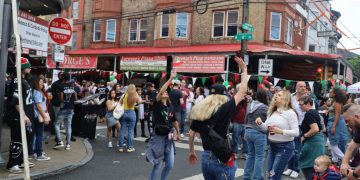




Every May, when the dogwoods bloom and the air finally shakes off winter’s last chill, South 9th Street in Philadelphia erupts into the oldest continuously operating outdoor market in America throwing itself the party it deserves. The Italian Market Festival (officially the 9th Street Italian Market Festival) is not a corporate-sponsored, ticketed, Instagram-perfect event. It is raw, loud, proud, chaotic, and utterly intoxicating. For two full days, the narrow spine of 9th Street from Fitzwater to Christian becomes a ribbon of red-white-and-green humanity: half a million people eating, drinking, dancing, arguing, singing, and proving once again that this is still the soul of Italian-American Philadelphia.

Roots That Run Deeper Than the Delaware
The market itself began in the 1880s when Genovese, Abruzzese, and Calabrese immigrants pushed wooden carts under awnings along 9th Street, hawking everything from live chickens to lemons shipped straight from Sicily. By the 1920s the curbside stands had evolved into permanent brick-and-tin storefronts: Di Bruno Bros. (1939), Talluto’s pasta (1967), Anastasia’s butcher shop, Esposito’s meats, Fante’s kitchenware, Claudio’s cheese, Sarcone’s bakery (1918), Isgro’s pastries (1904). The names have not changed much because the families never really left.
Rocky Balboa cemented the myth when he jogged past the stalls in 1976, hurling an orange into the air like a grenade of South Philly pride. But long before Stallone’s fictional boxer, the market fed real prizefighters, longshoremen, seamstresses, and priests. It survived Prohibition (bootleg chianti flowed in the cellars), the Great Depression (credit was given in notebooks still kept behind counters), urban renewal threats in the 1960s, and every wave of gentrification since. The festival, launched in 1974 as a modest block party, is now the annual reminder that this stretch of asphalt belongs to the people who never stopped showing up.
The Half-Mile Grease-Pole Climb: A Spectacle of Glorious Defeat
Saturday at 4 p.m. sharp, the crowd forms a human canyon around the 30-foot greased telephone pole at the corner of 9th and Washington. Prosciutto, salami, provolone, and thousand-dollar bills are lashed to the top. Four-person teams (usually cousins, coworkers, or guys who have been training in their backyards since January) charge the pole like it insulted their grandmothers. Most years, the pole wins. Spectators scream advice in South Philly Italian that would make a sailor blush. When a team finally reaches the summit (usually after two hours of slipping, cursing, and creative cheating), the street explodes. Grown men cry. Someone fires up “Sweet Caroline” on a Bluetooth speaker. The mayor hands over a ceremonial check. The meat is sliced on the spot and passed through the crowd like communion.
It is ridiculous. It is perfect. It is Philadelphia distilled into one greasy, glorious moment.
The Procession of the Saints: Faith, Fireworks, and Cannoli
Sunday morning belongs to the saints. At 10 a.m., the procession winds out of St. Paul’s Catholic Church on Christian Street, led by the St. Paul’s Boys’ Brigade Band in their crisp navy uniforms. Statues of the Virgin Mary, Saint Anthony, and Saint Rita (draped in $20 bills pinned by the faithful) are carried on the shoulders of men who have done this since they were altar boys. Women in black lace mantillas follow, murmuring decades of the rosary. The scent of incense mixes with roasted pork and funnel cake. Fireworks (yes, at 11 a.m.) crack overhead as the procession pauses at every butcher shop and bakery so the owners can pin more money to the statues. By the time the saints return to the church, Mary’s gown is a fluttering quilt of cash that will pay for the next year’s festival and the parish school tuition of kids whose grandparents once did the same.
The Food: An Argument You Can Eat
Forget the watered-down “Italian festival” fare you find in the suburbs. This is the real deal.
- Roast pork sandwiches from DiNic’s satellite stand: slow-roasted, juice-dripping, sharp provolone, bitter broccoli rabe, the roll soaked through in the best possible way.
- Tripe simmering in cauldrons outside Danny & Dee’s, served to old-timers who insist it tastes like Sunday dinner in 1958.
- Braciole skewers from Esposito’s, grilled over hardwood until the beef curls like a fist.
- Cannoli lines that snake around the block: Isgro vs. Termini is a debate older than most of the people in line. (Pro tip: buy one of each and refuse to choose.)
- Arancini the size of softballs from Paesano’s pop-up, stuffed with short-rib ragù.
- Porchetta trucks that park illegally and vanish the moment police look the other way.
- Limoncello slushies sold from coolers that definitely do not have permits.
And then there are the grandmothers. Every year, nonnas set up folding tables outside their rowhomes and sell homemade cavatelli, gnocchi, and sauce by the quart. Cash only. No labels. You hand over a twenty and walk away with a plastic container that will feed a family of six and ruin all future marinara forever.
The Music: From Sinatra to House to Whatever This Is
Three stages run nonstop. On Christian Street, the Verdi Band plays opera overtures while men in linen suits and pinky rings slow-dance with their wives. At the main stage on Washington Avenue, second-generation cover bands belt out Sinatra, Dean Martin, and Louis Prima until the sun drops, then seamlessly pivot to modern Italian house music that rattles the windows of 150-year-old rowhouses. Somewhere around 10 p.m., a DJ who looks barely old enough to drive drops a remix of “Tarantella” that sends thousands of people into a spinning, screaming, red-wine-fueled frenzy. The cops (mostly Irish and mostly from South Philly themselves) just smile and wave glow sticks.
The People: Where Philadelphia Comes to Remember Who It Is
You will see every layer of the city here. Abuelas from the Mexican community that now dominates the southern end of the market buying queso fresco next to Italian grandfathers arguing about the Eagles draft picks. Young couples pushing $1,200 strollers through crowds that smell like garlic and sweat. Temple students in designer sunglasses. Construction workers still wearing dusty Carhartts. Priests in Roman collars drinking beer out of red Solo cups. A 92-year-old veteran in a Korean War cap who has not missed a festival since 1975.
This is not a tourist trap. Tourists come, of course (drawn by TikTok videos and “best food festivals” lists), but they are politely absorbed into the chaos. The festival does not cater to them. It simply allows them to witness something authentic and, if they are lucky, become part of it for a day.
The Evolution: Gentrification, Immigration, and Survival
The market has changed. The Mexican taquerias now outnumber some of the old Italian butcher shops. Vietnamese pho restaurants sit next to 90-year-old cheese stores. Rents have tripled in a decade. Condos with rooftop decks loom over the same awnings that once shaded pushcarts. Yet the festival remains stubbornly, defiantly itself. The new immigrants (Oaxacans, Indonesians, Cambodians) set up stalls alongside the old guard. The grease pole still goes up. The saints still walk. The roast pork still drips.
This is the miracle of 9th Street: it absorbs everything and remains unmistakably South Philly. The festival is the annual proof.
The Hangover and the Promise
Sunday night ends with fireworks over the market’s rooftops, launched from a vacant lot that used to be a butcher shop. The crowds thin. The sanitation trucks arrive at dawn to sweep away a carpet of confetti, waxed paper, and broken plastic forks. By Monday morning, the stalls are open again at 7 a.m., quieter but still alive.
The Italian Market Festival is not the biggest festival in America. It does not have celebrity chefs or corporate sponsors or VIP sections. What it has is memory, muscle, and an unbreakable sense of place. It is the weekend when South 9th Street looks the city in the eye and says, “This is who we are. This is what we built. And we’re not done yet.”
See you next May. Bring cash, elastic-waist pants, and a willingness to get tomato sauce on your shoes. Everything else will take care of itself.