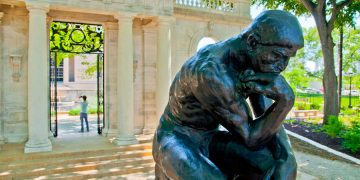




Amid the bustling avenues of Philadelphia’s Benjamin Franklin Parkway, where cultural icons cluster like jewels on a crown, the Rodin Museum stands as a serene testament to one sculptor’s unyielding quest to capture the human soul in bronze and marble. This intimate enclave, administered by the Philadelphia Museum of Art, houses one of the world’s premier collections of Auguste Rodin’s works outside Paris, inviting visitors to confront the raw emotions of love, despair, and contemplation frozen in time. In 2025, as the museum navigates a brief closure for essential maintenance from January 2 to February 15, 2026, it continues to draw admirers who seek solace in Rodin’s dramatic forms amid the city’s vibrant art scene.
Founded nearly a century ago through the vision of a single collector, the museum not only preserves Rodin’s legacy but also weaves it into Philadelphia’s narrative of artistic ambition. With over 140 sculptures, including iconic pieces like *The Thinker* and *The Gates of Hell*, the Rodin Museum offers a profound dialogue between past and present, where every curve and crease in the metal whispers stories of triumph and tragedy. As crowds return post-maintenance, the institution reaffirms its role as a quiet powerhouse in America’s museum landscape, blending French Romanticism with American philanthropy in a space that feels both timeless and urgently relevant.

A Vision Cast in Bronze: The Founding and History of the Rodin Museum
The Rodin Museum’s origins trace back to the early 20th century, when Philadelphia movie theater magnate Jules E. Mastbaum embarked on a passionate quest to assemble the world’s finest collection of Auguste Rodin’s sculptures. Mastbaum, enchanted by Rodin’s works during a 1923 visit to Paris, amassed over 200 pieces in just three years, including bronzes, marbles, plasters, drawings, and studies. His ambition extended beyond personal acquisition; he envisioned a dedicated museum in Philadelphia to share Rodin’s genius with the public. Tragically, Mastbaum passed away in 1926 before seeing his dream realized, but his widow, Etta Wedell Mastbaum, honored his wishes by donating the collection to the city. The museum opened its doors on November 29, 1929, just weeks after the stock market crash that ushered in the Great Depression—a poignant timing that underscored art’s role as a beacon during dark times.
Designed by French architect Paul Cret and landscape architect Jacques Gréber, the Beaux-Arts building drew inspiration from Rodin’s own Hôtel Biron in Paris, creating a harmonious environment for the sculptures. The museum’s affiliation with the Philadelphia Museum of Art, formalized in its administration, has ensured its preservation and expansion. Over the decades, it has weathered economic shifts and urban changes, including a major renovation in 2012 that restored its gardens and galleries to their original splendor. In 2017, the museum joined global institutions in commemorating the centenary of Rodin’s death, hosting exhibitions that highlighted his enduring influence on modern art.
By 2025, the Rodin Museum has become a cornerstone of Philadelphia’s Parkway Museums District, attracting over 60,000 visitors annually before the pandemic and rebounding strongly. Its history reflects broader themes in American cultural philanthropy: Mastbaum’s collection, valued at millions even in the 1920s, represents how private passion can yield public treasures. Recent developments include enhanced digital access, with virtual tours allowing global audiences to explore Rodin’s works amid ongoing conservation efforts. As the museum prepares for its 2026 reopening post-maintenance, it stands as a symbol of resilience, much like the city it calls home—Philadelphia, where revolutionary ideals first took root.
Auguste Rodin: The Sculptor Who Bent Bronze to Human Will
Auguste Rodin, born in Paris in 1840 to humble beginnings, revolutionized sculpture by infusing classical forms with raw emotional intensity, earning him the title of the father of modern sculpture. Orphaned young and struggling through failed art school admissions, Rodin honed his craft as a decorative artist before achieving breakthrough success with *The Age of Bronze* in 1877—a hyper-realistic nude that scandalized critics who accused him of casting from life. Undeterred, Rodin embraced controversy, drawing inspiration from Michelangelo and Dante to create works that pulsed with life, movement, and psychological depth.
His magnum opus, *The Gates of Hell*, commissioned in 1880 for a proposed museum that never materialized, became a lifelong project incorporating over 200 figures inspired by Dante’s *Inferno*. From this portal emerged independent masterpieces like *The Thinker* (originally *The Poet*, contemplating hell’s torments) and *The Kiss* (Paolo and Francesca’s doomed embrace). Rodin’s technique—modeling in clay with vigorous, impressionistic strokes before casting in bronze—captured fleeting expressions and dynamic poses, breaking from the smooth idealism of neoclassicism. By his death in 1917, Rodin had produced thousands of works, donated his studio to France, and influenced generations from Matisse to Moore.
In Philadelphia’s Rodin Museum, his significance shines through a collection that spans his career, offering insights into his iterative process. Drawings and plasters reveal how he reworked figures, emphasizing themes of human frailty, desire, and intellect. Rodin’s legacy endures in 2025, with scholars noting his proto-modernist approach—fragmented forms and expressive surfaces that prefigured abstraction. In an era of digital art, Rodin’s tactile bronzes remind us of sculpture’s power to evoke the visceral, making the museum a pilgrimage site for those seeking the artist’s unfiltered vision.
Architectural Elegance and Verdant Serenity: The Building and Gardens
The Rodin Museum’s architecture evokes the grandeur of a French chateau, a deliberate choice by Paul Cret to complement Rodin’s dramatic sculptures. Constructed from Indiana limestone with a copper roof now patinated green, the Beaux-Arts structure features a grand entrance portico flanked by columns and a reflecting pool that mirrors the facade’s symmetry. Inside, galleries radiate from a central octagonal room, their high ceilings and natural light creating intimate spaces for contemplation. Cret, a Philadelphia-based architect known for the Benjamin Franklin Bridge, collaborated with Gréber to integrate the building seamlessly with its landscape, drawing from classical French gardens.
The Meudon Gate, a replica of Rodin’s studio entrance in France, welcomes visitors to the grounds, where manicured lawns and flowerbeds frame outdoor sculptures. The Dorrance H. Hamilton Garden, restored in 2012, features paths lined with *The Thinker* overlooking the Parkway and *The Gates of Hell* set against ivy-covered walls. These gardens not only enhance the aesthetic but also provide a tranquil counterpoint to the urban bustle, hosting yoga sessions and outdoor events in warmer months.
In 2025, the museum’s architecture remains a draw, with conservation efforts ensuring its preservation amid climate challenges. The closure for maintenance underscores a commitment to structural integrity, addressing issues like water damage and lighting upgrades. Editorially, the building and gardens embody Rodin’s philosophy: art in harmony with nature, where stone and greenery converse in silent eloquence, inviting visitors to linger and reflect.
Masterpieces in Motion: Key Collections and Sculptures
The Rodin Museum’s collection, comprising nearly 150 objects, offers a comprehensive survey of Rodin’s oeuvre, from early studies to monumental casts. At the entrance, *The Thinker*—one of 28 authorized casts—perches pensively, its muscular form embodying intellectual torment. Originally conceived for *The Gates of Hell*, this 1904 bronze has become synonymous with philosophy, its furrowed brow and clenched fist capturing the weight of thought.
Dominating the facade, *The Gates of Hell* (cast 1926-1928) towers at 20 feet, a chaotic portal teeming with over 180 figures writhing in eternal agony. Inspired by Dante and Ghiberti’s *Gates of Paradise*, it features vignettes like Ugolino devouring his sons and the Three Shades pointing downward. Inside, highlights include *The Burghers of Calais* (1884-1895), depicting six French heroes surrendering to English forces, their expressions of defiance and despair rendered with unflinching realism. *The Kiss* (1882), a marble embrace of forbidden lovers, exudes sensuality, while *Balzac* (1898)—a controversial nude portrait of the writer—showcases Rodin’s bold abstraction.
Plasters and drawings reveal Rodin’s process: fragmented hands and torsos emphasize expression over completeness, prefiguring modernism. The collection’s diversity—bronzes, marbles, ceramics—spans Rodin’s career, from academic works like *The Man with the Broken Nose* (1864) to late erotic sketches. In 2025, these pieces continue to inspire, with audio guides providing context on Rodin’s techniques, such as his use of multiple casts to experiment with scale and composition.
Sculpting the Present: Current and Upcoming Exhibitions in 2025
In 2025, the Rodin Museum’s exhibition program delves deeper into the artist’s thematic obsessions, building on its permanent collection with focused displays. The ongoing *Rodin’s Hands* exhibition, which explores how Rodin used disembodied hands to convey narrative and emotion, remains a highlight through the year. Featuring over 20 works, including plaster studies and bronze casts, it illustrates Rodin’s fascination with hands as expressive instruments—clenched in anger, extended in supplication, or intertwined in tenderness. Guided tours, available on select days, unpack these pieces, drawing connections to broader art history.
Looking ahead, no major new exhibitions are announced for late 2025, but the museum’s affiliation with the Philadelphia Museum of Art suggests potential collaborations, such as loans for thematic shows on modernism. Past centenary events in 2017 set a precedent for innovative programming, like installations pairing Rodin with contemporary artists. The January 2026 closure will allow for gallery refreshes, potentially introducing updated interpretations upon reopening. Community feedback on social platforms praises these exhibitions for their accessibility, with one visitor noting how *Rodin’s Hands* humanizes the master’s genius.
Editorially, these shows position the museum as a dynamic space, not a static repository—bridging Rodin’s 19th-century innovations with 21st-century dialogues on body, identity, and expression.
Pathways to Discovery: Visitor Information and Practicalities
Planning a visit to the Rodin Museum in 2025 requires noting its schedule amid the upcoming closure. Open Wednesday through Monday from 10 a.m. to 5 p.m., the museum charges $15 for adults, with free admission for children under 12, students with ID, and members. Pay-what-you-wish policies on the first Sunday of the month and Friday evenings make it accessible. Located at 2151 Benjamin Franklin Parkway, it’s easily reached via SEPTA buses or the Parkway’s trolley loop.
Accessibility features include wheelchair ramps, elevators, and audio descriptions for select works. Guided tours, available daily, cater to various groups, while family programs engage younger visitors with hands-on activities. The museum shop offers replicas, books, and Rodin-inspired jewelry, and nearby cafes on the Parkway provide dining options.
In 2025, digital enhancements like the museum’s app offer virtual previews, ideal during closures. Reviews on platforms like Yelp and TripAdvisor average 4.5 stars, with visitors lauding the intimate scale—perfect for an hour’s immersion without overwhelming crowds. As one reviewer noted, the museum’s verdant setting provides a peaceful respite from urban hustle.
Engaging the Senses: Events, Programs, and Community Outreach
The Rodin Museum’s 2025 calendar brims with events that animate its collections, fostering connections between art and audience. Summer Fridays, from May to August, extend hours to 8:30 p.m. with cocktails, small plates, and live music in the gardens, transforming the space into a social hub. Exhibition tours, like those for *Rodin’s Hands*, occur weekly, delving into themes with expert guides.
Educational programs abound: workshops on sculpture techniques for adults, storytime sessions for children inspired by Rodin’s myths, and lectures on his influence. Partnerships with local schools bring students for hands-on learning, while virtual webinars reach global viewers. Community engagement shines through initiatives like free admission days and collaborations with Philadelphia’s diverse neighborhoods, reflecting Mastbaum’s public-spirited vision.
In 2025, no major new events are detailed, but the museum’s track record suggests pop-up installations or artist talks. Feedback from visitors emphasizes these programs’ inclusivity, making high art approachable. Editorially, such outreach ensures Rodin’s works aren’t isolated artifacts but living conversations, enriching Philadelphia’s cultural ecosystem.
Guardians of Genius: Conservation Efforts and Legacy
Conservation at the Rodin Museum safeguards Rodin’s fragile masterpieces against time and elements. In 2025, ongoing projects include bronze patina restoration and plaster stabilization, using advanced techniques like laser cleaning. The 2012 renovation set a benchmark, reinstalling sculptures with seismic protection and climate controls.
Affiliated with the Philadelphia Museum of Art, the museum benefits from shared expertise, including digitization for global access. Community involvement includes volunteer docents and donor-supported funds for acquisitions. Rodin’s legacy extends through these efforts, inspiring contemporary sculptors and ensuring his vision endures.
As Philadelphia evolves, the museum’s role in cultural preservation grows, a quiet force amid the city’s dynamism. Editorially, it’s a sanctuary where bronze defies decay, mirroring humanity’s own quest for permanence.
Eternal Echoes: The Rodin Museum’s Enduring Allure in Philadelphia
In 2025, the Rodin Museum remains Philadelphia’s hidden gem, where Auguste Rodin’s bronzes continue to provoke and inspire. Amid maintenance pauses and exhibition renewals, it stands as a bridge between eras, inviting reflection on human experience. In the City of Brotherly Love, this sanctuary of sculpture whispers that art’s true power lies in its ability to connect us across time, one contemplative gaze at a time.