



Philadelphia has never been shy about its food identity. The cheesesteak gets all the magazine covers, the roast pork gets the neighborhood loyalty, and the soft pretzel gets the nostalgia. But quietly, persistently, and with extraordinary depth of flavor, Ethiopian cuisine has carved out its own essential chapter in this city’s culinary story — and it’s one that more Philadelphians should be reading.
From West Philly’s Baltimore Avenue corridor to a tucked-away cafe in Rittenhouse Square, the Ethiopian restaurant scene in Philadelphia is thriving, rooted, and genuinely delicious. This isn’t a trendy import. Dahlak, one of the oldest Ethiopian spots on Baltimore Avenue, has served the West Philadelphia community since the 1980s — long before “communal dining” became a buzzword on food media timelines. These restaurants came from families, built communities, and stayed.
If you’ve never sat down at a table spread with injera and watched a platter of stews arrive like a color wheel of flavor, this guide is your invitation. If you have — well, you already know. Let’s talk about where to go, what to order, and why Ethiopian food belongs in your regular rotation.

What Is Ethiopian Food, Anyway?
Before we get to the restaurants, a quick primer — because Ethiopian food has its own architecture, its own rituals, and its own vocabulary, and knowing a few basics will make your first (or fifth) visit richer.
The foundation of nearly every Ethiopian meal is injera — a spongy, slightly sour flatbread made from teff flour, a grain native to the Ethiopian Highlands. Teff is naturally gluten-free, which makes injera a rare gift in a world of flatbreads: it’s the plate, the utensil, and the bread course all at once. You tear off pieces with your right hand and use them to scoop up the stews, sautés, and salads arranged on top of or alongside it.
Those stews are called wots (also spelled “wat”). They come in many forms: doro wot is a slow-braised chicken stew in a deep red berbere sauce, often served with a hard-boiled egg. Misir wot features red lentils cooked low and slow with onions, garlic, ginger, and berbere. Tibs refers to sautéed meat — usually beef or lamb — with onions, peppers, and tomatoes. Kitfo is Ethiopian steak tartare, finely minced beef blended with spiced clarified butter and mitmita, a chile-forward spice mix.
Berbere is the spice blend that threads through all of it — a complex mix of chili peppers, ginger, cinnamon, cardamom, fenugreek, and more. Every family, every restaurant, and every cook has their own ratio. It’s the fingerprint of an Ethiopian kitchen.
Meals in Ethiopian culture are traditionally eaten communally, from a shared platter, with your hands. The gesture of feeding someone else — tucking a pinch of injera and stew into their mouth — is called gursha, an expression of love and friendship. Eating Ethiopian food solo at the bar is perfectly valid (and many of Philly’s restaurants welcome it), but the full experience is meant to be shared.
Baltimore Avenue: The Heart of Ethiopian Philadelphia
If there is a spiritual center for Ethiopian food in Philadelphia, it runs along Baltimore Avenue in West Philadelphia. The stretch between 45th and 48th streets, in particular, holds more of the city’s Ethiopian dining heritage than anywhere else. This is where families built restaurants, where community gathered, and where the food got its roots in Philadelphia soil.
Dahlak — 4706-08 Baltimore Avenue, Philadelphia, PA 19143
Dahlak was opened in 1986 by Neghisti Ghebrehiwot and her sister Belinish, two Eritrean refugees who had settled in West Philadelphia after fleeing their home country. That origin story matters. This isn’t a restaurant built by investors studying food trends — it’s a restaurant built by people who needed to feed their community and share the flavors of home.
The majority of Ethiopian cuisine at Dahlak is comprised of stews, usually with an onion and tomato base, served on a bed of injera, a spongy flatbread. The kitchen developed its own signature take on berbere — a traditional Ethiopian spice blend of ginger, cinnamon, cayenne, and garlic — which influences all the food prepared there.
Dahlak feels like someone’s living room — one that just happens to have a bar in the corner. On any given Wednesday through Sunday night, the bar fills up, the music gets louder, and the platters of beef tibs and berbere stew arrive on beds of injera wide enough to cover the table. The restaurant hosts concerts, poetry readings, and a weekly karaoke night that ends when the last person finally lets go of the microphone — which is usually pretty late.
Order the tibs. Order the lentils. Stay for a beer. Dahlak has been doing this for nearly four decades, and it shows in every bite.
Doro Bet — 4533 Baltimore Avenue, Philadelphia, PA 19143
A few blocks down Baltimore Avenue sits Doro Bet, the third venture from the Ali Family Restaurants, opening in September 2022. If Dahlak is the patriarch of the neighborhood’s Ethiopian scene, Doro Bet is its younger, more restless sibling — equally committed to Ethiopian flavor but willing to take a few creative swings.
Doro Bet uses teff flour to make its fried chicken extra crispy, dipped in a choice of buttermilk batter, Awaze sauce for spice lovers, or Alicha for a milder flavor. The result is something that defies easy categorization: it’s Ethiopian and it’s American South, and it’s entirely its own thing. The teff crust cooks to a crackling golden shell, and the Awaze dipping sauce — a berbere-based condiment — brings the kind of heat that builds slowly and satisfyingly.
Doro Bet also serves pillowy mac and cheese, smothered wings, and traditional doro options — peppery stewed chicken that falls off the bone. It’s a quick-service spot, perfect for lunch or a casual weeknight dinner when you want something bold, filling, and unlike anything else on the block.
University City: Where Coffee Culture Meets Injera
The University City neighborhood — home to Penn, Drexel, and one of the densest concentrations of students and academics in any American city — has developed its own cluster of Ethiopian spots, many of which blur the lines between café, restaurant, and community hub. Studying for comps? Writing a dissertation? You could do worse than spending a few hours at Kaffa Crossing.
Kaffa Crossing — 4421 Chestnut Street, Philadelphia, PA 19104
Kaffa Crossing takes its name from the region in Ethiopia where, legend has it, coffee was first discovered by a goat herder named Kaldi around 850 A.D. The name is a clue to what this place values: the whole Ethiopian experience, not just the food. Coffee here is treated with reverence. The injera is treated the same way.
Owner Yonas Kebede and his cousins rehabbed a long-vacant storefront, salvaging the original tin ceiling and a hardwood floor hidden under layers of old linoleum. They installed free WiFi early on, which drew a laptop-toting student crowd from University City. It wasn’t long before the food followed — and when it did, it was serious.
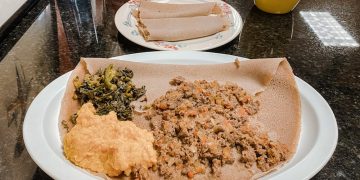
The kitfo at Kaffa Crossing is worth seeking out. The finely chopped beef, mounded over injera next to steamed collard greens, is glossed to a deep ruby hue by clarified butter infused with mitmita — a complex seasoning blend — with shades of ginger, cloves, cardamom, and chile spice. The mitmita comes from Addis Ababa, courtesy of the owner’s mother. That detail — spices mailed from family in Ethiopia — tells you everything about what kind of kitchen this is.
For something more approachable, the vegetarian combination platter is packed with stewed yellow split peas, spiced split lentils, tender collard greens, string beans, and carrots. Kaffa also serves breakfast — crushed fava beans with jalapeño-spiced eggs are a deeply satisfying way to start the morning, especially with a cup of their fair-trade Ethiopian coffee. The restaurant also stocks traditional spices, coffee, and other items for purchase.
Abyssinia — 229 S. 45th Street, Philadelphia, PA 19104
Abyssinia is consistently rated the best Ethiopian restaurant in Philadelphia. That’s a strong claim, but the regulars here — and there are many — would not argue with it.
Abyssinia is beloved for many reasons. College students and West Philadelphians flock here for affordable food, friendly service, and large portions that are perfect for sharing. The menu is organized around the great categories of Ethiopian cuisine — beef, lamb, chicken, vegetarian — and the quality across all of them is unfailingly high.
Vegan dishes at Abyssinia include mesir wot, kik alicha, shiro wot, and azifa fitfit. The vegetarian platter here is one of the best arguments for plant-based eating in the entire city — not because it’s a concession to dietary preferences, but because Ethiopian vegetarian cooking is genuinely one of the great cuisines of the world. The lentils are silky. The split peas are buttery. The collard greens carry a warmth that comes from long, patient cooking.
For the full experience, go for the combination platter and let the kitchen decide the spread. Abyssinia has been a favorite of locals for twenty years, with customers returning again and again for the mesir wot and shiro wot, describing the food as perfect every time.
Center City: Ethiopian Goes Downtown
It would be easy to assume that Ethiopian food belongs exclusively to West Philly — and historically, that’s where most of it lived. But the neighborhood has expanded, and so has the cuisine’s footprint across the city.
Almaz Cafe — 140 S. 20th Street, Philadelphia, PA 19103
Almaz Cafe in Rittenhouse Square is the kind of place where you can sit on the sidewalk on a nice day, sip Ethiopian coffee, and people-watch as the afternoon passes by. It lives between two identities — part coffee shop, part Ethiopian restaurant — and it handles both with more grace than you’d expect from a spot tucked onto a South 20th Street block near Walnut.
Almost everything on the menu is under $20 and available for takeout, including a creamy split pea soup, soft injera, and tender cubes of berbere-covered beef — good enough to take for a solo lunch in the park. On the full menu, the doro wot is slow-braised and deeply spiced, the kind of chicken dish that makes you wonder why you ever order anything else.
The upstairs balcony at Almaz offers an intimate view over the bilevel space, where Ethiopian music plays and a map of the country hangs on the wall. For Center City diners who’ve never ventured to West Philly for Ethiopian food, Almaz is the closest thing to a gateway drug the cuisine has in this zip code.
ERA Bar & Ethiopian Restaurant — 2743 Poplar Street, Philadelphia, PA 19130
ERA at 2743 Poplar Street in Fairmount operates as a bar from 4pm to 2am and a restaurant from 4pm to 11pm on weekdays. The combination might sound like a compromise, but it works in ways that feel very Philly: there’s a u-shaped bar, regulars drinking cheap beer, and then, arriving from the kitchen, food that stops the conversation cold.
The peppery steak, curried cabbage, and stewed lentils at ERA are unforgettable — and the menu is big enough for three or more, divided into beef, vegetarian, lamb, chicken, and combinations. ERA is the kind of neighborhood Ethiopian spot that turns first-timers into converts, partly because the expectations are low and the food overdelivers consistently.
Regulars praise the yebeg tibs, the beef dishes, and the vegetarian platters in equal measure. Extra injera is offered at no charge, which tells you something about the kitchen’s generosity.
The Ali Family Restaurants: A Mini-Empire Worth Knowing
Running parallel to the legacy restaurants on Baltimore Avenue is a newer operation that deserves its own paragraph. The Ali Family Restaurants operate three Ethiopian and Ethiopian-fusion spots in West Philadelphia and Germantown: Alif Brew & Mini Mart, Salam Cafe, and Doro Bet.
Alif Brew & Mini Mart opened in 2020 and offers classic Ethiopian flavors with gluten-free injera platters, injera wraps stuffed with protein and vegetables, freshly fried sambusas, and a mini-market stocked with imported goods. The rest of Alif’s menu outside two meat options is completely vegan.
Salam Cafe expanded the family’s reach in 2021, adding Middle Eastern dishes like lamb chops, chicken kebab, and salmon alongside the Ethiopian classics. Salam Cafe in Germantown has warm and friendly service, and the spicy stewed chicken is a standout — along with a dangerously addictive loose leaf tea. It functions as part restaurant, part market, part coffee shop, which makes it one of the more versatile stops on the city’s Ethiopian circuit.
Doro Bet, as described above, rounds out the trio with its teff-battered fried chicken and fusion-forward menu.
Buna Cafe: Where Brunch Earns Its Name
Buna Cafe (look for their West Philadelphia location on Baltimore Avenue) occupies a special place in the city’s Ethiopian landscape because it has figured out Ethiopian brunch in a way that no one else has quite cracked.
Where Buna really shines is at Saturday and Sunday brunch — which offers a larger menu than the regular one. The BYOB goes all out with Ethiopian coffee made in a jabena, traditional stovetop popcorn, and dishes like peppery, smoky injera-spiced scrambled eggs, vegetable combo, and crispy whole fish over rice. The injera scrambled eggs alone are worth making a weekend reservation for — tangy, charred at the edges, deeply savory, they are the best argument anyone has made recently for expanding what brunch can be.
Buna’s doro wot is tomato-heavy and their sambusas are flaky — worth a visit any day of the week, but the brunch menu is where the cafe truly distinguishes itself.
Why Ethiopian Food and Philadelphia Are a Natural Match
There is something about Philadelphia’s character — its directness, its lack of pretension, its deep loyalty to neighborhood institutions — that aligns naturally with Ethiopian dining culture. The food is not fussy. It doesn’t need candlelight and a sommelier. It needs good company, a shared platter, and enough injera to get through the stews.
Many of West Philadelphia’s Ethiopian restaurants have been around for decades, and many of them constitute essential community gathering places. That longevity is not accidental. These restaurants are embedded in the fabric of their neighborhoods in the way that the best Philadelphia institutions always are — the cheesesteak counter, the corner bar, the Italian bakery. They have regulars who’ve been coming for twenty years and newcomers who are discovering them for the first time. Both are welcome.
The vegetarian depth of Ethiopian cuisine also deserves more credit than it typically gets. Ethiopian cooking offers an enormous range of vegan options: lentil dishes, split pea stews, spiced chickpeas, braised greens, and more — all built around the same complex spice traditions as the meat dishes. For a city with a growing population of plant-based eaters, this is a cuisine that delivers without compromise. You’re not getting a sad substitution. You’re getting dishes that were designed this way, born from the Ethiopian Orthodox Christian tradition of fasting — where meat is prohibited on certain days — and refined over centuries.
Your Ethiopian Food Glossary: What to Order and What to Know
Walking into an Ethiopian restaurant for the first time can feel like arriving at a party where everyone else seems to know each other. A few terms to get you oriented:
Injera — the spongy teff flatbread that serves as both plate and utensil. Naturally gluten-free and slightly sour.
Wot / Wat — a stew, the building block of the meal. Can be meat-based (doro wot, yebeg wot) or vegetarian (misir wot, kik alicha, shiro wot).
Tibs — sautéed meat, usually beef or lamb, with onions and peppers. Awaze tibs adds the berbere-based hot sauce. One of the most reliable dishes to order at any restaurant.
Kitfo — minced beef with spiced clarified butter (niter kibbeh) and mitmita. Can be served raw (raw is the traditional way), leb leb (slightly cooked), or fully cooked. At places like Kaffa Crossing, the raw version is revelatory.
Shiro wot — a silky, thick stew made from chickpea or bean flour, deeply savory and underrated by newcomers.
Sambusa — an Ethiopian-style pastry, similar to a samosa, stuffed with spiced lentils and green chilies.
Combination platter — the best way to start. You’ll get a spread of multiple wots and sides arranged on injera. Most restaurants offer meat combos and vegetarian combos, and many offer a mix.
Ethiopian coffee ceremony — the traditional three-round coffee service (abol, tona, baraka) served with incense and popcorn. Not available at every restaurant but worth seeking out when it is.
Bottom Line
Philadelphia’s Ethiopian food scene is not a niche. It’s not a hidden gem that only food obsessives have found. It’s a full, living, decades-deep culinary tradition running through the neighborhoods of this city, and it deserves the same kind of attention that Philadelphia gives to its Italian markets and its Vietnamese sandwich shops.
Whether you want to hand-feed your date some spiced red lentils, sit near mesob baskets while working through a plate of stewed chicken solo, or are looking for an affordable group dinner — Ethiopian food in Philadelphia delivers, every time.
Start at Abyssinia for the classics. Go to Kaffa Crossing for coffee and kitfo. Hit Dahlak on a Friday night when the karaoke is running and the bar is full. Try Doro Bet’s teff fried chicken on a Tuesday afternoon. Let Almaz Cafe convert you over lunch in Rittenhouse. And when the weekend comes, bring a bottle of wine to Buna for the brunch that might quietly rearrange your food priorities.
Philadelphia has always been a city that rewards the curious eater. On Baltimore Avenue, on Chestnut Street, on Poplar Street — the platters are waiting.
Quick Reference: Ethiopian Restaurants in Philadelphia
- Abyssinia — 229 S. 45th St., Philadelphia, PA 19104
- Dahlak — 4706-08 Baltimore Ave., Philadelphia, PA 19143
- Doro Bet — 4533 Baltimore Ave., Philadelphia, PA 19143
- Kaffa Crossing — 4421 Chestnut St., Philadelphia, PA 19104
- Almaz Cafe — 140 S. 20th St., Philadelphia, PA 19103
- ERA Bar & Ethiopian Restaurant — 2743 Poplar St., Philadelphia, PA 19130
- Buna Cafe — Baltimore Ave., West Philadelphia
- Salam Cafe — Germantown neighborhood