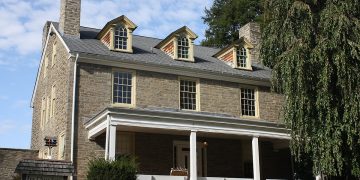




There is something quietly defiant about Fox Chase Farm. Surrounded by the sprawling suburban grid of Northeast Philadelphia, tucked behind a stretch of Pine Road in the city’s far northeastern corner, this 113-acre working farm has refused, decade after decade, to become a strip mall or a subdivision. It grows vegetables. It keeps horses. It runs school tours. It teaches children how food actually comes from dirt, and how much patience that requires. And it does all of this within the boundaries of Philadelphia — a city most people associate with cheesesteaks, row houses, and championship parades, not hayrides and heritage breeds.
That tension — urban grit meeting agricultural roots — is exactly what makes Fox Chase Farm one of the most singular places in the entire Delaware Valley.

The Land Has Memory
To understand Fox Chase Farm today, you have to understand what Northeast Philadelphia once was. Before the postwar housing boom swallowed up farmland from Frankford to Bucks County, this part of the city was genuinely rural. Farms defined the landscape. The Fox Chase neighborhood itself — named for the English fox hunting tradition that wealthy Quaker families brought to the region in the 18th century — was agricultural territory well into the 20th century.
The land that now comprises Fox Chase Farm has been in continuous agricultural use for over three centuries. It passed through various private hands before the City of Philadelphia acquired it in 1953, integrating it into the broader Fairmount Park system. At a time when cities across America were razing green space to build highways and parking lots, Philadelphia made the unusual decision to keep this farm as a farm. That decision, initially considered a practical measure for maintaining open space, grew into something much more significant over time.
Today, Fox Chase Farm operates under the management of the Fairmount Park Conservancy in partnership with the City of Philadelphia’s Parks & Recreation Department. It is one of the last working farms within the city limits of any major American city, and that alone makes it extraordinary.
What a Working Farm Actually Looks Like in 2024
Visitors who arrive expecting a theme park version of rural life are quickly corrected. Fox Chase Farm is the real thing. It operates year-round, producing vegetables and maintaining livestock regardless of the calendar, the weather, or the tourist season. The farm’s fields rotate through crops seasonally — corn, pumpkins, sunflowers, herbs, leafy greens — and the soil management follows genuine agricultural practice, not decorative gardening.
The livestock component is equally authentic. The farm has long maintained horses, and equestrian programming has been a cornerstone of the operation for decades. The Fox Chase Farm Equestrian Center offers lessons and boarding, connecting urban and suburban riders to a facility that carries genuine horsemanship tradition rather than the kind of sterile, arena-only experience common to newer riding schools. There is a working quality to the barns and paddocks here that feels earned rather than constructed.
Chickens, pigs, and other farm animals have come and gone from the roster over the years depending on programming needs, but the essential character — a farm that actually farms — has remained constant. This is not a petting zoo dressed up with hay bales for Instagram. The animals here are part of a working agricultural system.
The Education Mission: Where the Farm Does Its Most Important Work
Perhaps no function of Fox Chase Farm carries more civic weight than its educational programming. For decades, the farm has served as the primary — and for many students, the only — direct encounter with working agricultural land in their entire school experience.
The numbers are significant. Thousands of Philadelphia schoolchildren visit Fox Chase Farm each year through organized field trips. For many of these children, particularly those from densely urban neighborhoods in North Philadelphia, West Philadelphia, and South Philadelphia, the farm represents something they have read about in books but never experienced directly: soil you can smell, crops you can touch, animals that are not household pets.
The farm’s educational programs are deliberately structured to do more than entertain. Curriculum-connected lessons walk students through the fundamentals of plant biology, sustainable agriculture, composting, and food systems. Children learn where vegetables come from not as an abstract fact but as a tangible, observable process. Seeds go into soil. Water and sunlight do their work. Weeks later, something edible emerges. That sequence, which most adults take on faith without ever witnessing directly, becomes vivid and real at Fox Chase Farm.
The farm also hosts summer programs and camps that extend the educational engagement beyond a single afternoon. These programs give young Philadelphians extended time with agricultural concepts, teaching skills from basic gardening to animal care in a structured environment that manages to feel more like discovery than school.
Educators and child development researchers have documented what farmers have always known intuitively: children who engage with working land develop stronger connections to food systems, greater comfort with natural processes, and a more grounded sense of where resources come from. Fox Chase Farm quietly delivers this education to Philadelphia’s youth at a scale and consistency that deserves far more attention than it receives.
Community Events and the Farm as Public Space
Beyond education, Fox Chase Farm has functioned for decades as a genuine community gathering space for Northeast Philadelphia. Its seasonal events have become neighborhood traditions — the kind of annual rituals that families build memories around and return to year after year.
The Fall Festival is the signature event in the farm’s calendar, typically drawing thousands of visitors over its run. Pumpkin picking, hayrides, corn mazes, live demonstrations of traditional farm skills, local vendors selling seasonal produce — it is a celebration of autumn that would feel at home in rural Lancaster County but happens here, in Philadelphia, accessible by city bus. For families who cannot easily escape to the countryside for fall foliage experiences, the Fox Chase Fall Festival is the countryside.
Spring and summer bring their own programming rhythms. Plant sales, agricultural demonstrations, community garden days, and special events tied to the academic calendar keep the farm engaged with the surrounding neighborhood across all four seasons. The farm’s grounds — open fields, tree lines, paddocks, a working creek corridor — also serve as informal recreation space for local residents who use them for walking, nature observation, and the simple pleasure of being somewhere that is not paved.
This dual identity — working farm and public park — requires careful management but has proven durable. The farm’s relationship with the surrounding Northeast Philadelphia community is one of genuine mutual investment. Neighbors advocate for it when its budget comes under pressure. Local families volunteer during events. Former students who visited on field trips bring their own children years later. The farm accumulates loyalty the way it accumulates compost: slowly, organically, and with lasting value.
The Funding Fights and Political Survival
Honesty requires acknowledging something that the farm’s cheerful seasonal events can obscure: Fox Chase Farm has spent much of its existence fighting for resources. As a city-operated agricultural facility, it occupies an unusual budget category — neither a standard park nor a recreation center, but something that requires specialized expertise and ongoing agricultural investment to maintain.
Over the years, budget cycles have occasionally targeted the farm for reduced funding or operational changes that threatened its core agricultural mission. Each time, the response from the community has been pointed and effective. Neighbors, educators, equestrians, former students, and environmental advocates have consistently shown up to defend the farm as an essential city resource. These advocacy battles have been instructive, revealing just how deeply the farm is embedded in the identity of Northeast Philadelphia.
The Fairmount Park Conservancy has been an important stabilizing partner in recent years, bringing fundraising capacity and organizational infrastructure to support the farm’s operations beyond what city budget allocations alone could sustain. Grants, individual donations, and earned revenue from equestrian programs and events contribute to a funding model that reduces the farm’s dependence on the volatile city budget process.
Still, the financial reality of maintaining a working farm within a major American city is genuinely difficult. The costs of agricultural equipment, animal care, soil management, infrastructure maintenance, and educational staffing are substantial. The farm remains, in this sense, an ongoing act of civic will — kept alive by the consistent argument that what it provides cannot be replicated cheaply or easily, and would be irreplaceable if lost.
Fox Chase in the Broader Context of Urban Agriculture
Philadelphia has seen a significant expansion of urban agriculture in recent decades, with community gardens, rooftop farms, and neighborhood growing spaces proliferating across the city. Fox Chase Farm both predates and differs from this movement in important ways.
Where urban agriculture initiatives are typically grassroots, small-scale, and community-organized, Fox Chase Farm is institutionally grounded, larger in scale, and historically continuous. It is not a reclaimed vacant lot or a converted rooftop — it is a functioning agricultural landscape that has remained agricultural without interruption across centuries of development pressure. That continuity is part of what gives it authority and what makes it irreplaceable.
At the same time, Fox Chase Farm shares the spirit of the broader urban agriculture movement: the conviction that food systems should be visible and legible to the people who depend on them, that land has social value beyond its market price, and that cities benefit from keeping some portion of their territory in productive relationship with natural cycles.
Philadelphia’s broader Fairmount Park system, one of the largest urban park systems in the world, provides the institutional framework that has protected Fox Chase Farm. The park system’s scale means that Fox Chase Farm is not an isolated anomaly but part of a larger civic philosophy about the relationship between the city and its natural landscape. This context has been protective — parks are politically defensible in ways that individual parcels are not.
The Landscape Itself: What You See When You Get There
Visitors approaching Fox Chase Farm along Pine Road encounter something that takes a moment to register as real. The tree lines, the open fields, the pastoral quality of the view — it reads, for a disorienting second, like a rural scene that should not be here. The surrounding neighborhood asserts itself in the background — rooftops visible over the tree line, the ambient sound of the city always present — but the farm holds its ground visually.
The fields in season are genuinely beautiful. Rows of corn in August, sunflower fields in late summer, the particular gold and orange palette of pumpkin patches in October — these scenes photograph well but photograph without capturing the full sensory experience. The smell of working soil and livestock, the sound of horses in paddocks, the tactile reality of walking a gravel path through planted fields: these are irreducible, and they are what education through screens cannot replicate.
The farm’s built environment includes historic barns and agricultural structures that carry genuine age and character. These buildings are not museum pieces frozen in preservation amber — they are working structures that show the wear and pragmatic modification of buildings that have been used continuously. A barn that has housed horses for a century looks different from one built last year to look like it has, and the difference matters in ways that are difficult to articulate but immediately felt.
The creek corridor along the farm’s eastern edge adds ecological value beyond the agricultural programming. This riparian zone supports native plant communities and wildlife habitat, connecting the farm to Philadelphia’s broader green infrastructure network. Walking it feels removed from the city in a way that the farmed fields, with their open sightlines, do not quite achieve.
Why Fox Chase Farm Matters Now More Than Ever
There is a version of the argument for Fox Chase Farm that rests entirely on nostalgia — the appeal of a vanishing rural way of life, the sentiment for agricultural traditions that most Americans have not directly participated in for generations. That argument, while not wrong, undersells the farm’s contemporary relevance.
Philadelphia’s food security landscape makes Fox Chase Farm’s existence more pointed than nostalgic. The city has significant food desert geography, with large portions of North and West Philadelphia lacking reliable access to fresh produce. An urban farm that produces vegetables, educates students about food systems, and models sustainable agricultural practice within city limits addresses real contemporary needs, not just sentimental ones.
The climate argument is similarly direct. Urban heat islands, stormwater management challenges, soil carbon sequestration, biodiversity corridors — Fox Chase Farm contributes meaningfully to each of these concerns simply by remaining what it is. Open agricultural land performs ecological services that paved surfaces do not. In a city facing increasingly significant climate adaptation challenges, the farm’s continued existence represents infrastructure in the fullest sense.
And then there is the argument from simple scarcity. Working farms within major American cities are vanishingly rare. The combination of institutional continuity, scale, agricultural authenticity, educational programming, equestrian tradition, and community integration that Fox Chase Farm represents cannot be rebuilt once lost. The assets are too layered, the relationships too long-cultivated, the land too irreplaceable. This is one of those civic resources whose value becomes obvious only in its absence, and that lesson tends to arrive too late.
Getting There and Getting Involved
Fox Chase Farm sits at 8500 Pine Road in Philadelphia’s Fox Chase neighborhood, accessible by SEPTA bus and a manageable drive from most parts of the city and inner suburbs. The grounds are open to visitors, and seasonal events are publicized through the Fairmount Park Conservancy and the city’s Parks & Recreation channels.
The equestrian center accepts inquiries for lessons and boarding from riders at all experience levels. Educational field trips can be arranged through the farm’s education programs, and teachers working with Title I schools should ask specifically about subsidized programming options. Volunteer opportunities exist throughout the year, with the fall harvest season offering the most accessible entry points for first-time volunteers.
Donating to the Fairmount Park Conservancy specifically in support of Fox Chase Farm is one of the most direct ways that Philadelphians who value the farm can support its long-term stability. The farm does not have the visibility of the Philadelphia Museum of Art or the constituent base of a major sports team, and it competes for philanthropic attention in a crowded field. Directed donations help.
A Farm Worth Fighting For
Fox Chase Farm is not the most famous place in Philadelphia. It does not appear in most tourist itineraries, does not generate the kind of cultural coverage that Center City institutions command, and does not have a professional marketing operation working to raise its profile. What it has instead is a three-century track record of doing exactly what a farm is supposed to do, in a city that has somehow kept the room for it to continue.
That is the story worth telling: not that Fox Chase Farm is a charming anomaly, but that it is an essential piece of civic infrastructure — educational, ecological, agricultural, and community — that Philadelphia has chosen, again and again, to protect. The choice is not inevitable, and it is never final. It requires ongoing advocacy, public investment, and the collective insistence that some things are worth more than the development value of the land beneath them.
Fox Chase Farm has earned that insistence. It continues to earn it every season.