



There are institutions that exist to educate, and then there are institutions that exist to fundamentally change the way a civilization thinks about health, science, and the care of human beings. The University of the Sciences in Philadelphia — known affectionately as USciences — belonged squarely in the second category.
With a rich scientific history spanning nearly 200 years, USciences helped build impactful careers and foster important medical breakthroughs, preparing students to be leaders and practitioners in the healthcare and science fields since its founding in 1821 as Philadelphia College of Pharmacy — the first college of pharmacy in North America. That is not a marketing tagline. That is a verifiable, documented fact that carries enormous weight. Before USciences existed, there was no formal system in the United States for training the people who made, dispensed, and understood the drugs that kept Americans alive.
This is the story of that institution — where it came from, what it built, why it mattered, and what it became.

The 68 Apothecaries Who Started Everything
Every great institution has an origin story. USciences has one of the most remarkable in American academic history.
University of the Sciences traced its history to February 1821, when 68 apothecaries met in Philadelphia’s Carpenters’ Hall to establish improved scientific standards and to develop programs to train more competent apprentices and students. They formalized their new association through a constitution, which declared their intent to establish a school of pharmacy to enhance their vocation and to “guard the drug market from the introduction of spurious, adulterated, deteriorated or otherwise mischievous articles.”
Read that again. These were working pharmacists — men who sold medicines from storefronts, who compounded remedies by hand, who understood that the absence of standards was killing people. They were not academics sitting in comfortable chairs debating theory. They were practitioners who recognized a crisis and responded to it with the most powerful tool available: education.
Classes began almost immediately after that meeting. In 1825, Philadelphia College of Pharmacy began publishing the first academic journal in the United States dedicated to pharmacy. Within four years of its founding, this institution was already producing original research and sharing it with the world. That is a tempo that most modern universities would struggle to match.
The founding mission was simple but radical: raise the bar. Ensure that the people dispensing drugs to sick Americans actually knew what they were doing. Protect the public from fraudulent, contaminated, or dangerous medicines. It was, in the language of today, a public health initiative disguised as a school of pharmacy.
Two Centuries of Firsts — A Legacy Defined by Innovation
One of the clearest ways to measure the significance of any academic institution is to count its firsts — the things it did before anyone else thought to do them. By that measure, USciences had few peers.
In 1885, PCP professor Joseph P. Remington published The Practice of Pharmacy, which soon became established as the standard text in the field. Later renamed Remington: The Science and Practice of Pharmacy, this comprehensive reference work remains widely used throughout the world. Few academic textbooks in any discipline have achieved that kind of staying power. Remington’s work was still being published in updated editions nearly 140 years after it first appeared — a testament to the intellectual depth that USciences consistently produced.
In 1883, Dr. Susan Hayhurst was conferred a degree in pharmacy, thus becoming the college’s first female graduate, and the first woman in the United States to be granted a degree in pharmacy. This happened at a time when women’s access to professional education was severely restricted across the country. USciences opened its doors to women in pharmacy when most institutions were still debating whether women belonged in professional programs at all. Dr. Hayhurst went on to become the director of the pharmaceutical department of the Women’s Hospital of Philadelphia — a career made possible by an institution that chose inclusion over convention.
The United States Pharmacopeia (USP) — the foundational document that established standards for manufacturing drugs across America — was first created in 1820, and at the 1830 convention, the Philadelphia College of Pharmacy presented a complete revised copy of the Pharmacopeia, demonstrating its central role in shaping American pharmaceutical standards from the very beginning.
This pattern repeated itself for two centuries. USciences was not a follower. It was a setter of standards, a builder of frameworks, a training ground for the people who would go on to define what American healthcare looked like.
The Campus That Grew Up With Philadelphia
There is something fitting about the fact that USciences sat in University City — the dense, electric, intellectually charged neighborhood in West Philadelphia that also houses the University of Pennsylvania and Drexel University. This was not a pastoral campus tucked away from the world. It was embedded in a city, surrounded by the energy and complexity of urban life, and shaped by that proximity.
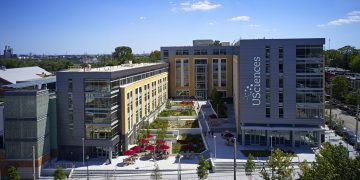
The USciences campus covered approximately 24 acres of urban landscape in the section of West Philadelphia known as University City. It is bordered on one side by Clark Park and on another by The Woodlands, a historic cemetery that now serves as a large urban park with walking and bicycle trails. The campus comprised 23 buildings, including academic halls, laboratories, mixed-use and dedicated residence halls, as well as open spaces and athletic venues.
The physical campus reflected the institution’s identity: serious, purposeful, and deeply connected to its surroundings. The same year it achieved university status, USP doubled the size of its campus when it acquired an adjacent vacant industrial site — the home of the original Breyers Ice Cream factory. The additional space allowed the university to add a 1,000-seat event gymnasium, recreation gymnasium, natatorium, fitness areas, and a new three-story academic building, the McNeil Science and Technology Center.
The McNeil Center — named after alumnus Robert L. McNeil Jr., former chairman and CEO of McNeil Laboratories, now part of Johnson & Johnson — became the heart of the university’s scientific instruction, housing biological sciences, mathematics, physics, and computer science programs.
Among USciences’ newest buildings was the Living & Learning Commons, a mixed-use residence hall that set the standard for dynamic living and learning communities for science and health professional students. The 436-bed residence hall offered private bathrooms and included classroom, retail, office, and student study space. The integration of living and learning space was intentional — a recognition that the development of scientists and healthcare professionals doesn’t stop when students leave the lecture hall. It continues in the hallway conversations, the late-night study sessions, the informal debates over dinner.
What USciences Actually Taught — And Why It Mattered
The programs at USciences were not chosen randomly. Every degree, every concentration, every certificate reflected a deliberate philosophy: train the people that healthcare systems actually need.
The university had three colleges: Misher College of Arts & Sciences, Philadelphia College of Pharmacy, and Samson College of Health Sciences. It offered 19 Bachelor of Science degree programs, 15 master’s degree programs, 8 certificate programs, and 11 doctoral programs in several areas of study. The Philadelphia College of Pharmacy offered courses in pharmaceutical sciences, pharmaceutical and healthcare business, and pharmacy practice and administration. Samson College of Health Sciences focused on kinesiology, occupational therapy, physical therapy, and physician assistant studies.
USciences offered a professional curriculum with hands-on education and real-world learning experiences, preparing students for immediate success. The university ranked number one in Pennsylvania, New Jersey, and Delaware, and in the top ten in the United States for return on investment 40 years after enrollment among private schools. That last statistic deserves attention. Return on investment measured four decades after enrollment is a proxy for career durability — for whether an education set students up for lasting professional success, not just a first job. USciences students, by that measure, were among the most well-prepared graduates in the entire country.
The university offered a specialized MBA program which was one of the few in the country exclusively for pharmaceutical and healthcare business, and it offered the first MBA in the country with a medical cannabis business management option. This was the kind of curriculum responsiveness that set USciences apart — a willingness to look at where the healthcare industry was actually going and build programs to meet it there, rather than waiting for other institutions to take the lead.
USciences undergraduate students had access to research as early as their first year, with state-of-the-art equipment in over 100 labs, and quality internship opportunities in a close-knit learning environment. Access to research from the first year is not something most universities can offer. It reflects a particular commitment to treating students not as passive recipients of knowledge but as active participants in the production of it.
The Broader Vision — Healthcare Education as Public Service
To understand USciences fully, you have to understand what kind of institution it was trying to be. This was not a research powerhouse in the mold of Johns Hopkins or Stanford. It was something different — a deeply specialized, tightly focused institution whose entire identity was organized around a single question: how do we produce the healthcare professionals that society needs?
Throughout its history, the university was and continued to be an incubator for a thriving alumni network who shared a passion for exploration and discovery in pharmacy, science, and healthcare, as well as for governmental, business, and administrative professions. The results of a USciences education showed up in pharmaceutical companies, hospitals, government health agencies, biotech startups, and clinical practices across the country and around the world.
USciences prepared students for in-demand health professions that ranked among the best jobs in the United States, including dentist, physician, physical therapist, physician assistant, veterinarian, and occupational therapist. In an era of increasing uncertainty about the value of a university degree, USciences offered something concrete: a direct pipeline from classroom to career in fields with documented, persistent demand.
The library — the J.W. England Library — housed a specialized collection including rare books in fields of pharmacy, drug compendia, toxicology, and occupational therapy. That collection represented two centuries of accumulated pharmaceutical knowledge, much of it produced or curated by USciences faculty and alumni. It was a living archive of American medicine.
The End of an Era — The Merger With Saint Joseph’s University
By 2020, the higher education landscape in the United States was under extraordinary pressure. Declining enrollment, rising costs, shrinking endowments, and the economic shock of the pandemic were forcing institutions to make difficult decisions. USciences was among them.
The idea of a merger was conceived in the summer of 2020 when USciences began the official process of searching for a collaborative partner, in part due to budget concerns. The institution’s endowment had been under strain for years. Credit rating agencies had taken note. The university needed a path forward, and it chose to find one proactively rather than wait for a crisis to force its hand.
Potential plans to merge were announced by the two universities in February 2021, and a definitive agreement was reached in June 2021. The partner USciences chose was Saint Joseph’s University, Philadelphia’s Jesuit institution, selected for its geographic proximity — less than five miles away — its aligned mission, and its complementary academic portfolio. Where USciences had pharmacy and health sciences, Saint Joseph’s had business, education, and the liberal arts. Together, the institutions could offer something neither could provide alone.
On June 1, 2022, USciences officially merged into Saint Joseph’s University. The merger was, by any measure, transformative for both institutions.
Saint Joseph’s University completed a historic merger with the University of the Sciences, acquiring dozens of academic programs in health and science, expanding the university’s footprint in University City with state-of-the-art facilities, growing its endowment to half a billion dollars, and combining two alumni networks of nearly 100,000.
The merger added 26 new programs. The new integrated university enrolled approximately 9,000 graduate and undergraduate students and employed more than 400 faculty members.
For USciences students, the transition was real and, for many, emotionally complex. The red devil with the pointy white ears and pitchfork — University of the Sciences’ mascot — was gracefully retired, along with the school colors and name. Institutions carry identity in unexpected places: in mascots, in school colors, in the particular way a campus smells in October. The people who loved USciences mourned those things even as they understood the logic of what was happening.
It was USciences that initiated merger talks with Saint Joseph’s, which was on the hunt for health and science programs. That detail matters. This was not a hostile takeover or a distressed sale. It was a deliberate choice by USciences leadership to find a future for its programs and its students — to ensure that the work of two centuries would continue, even if the name on the door would change.
The Philadelphia College of Pharmacy — A Name That Survived
Not everything was lost in the merger. The most historically significant brand within USciences — the one that predated it, that gave it its identity, that connected it to 1821 and the 68 apothecaries in Carpenters’ Hall — survived.
The Philadelphia College of Pharmacy continued building on 200 years of legacy within the School of Health Professions, under the leadership of Edward Foote, PharmD. The nation’s first pharmacy college kept its name, its accreditation, and its identity as a distinct entity within the larger university structure. Programs in physical therapy, physician assistant studies, and occupational therapy also transferred intact into Saint Joseph’s School of Health Professions.
The Marvin Samson Center for the History of Pharmacy, located in Griffith Hall, houses artifacts, objects, and records associated with pharmacology, pharmaceutical manufacturing, and the practice of pharmacy, as well as the history of the institution. That center represents something important: a commitment to remembering. The history of American pharmacy is not just academic trivia. It is the story of how the United States built the infrastructure to keep its people alive.
What USciences Left Behind — A Legacy Too Large to Fit in One Paragraph
The closing of USciences as an independent institution was a loss. There is no honest way to say otherwise. When an institution with a 200-year history, a clear mission, and a documented record of producing excellent healthcare professionals ceases to exist as a standalone entity, something is genuinely gone.
But the legacy of USciences is not located in a building or a name. It is located in the pharmacists who graduated from its programs and went to work in every state in the country. It is in the physical therapists who now treat patients in clinics and hospitals. It is in the physician assistants who extend the reach of medicine into communities that would otherwise go underserved. It is in the pharmaceutical executives who run the companies that produce the drugs that keep millions of people healthy.
Since its founding in 1821, USciences grew to more than 30 degree-granting programs from bachelor’s through doctoral degrees in the health sciences, bench sciences, and healthcare business and policy fields. Each of those programs produced graduates. Each of those graduates went into the world and did work that mattered. That is the actual output of the institution — not buildings, not rankings, not endowment figures. People, trained to do essential things well.
The alumni network — now nearly 100,000 strong, combined with Saint Joseph’s — carries the identity of USciences forward in the most durable way possible: through practice, through expertise, through the daily work of healthcare.
The Broader Lesson for American Higher Education
The story of USciences is, in miniature, the story of American higher education in the early 21st century. Institutions that were founded to meet specific needs, that built deep expertise over long periods, are now navigating a landscape that rewards scale, breadth, and financial resilience in ways that specialized institutions often cannot match.
For the University of the Sciences, the merger offered continuity for students amid financial challenges in recent years that led both Fitch Ratings and Moody’s Investors Service to downgrade the institution as its endowment funds dwindled. The market for specialized, smaller private institutions is genuinely difficult. That is not a moral failing. It is a structural reality of a higher education system in transition.
What USciences modeled, in its final years, was something worth noting: a willingness to prioritize its students and its programs over its institutional ego. The decision to seek a merger partner proactively — before a financial crisis made the choice for them — was a form of institutional stewardship. The programs survived. The Philadelphia College of Pharmacy survived. The graduates who enrolled in those programs got their degrees.
University of the Sciences in Philadelphia — Final Assessment
Two hundred years is a long time. The 68 apothecaries who met in Carpenters’ Hall in 1821 could not have anticipated what they were starting. They wanted to raise the standards for pharmacy practice in a growing American city. What they built was the foundation for the entire American pharmaceutical education system.
The original objectives of the University, drafted in 1821, were based on the traditional roles of the academy — teaching, research, and service. Teaching, research, and service. Those three words, written down two centuries ago, turned out to be an extraordinarily durable operating philosophy. The institution that those words described — that taught pharmacists and physicians’ assistants and physical therapists and occupational therapists and chemists and biologists — did exactly what it said it would do for exactly as long as it could.
It is easy to remember institutions by their endings. USciences ended as part of Saint Joseph’s University, its campus eventually sold, its name retired. But that is not the right frame for understanding what it was. The right frame is the pharmacist in Memphis who can trace her training to a curriculum built on two centuries of pharmaceutical science. It is the physician assistant in rural Pennsylvania who learned to take patient histories in a simulation lab on South 43rd Street. It is the occupational therapist in California who learned to restore function to people who had lost it, in a program that connected directly back to a group of apothecaries who decided that expertise was not optional.
University of the Sciences in Philadelphia did not just educate students. It built, over 200 years, a large portion of the infrastructure through which American medicine delivers care. That infrastructure did not disappear when the name changed. It lives in the people who graduated, and in the patients those people serve.
That is a legacy worth knowing.
University of the Sciences in Philadelphia (USciences) formally merged into Saint Joseph’s University on June 1, 2022. The Philadelphia College of Pharmacy continues to operate under Saint Joseph’s School of Health Professions. The institution’s records are maintained at Saint Joseph’s University, Philadelphia, PA.