



There are apartments in Philadelphia, and then there is Edgewater. The distinction matters more than you’d think. The city has no shortage of places to sleep, but very few places where the geometry of urban life aligns so naturally that you can run along a river in the morning, browse a world-class art collection in the afternoon, and walk home past a fountain designed by the grandson of the man who put William Penn on top of City Hall — all without once feeling the exhausting friction of a city working against you.
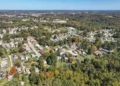
Edgewater Philadelphia is a residential community anchored at 2323 Race Street in the Logan Square neighborhood of Center City, with its newer Phase II building at 230 North 23rd Street. But reducing it to addresses misses the point. Edgewater is better understood as a position — a carefully chosen place to stand in a city that rewards people who pick their spot wisely. It sits at the far northwestern edge of Center City proper, pressed up against the Schuylkill River, sandwiched between the cultural abundance of Logan Square and the leafy brownstone streets of Fairmount. It is not quite downtown and not quite neighborhood — it is the best parts of both, with a waterfront trail outside the door and a Trader Joe’s within walking distance.
That combination — serene and accessible, removed yet central — is rarer than it sounds in any American city. In Philadelphia in 2025, it is genuinely remarkable.

The Address That Explains Everything
Logan Square sits between Broad Street and the Schuylkill River, stretching from Market Street to Spring Garden Street. Its proximity to Center City makes it a great place for those looking to pack in sightseeing, culture, and daily life in equal measure. Edgewater occupies the neighborhood’s quieter, westernmost flank, where the grid of Center City starts to soften into something more residential, where the highway sound from I-676 is present but not oppressive, and where the trees along North 23rd Street have been growing long enough to provide real shade.
The original Edgewater building rose twelve stories in 2006. The newer Edgewater Phase II — a seven-story, 180-unit structure designed by JKRP Architects — completed construction in late 2024, adding studios through two-bedroom apartments to the complex. The building stands 83 feet tall across North Bonsall Street from the original structure, together forming a small community within the larger neighborhood.
As built, the structure’s dark silver panels are slightly reflective, lending it a lighter and airier appearance that interacts with the weather and lighting conditions, while allowing context-friendly brick sections to stand out. A band of off-black brick at the ground floor adds sophistication and visual interest at the pedestrian level. This is not accidental architectural restraint — it is a building that was designed to belong to its block rather than dominate it, which says something about the intentions of the people who built it.
Edgewater Apartments carries a walk score of 83 and a transit score of 100 — by any measurement, a rider’s and walker’s paradise. For anyone who has lived in American cities long enough to understand how rare a transit score of 100 actually is, that number alone makes a compelling case.
Between Fairmount and Rittenhouse: The Privilege of Proximity
Living at Edgewater means being sandwiched between two of Philadelphia’s most beloved neighborhoods, and the benefits of that position compound daily.
To the south and east lies Rittenhouse Square, the city’s most celebrated residential address, where Victorian brownstones line quiet streets and the square itself — one of William Penn’s five original public spaces — draws everyone from morning dog walkers to Saturday farmers market regulars. The walk from Edgewater to Rittenhouse Square takes roughly fifteen minutes on foot. Residents describe spending stretches of their free time wandering around Rittenhouse to pick up groceries, drink coffee, and generally hang out — and note that the Schuylkill River walk and the Museum District are both within comfortable walking distance.
To the north and west sits Fairmount, sometimes called the Art Museum Area, a neighborhood that operates at a slightly different frequency than the rest of the city. Bordered by Logan Square, Spring Garden, and Brewerytown, Fairmount is home to one of the most impressive fine art collections in the nation at the Philadelphia Museum of Art. It is a neighborhood that has historically attracted people who are intellectually and physically active, and who want their surroundings to reflect that — broad avenues, park access, river views, and restaurants that feel local rather than performed.
Many of Philadelphia’s top attractions — Boathouse Row, the Philadelphia Museum of Art, the Barnes Foundation, Eastern State Penitentiary — are clustered here, as are thousands of nearby acres of Fairmount Park, which offers miles of trails for running, biking, and hiking.
For Edgewater residents, Fairmount is not a destination — it is an extension of the backyard.
The Schuylkill River Trail: Philadelphia’s Best Commute
If there is one thing that defines the physical experience of living at Edgewater above all else, it is the Schuylkill River Trail. The trail runs directly beside the property, and its presence transforms the way time passes in this part of the city.
The iconic Schuylkill River Trail runs right next door to Edgewater, offering a picturesque setting for various outdoor activities, while Azalea Garden is also just moments away — the perfect place for a picnic retreat.
The trail is one of Philadelphia’s most-used corridors, and for good reason. It connects the dense, walkable streets of Center City to the vast green expanse of Fairmount Park along the river’s edge, providing a car-free path that works equally well for a casual evening stroll, a serious training run, or a practical bicycle commute. One resident described taking a roughly 25-minute walk along the river trail to their job at a major hospital — a commute that doubles as both exercise and genuine pleasure.
This is the kind of thing that sounds like marketing language until you actually do it. There is something structurally different about a morning that begins with twenty minutes beside a river, with Philadelphia’s skyline visible behind you and the water catching the light ahead. It does not make commuting glamorous, but it makes it something other than purely transactional.
Along Schuylkill Banks — one of the most-visited stretches in the city — residents and visitors enjoy skyline and riverfront views that feel genuinely removed from the noise of urban life, even while remaining within the city limits.
The Benjamin Franklin Parkway: Philadelphia’s Champs-Élysées
No account of Edgewater’s location is complete without understanding the Benjamin Franklin Parkway, which begins just a few blocks east and radiates cultural energy outward like nothing else in the city.
The Parkway was modeled after the Champs-Élysées in Paris, and the Philadelphia Museum of Art and the Free Library of Philadelphia — both based on Parisian architecture — became part of this sweeping design. The comparison to Paris is not idle flattery — the Parkway is a wide, diagonal boulevard cutting through the city’s grid, flanked by flags, fountains, and institutions, and it creates the kind of grand civic feeling that most American cities were never designed to achieve.
Lined with must-see museums, abundant art and eclectic architectural wonders, the Benjamin Franklin Parkway bisects the neighborhood and serves as Party Central for massive events and parades.
The Parkway is also the address of some extraordinary institutions that are simply part of everyday life for anyone living at Edgewater. The Barnes Foundation holds one of the most extraordinary collections of Impressionist and Post-Impressionist art anywhere in the world — assembled by eccentric collector Albert Barnes and displayed according to his idiosyncratic organizational vision in a purpose-built building on the Parkway. The Rodin Museum offers a focused, intimate experience that many visitors prefer to the grand scale of the Philadelphia Museum of Art — the collection includes the largest group of Rodin’s work outside of Paris.
The Academy of Natural Sciences opened at 19th and Race Streets in Logan Square in the late 19th century. It was joined by the Franklin Institute in 1934. Today, the Barnes Museum, the Rodin Museum, and the Philadelphia Museum of Art all sit along the Parkway, forming what amounts to a genuine museum mile — one that Edgewater residents can reach on foot in minutes.
For families, the Franklin Institute remains one of Philadelphia’s most beloved institutions, a science museum that manages to be both rigorous and genuinely fun. The Academy of Natural Sciences houses North America’s oldest natural history museum and features dinosaur exhibits that have delighted generations of children. The proximity of all of these to Edgewater is not incidental — it is the central argument for the neighborhood.
The Philadelphia Museum of Art: More Than Rocky Steps
It would be an oversimplification to reduce the Philadelphia Museum of Art to a famous set of stone steps and a bronze boxer at the bottom. The steps are iconic, yes, and running up them is a Philly rite of passage that draws tourists and locals alike year-round. But the museum itself deserves more serious attention.
The Museum was a legacy of the great Centennial Exposition of 1876 held in Fairmount Park — born from a Pennsylvania State Legislature act in 1873 that set in motion plans for a permanent building designed to serve as the art gallery of the exposition, which was then to remain open as a Museum of Art and Industry for the improvement and enjoyment of the people of the Commonwealth.
That founding mandate — art for the people of the Commonwealth — still resonates in how the museum operates today. There is so much to see that a single ticket covers admission for two days at the main building and also grants entry to the Perelman Building, the Rodin Museum, and two historic houses in Fairmount Park. For Edgewater residents, the museum is not a special occasion destination — it is a neighbor.
Just beyond Fairmount’s borders in Logan Square, attractions including The Franklin Institute, the Rodin Museum, the Barnes Foundation, and the Academy of Natural Sciences are all easily accessible — making the entire corridor one of the richest cultural districts in the American Northeast.
Eating and Drinking in the Neighborhood
The neighborhood around Edgewater punches well above its geographic weight when it comes to food and drink, particularly given that it occupies a zone between Logan Square, Rittenhouse, and Fairmount — each with its own dining culture.
Sabrina’s Cafe, a neighborhood staple, serves brunch every day of the week, including good pancakes that keep locals coming back reliably. Victory Brewing Co. offers one of the few proper breweries in Center City, with 30+ on-tap beers, long tables for groups, and a rooftop with a view of the entire Benjamin Franklin Parkway. Jean-Georges, the high-end French restaurant on the top floor of the Four Seasons, offers panoramic city views for when occasion calls for it. Vernick Coffee Bar in the Comcast Center handles mornings and lunches with serious quality.
Residents frequently mention the uncommon grocery access as a legitimate quality-of-life upgrade. Trader Joe’s, Whole Foods, and Giant are all within walking distance, which, in the context of urban grocery options, borders on extravagant. Living directly above a Trader Joe’s means grocery shopping becomes genuinely effortless — a five-minute errand rather than a logistical event.
Beyond these staples, the neighborhood rewards exploration. Fairmount Avenue’s local restaurant strip provides the kind of casual, neighborhood-serving dining that keeps a street feeling alive — places where regulars are recognized, where the bartender knows what you drink, and where the food reflects the place rather than trying to be something from somewhere else.
Getting Around: Transit, Bikes, and the Art of Not Needing a Car
One of the underappreciated pleasures of Edgewater is how easily a resident can navigate the entire city — and several points beyond it — without once sitting in traffic.
The SEPTA trolley stop at 22nd and Market is approximately a five-minute walk from the building, and 30th Street Station — a hub for Amtrak regional rail and SEPTA services — is about a ten-minute walk away. For anyone who travels regularly to New York, Washington, or Boston, the proximity to 30th Street Station is a genuine asset. Amtrak’s Northeast Corridor runs through it, and the station itself — a beaux-arts landmark completed in 1933 — is one of the more beautiful train stations in the country.
The SEPTA trolley provides fast, frequent connections to Center City and University City, linking Edgewater to Penn, Drexel, Jefferson, and HUP with the kind of reliability that makes car ownership feel optional rather than necessary. Logan Square ranks among the most walkable neighborhoods in all of Philadelphia, with a neighborhood walk score of 95.
For cyclists, the Schuylkill River Trail and the bike lanes along the Parkway create a protected network that reaches most corners of Center City without requiring riders to share lanes with aggressive Center City traffic. Indego, Philadelphia’s citywide bike share program, has stations throughout the area.
Community, Character, and the Quiet Life at the Edge of Things
There is a particular character to the people who end up at Edgewater, and residents tend to describe it in remarkably consistent terms. The building has been popular among medical residents from Penn, Jefferson, and nearby hospital systems — physicians in training who need proximity to hospitals, reliable transit, a place to decompress after long shifts, and enough urban life nearby to remember what the outside world feels like. But it also draws young professionals, couples, remote workers, and people who simply did the math and realized that paying for location near this much culture is not extravagance — it is efficiency.
The dog community at Edgewater deserves its own mention. The building’s private fenced dog park makes it genuinely easy for pet owners to give their animals exercise and attention even on tight schedules — a detail that residents consistently cite as a genuine quality-of-life feature rather than a marketing afterthought.
The building sits slightly set back from the busiest streets, giving it a more private feel despite the surrounding urban density — a combination that residents describe as being in the middle of everything while feeling removed from it. That is not a contradiction. It is the specific achievement of good urban design — providing shelter without isolation, proximity without noise, access without intrusion.
The New Edgewater: Phase II and the Changing Skyline
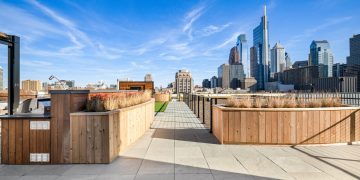
Construction completed on Edgewater Phase II at 230 North 23rd Street in December 2024. The seven-story, 145,473-square-foot building features residences ranging from studios to two bedrooms and adds a rooftop and a pool available to residents of both buildings.
The mature street trees on North 23rd Street were preserved throughout construction, and North Bonsall Street was landscaped in the process. The large surface auto parking lot that previously occupied the site is gone. The Juliet balconies add a touch of class, and the cast stone base is attractive. Approximately 270 new Logan Square residents now add vitality to the block.
The completion of Phase II matters beyond the unit count. It signals a broader confidence in this corner of the city — an architectural bet that people will continue to want what Edgewater offers: waterfront proximity, cultural density, transit access, and the specific pleasure of living somewhere that actually makes sense. In a city that has seen significant neighborhood development across multiple districts in recent years, the continued investment at this particular location speaks to how well it functions.
Logan Square’s Deeper History: The Ground Beneath the Feet
It would be a mistake to admire Edgewater and its surroundings without acknowledging the layered history underneath them.
Logan Square traces back to William Penn’s original 1684 grid design for Philadelphia — one of five public squares laid out for the city. The northwest square served variously as pasture land, execution grounds, and graveyard before slowly evolving into the communal space Penn had intended. The last public execution there took place in 1823.
In 1924, the grand Swann Memorial Fountain was added at the center of the circle — designed by Alexander Sterling Calder, son of the man who designed William Penn’s statue on top of City Hall. The fountain’s water figures represent Philadelphia’s geography near two rivers and its multicultural history.
That lineage — from execution ground to Calder fountain to museum mile — is not just historical trivia. It is the story of a city repeatedly choosing to make something better of a place than what came before. Edgewater participates in that tradition. It replaced a surface parking lot with housing and landscaping. It preserved the street trees. It kept the building to a scale that does not overwhelm the block. These are small decisions that accumulate into the character of a neighborhood.
Who Edgewater Is For — and Why It Works
The honest answer is that Edgewater works best for people who value density of experience over square footage of apartment. The units are not the largest in the city, and the rents reflect one of Philadelphia’s most sought-after corridors. What residents are paying for is not floor space — it is position.
Edgewater is within a seven-minute walk of Moore College of Art & Design, and proximity to Drexel University, the University of Pennsylvania, and multiple hospital systems makes it a natural choice for the academic and medical communities that define this part of the city.
For newcomers to Philadelphia trying to understand how the city fits together, Edgewater offers an ideal vantage point. From here, you can walk to Rittenhouse for brunch, bike to Fairmount for dinner, catch the trolley to Center City for work, run the river trail in the morning, and be at 30th Street Station for a weekend train to New York in under ten minutes. The city, from this position, is legible.
For people who have lived in Philadelphia long enough to know exactly what they want from it, Edgewater offers the satisfaction of a choice that keeps paying dividends — culturally, practically, and on those autumn evenings when the light hits the Schuylkill just right and the Museum of Art sits on the hill above the water like something from a painting, which, given what is inside it, seems entirely appropriate.
Final Thought: The Edge Is the Center
The name Edgewater implies marginality — a place at the rim of things. The reality is the opposite. This is a community positioned at the center of what makes Philadelphia worth living in: its cultural seriousness, its walkability, its river, its history, and its ongoing, unfinished argument with itself about what a great American city should be.
To live at Edgewater is to have skin in that argument. To run along the Schuylkill in the morning is to understand what the city built its institutions beside. To walk past the Swann Memorial Fountain on the way to the Franklin Institute is to move through layers of time that most American neighborhoods cannot offer. And to come home to a building on Race Street at the end of all of it is to feel, in a way that is hard to articulate but easy to recognize, that you picked your spot well.
In a city full of good places to live, Edgewater is one of the very best. Not despite its location at the edge — but entirely because of it.