



There are places in every city that exist somewhere between myth and reality — spots that belong equally to neighborhood legend, Instagram feeds, and the nightly news. In Philadelphia, that place has a name, and it has had one for centuries: Devil’s Pool.
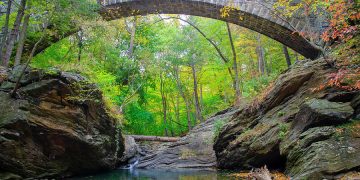
Tucked deep inside the 1,800-acre Wissahickon Valley Park in Northwest Philadelphia, Devil’s Pool is a natural swimming hole where Cresheim Creek pours into the Wissahickon Creek, pooling into a basin ringed by mossy boulders and shadowed by a 65-foot stone aqueduct. It is, by almost every measure, the most arresting spot in a city not short on arresting spots. It is also illegal to swim in, genuinely dangerous, periodically deadly, and yet visited by hundreds of people on any warm summer afternoon.
That tension — between beauty and peril, between belonging and prohibition, between preservation and freedom — is what makes Devil’s Pool one of the most fascinating urban landmarks in the United States. This isn’t just a swimming hole. It’s a window into how cities manage wildness, how communities claim space, and how a stretch of creek in Philadelphia became a symbol for something much larger than itself.

Where Exactly Is Devil’s Pool and How Do You Get There?
Devil’s Pool sits at the intersection of three Philadelphia neighborhoods — Chestnut Hill, Mount Airy, and Roxborough. It is technically part of Fairmount Park, one of the largest urban park systems in America, and is maintained by Friends of the Wissahickon (FOW), a nonprofit conservation organization that has stewarded this land since 1924.
There are two main access points. The first is from the Valley Green Road parking lot near Valley Green Inn, where you pick up the Orange Trail heading south along the Wissahickon Creek. You’ll encounter Devil’s Pool about a half-mile from Valley Green Road — this is where Cresheim Creek flows into the Wissahickon Creek, forming a small waterfall and a deep pool. The second entrance is from Livezey Lane, which offers more direct access but is also the route most associated with crowding and parking violations in the summer months.
The moderate Cresheim Trail and Devil’s Pool Loop covers approximately 4.5 miles and takes most hikers about two hours to complete, following sections of the Cresheim Creek Trail, White Trail, Cresheim Trail, and Orange Trail. The hike itself — through gorge-carved valleys, past towering Wissahickon schist outcroppings and the rustling canopy of birch, sycamore, and poplar — is worth making even if Devil’s Pool were not the destination.
There are no entrance fees. No permits. No reservations. Wissahickon Valley Park is a public park freely accessible to all. This accessibility, in fact, is part of what defines the place and its perpetual tensions.
The Geology Behind the Magic
Before there were legends, before there were cliff divers and Instagram reels, before any of the human drama, there was the land itself.
Devil’s Pool is located at the mouth of Cresheim Creek. As the ravine widens, the waters gather in a basin surrounded on either side by rocky outcroppings before flowing into the Wissahickon Creek. The basin is formed from Wissahickon schist — ancient metamorphic rock that, over long periods of mountain building, was slowly transformed from shale and sandstone into the schist and quartzite found in the valley today.
The aqueduct standing above the pool — a single-arch stone bridge some 60 feet above the water, finished in Wissahickon schist — was built in the 1890s under the direction of the Department of Public Works to carry a buried sewer across the Cresheim valley. The Philadelphia Times, reviewing it in 1892, noted that the bridge “has been built in a neat and substantial manner that adds to the already beautiful scenery of that neighborhood.” The understatement is almost comical. That bridge is now one of the most photographed structures in Philadelphia, its graceful arch framing views of the pool below like a painting left out in the open air.
After a heavy rain, the pool reaches about 15 feet at its deepest point — the target area for jumpers is remarkably small. When dry weather prevails, it can be considerably shallower. The pool is not large. But its combination of cascading water, surrounding boulders, hemmed-in valley walls, and that looming stone arch gives it a theatrical quality that no municipal pool can replicate.
A History Older Than Philadelphia Itself
The name “Devil’s Pool” predates the city by centuries, and its origins are layered in Indigenous history, colonial mythology, and the kind of oral tradition that tends to evolve with every retelling.
Prior to European colonization in the 1680s, the Cresheim and Wissahickon valleys were inhabited by the Lenape people. The name “Devil’s Pool” has its origins in them, or at least in legend passed down through generations since these indigenous dwellers were forced from their lands.
While the story contains many variations, at its essence, a battle between the Great Spirit and the Evil Spirit resulted in the creation of Devil’s Pool. The Great Spirit prevailed, hurling a huge boulder at the Evil Spirit, either killing him or banishing him to the bottom of the pool, depending on which variation you prefer. The Physical evidence of this cosmic battle? The boulder still rests at the brink of the pool. A 1958 Philadelphia Inquirer piece noted that if you look closely, you can see the Great Spirit’s thumbprint in the stone.
Alex Bartlett, an archivist at the Chestnut Hill Historical Society, says no one knows exactly where the name “Devil’s Pool” comes from, but he’s pretty sure it stems from an old legend — a sort of urban myth — that the Native American Lenape tribe considered the pool an interface between good and evil.
The site’s role in American history doesn’t stop with Indigenous legend. In 1776, it was the site of a prayer service for a band of militiamen and their families, including Jacob Rittenhouse, who were leaving for duty in the Continental Army. One account from Revolutionary War days says that during the Battle of Germantown in October 1777, some of Armstrong’s men captured 14 Hessians here and took them to nearby Livezey.
The spot even drew painters. Carl Philipp Weber painted “Devil’s Pool, Cresheim Creek” in 1889 — a work now held in the collection of Schwarz Gallery. By the late 19th century, visiting Devil’s Pool was already a recreational tradition. An 1890 photograph shows young men and women from a Sunday school group at Oxford Presbyterian Church sitting on its rocks near a thatched-roof pavilion. The pool was not a secret even then. It was simply beloved.
The Allure That Cannot Be Legislated Away
Here is the fundamental paradox of Devil’s Pool: it gets an average of 400 visitors per day during peak season and as many as 1,200 visitors on really hot days like the Fourth of July. Every single one of those visitors who enters the water is technically breaking the law. And yet they keep coming, year after year, generation after generation.
Why? Because for those who can’t afford a beach trip or a swim club membership, the site feels like a sort of hidden urban haven. Because although Philadelphia offers more public pools per capita than any other American city, no municipal pool offers this: a forest gorge, a waterfall, a medieval-looking stone arch, mossy cliffs, and the particular sensation of being, somehow, far from the city you live in.
On a Sunday afternoon in early June, families arrive with beach chairs and coolers of snacks. Some start small fires on the creek’s banks or balance portable grills among the rocks. Teenagers leap off 15-foot-high cliffs, their screams colliding with music bouncing around the valley walls that have made this a gathering place for centuries.
One 16-year-old visitor put it plainly to Grid Magazine: “When you’re here, nobody can rule you. You can be yourself. But with that you’ve got to be careful of certain things. This isn’t a pool, and there’s no lifeguard.”
That connection has made visiting Devil’s Pool a generational affair. People who first came as children bring their own children. The ritual has become identity, part of what it means to grow up in Northwest Philadelphia. Banning it — truly, practically banning it — would require erasing something deeper than behavior. It would require erasing memory.
The Very Real Dangers at Devil’s Pool
None of the above should be read as an endorsement of swimming at Devil’s Pool. The dangers are real, well-documented, and in some cases fatal.
The obvious physical risks start with the jump itself. The boulders surrounding the pool allow drops of anywhere from 5 to 15 feet. But the aqueduct — the beautiful 1890s stone arch — towers 60 feet above the water. People have leapt and survived; people have also leapt to death and paralysis. Philadelphia Magazine profiled a young man who had to relearn how to walk after breaking his back jumping from the bridge. Four years before that, a Montgomery County teenager broke his neck and punctured a lung after jumping from the stone bridge.
Beneath the surface, the hazards multiply. Police divers have encountered rusty, discarded bikes and shopping carts in the Wissahickon riverbed. Anthony Kowalski, a police diver with 19 years of experience, put it bluntly: “If you dive in there, you might die in there.”
Strong currents are a factor that catches many swimmers off guard. The pool appears calm but the confluence of two creeks creates unpredictable flow patterns, especially after rain. In June 2023, two visitors to the Wissahickon drowned less than three weeks apart — a 38-year-old man who accidentally fell into Devil’s Pool, and a 21-year-old who experienced distress while swimming on a 94-degree day. A decade before that, the Wissahickon made international news when a father jumped into the creek in an attempt to save his struggling 13-year-old son; both drowned.
Craig Johnson, who has lived in Glen Fern — the 300-year-old stone house just a few hundred feet from Devil’s Pool — says a half-dozen accidents at the site each year require emergency attention from first responders.
Then there is the water itself. The Wissahickon Watershed covers 64 square miles, and its headwaters begin beneath a shopping mall parking lot in Montgomery County. From there, the creek flows through 15 heavily developed municipalities before reaching Philadelphia. That journey picks up contaminants at every turn. Tests by the Philadelphia Water Department show that although water quality is improving, the creek is still not clean enough to swim in.
A 2024 Temple University study offered some nuance: researchers found the risk of contracting an illness from pathogens while swimming in Devil’s Pool may be about 1 in 1,000 exposures — which sits within the range of the EPA’s own thresholds for freshwater recreation, and lower than conditions at some designated swimming areas. The risks are real but not as apocalyptic as some headlines suggest. Still, dangerous pathogens primarily come from animal feces, pesticides, lawn fertilizers, and motor oil that wash into the creek during rainstorms — and no one knows exactly what has washed in before any given summer afternoon.
The Debate Over What to Do About It
For decades, Philadelphia’s authorities, environmentalists, and community members have argued about how to handle Devil’s Pool. None of the proposed solutions have been fully satisfying.
Chris Palmer, the Parks and Recreation Deputy Commissioner for Operations, acknowledged the city has tried many approaches: “We have a major issue in the Wissahickon with swimming in Devil’s Pool. We’ve worked really hard with a number of solutions, and we just can’t be there all the time to protect the public from their own doing.”
One proposal has been to fill parts of the pool with rocks, making it physically impossible to swim. FOW has pushed back firmly against this. “You’re really permanently altering a historic environmental feature to curb the behavior of a relatively small number of people,” Maura McCarthy, the FOW executive director, argued. “Not that their lives aren’t important, but also there are a lot of people who use the pool in a non-dangerous way.”
The city has responded with increased police presence, particularly over holiday weekends. Violators who swim are issued summary citations. Illegal parking on Livezey Lane — the closest access route to Devil’s Pool — carries its own fines, since it is the only direct path for emergency vehicles.
Social media has significantly worsened the situation, according to police divers, with bigger and rowdier crowds and a greater potential for dangerous behavior. What was once passed from neighbor to neighbor as local knowledge is now a viral destination listed on TikTok and Google Maps with thousands of tags, reviews, and jump videos.
Nearby residents have their own grievances: out-of-town cars parked on lawns, trash, and people urinating on private property. Some have called for the watering hole to be filled in entirely.
Ruffian Tittmann, executive director of Friends of the Wissahickon, has said her organization has gone “all-in” on a leave-no-trace approach, working to educate visitors about the harm caused by any trash, waste, or food left behind. New infrastructure has helped too: a pedestrian bridge and walkway that Friends of the Wissahickon helped build in 2024 opened at the Valley Green entrance, offering a more sustainable way to access the area.
What Devil’s Pool Means to Philadelphia
Strip away all the policy debates, the drowning statistics, and the water quality reports, and you are still left with something that resists easy categorization.
From Harper’s Meadow to the Philadelphia Canoe Club, the Wissahickon Creek presents a veritable outdoor museum of natural and manmade landmarks. But no place in all the Wissahickon encapsulates the natural and man-made quite like Devil’s Pool.
It is the only covered bridge inside a major American city, the ancient stone arch, the glacially-carved valley walls, the waterfall misting the air in summer heat — all of it in one compact, walkable, freely accessible spot. You can reach it on the Route 9 bus from Center City in under 30 minutes. No car required. No membership card. No admission fee.
Devil’s Pool remains a spectacular natural asset — arguably the most beautiful place in Philadelphia — and remains worthy of ongoing protection.
That conclusion, from FOW, carries weight precisely because it comes from the organization most burdened by Devil’s Pool’s complications. They clean up the trash. They respond to the accidents. They navigate the tension between preservation and public access every single summer. And still, they describe it as the most beautiful place in their city.
There is something clarifying about that. Beauty is not diminished by being complicated. A place does not have to be safe or tidy or uncomplicated to matter deeply to the people who love it. Devil’s Pool is all of those inconvenient things — dangerous, contested, beloved — and it matters more because of them, not less.
Visiting Devil’s Pool: What You Need to Know
If you plan to visit Devil’s Pool — and thousands of people do every year — a few practical notes are worth keeping in mind.
Getting there: The easiest route for most visitors is the Valley Green Road parking lot off Northwestern Avenue in Chestnut Hill. From there, take the Orange Trail south for approximately half a mile. You can also take public transit; SEPTA’s Route 23 bus stops near Germantown Avenue and access to Wissahickon Valley Park is walkable from there.
Best time to visit: If you visit in the late fall, winter, and early spring, you’ll enjoy fewer crowds and an overall better experience. Autumn is particularly stunning — the valley turns extraordinary shades of amber and rust, the creek runs cold and clear, and the entire gorge feels like something from a century before. Summer brings the crowds and the heat and the cliff-jumping chaos.
What to bring: Sturdy, waterproof boots are a practical choice, particularly if you want to explore the rocky confluence of the two creeks. The terrain is uneven and wet. There are no restrooms at the pool itself — the nearest facilities are at Valley Green Inn, a short trail away.
The legal situation: Swimming and wading in Devil’s Pool remain prohibited under Philadelphia Parks and Recreation rules. This is not a technicality. People have been seriously injured and killed here. The rocks are slippery, the currents are stronger than they look, and submerged objects — things you cannot see from the surface — pose serious injury risks. The pool can absolutely be appreciated without entering the water.
Leave No Trace: The park’s beauty is entirely contingent on visitors behaving responsibly. Every piece of trash left behind, every fire lit on the rocks, every can tossed into the creek, degrades something that took millennia to create and cannot be rebuilt. Friends of the Wissahickon has worked for years to repair damage caused in minutes. Their work is worth respecting.
The Last Word
Philadelphia is not usually thought of as a wild city. It is a city of row houses and concrete, of street-corner history and dense urban texture. And yet somewhere in its northwest corner, a creek tumbles through a gorge that the concrete has never swallowed, past boulders that bear the thumbprint of a spirit older than any city, under a Victorian stone arch built to carry a sewer and wound up framing one of the most beautiful views on the eastern seaboard.
“We can make open spaces in town,” read an 1902 editorial in The Philadelphia Times, “but no art can ever create another Wissahickon or Cresheim creek.”
That was written over 120 years ago, and it remains exactly right. Devil’s Pool is not a problem to be solved. It is a place to be reckoned with — loved carefully, visited wisely, and protected fiercely, because nothing like it can ever be made again.