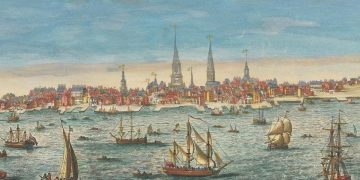




Long before New York swallowed the Atlantic trade or Boston cemented its Puritan legacy, Philadelphia stepped onto the North American stage with an audacity few settlements dared. Founded in 1682 on a narrow neck of land between the Delaware and Schuylkill rivers, the city did not creep into existence. It announced itself. William Penn, proprietor and visionary, laid out broad streets in a disciplined grid, named them with plainspoken clarity—Market, Chestnut, Walnut—and promised a “greene countrie towne” that would never choke on its own growth. That promise, radical for its time, became the skeleton key to Philadelphia’s explosive ascent.

By 1776, when the Continental Congress gathered in the modest brick State House, the city already ranked as the second-largest urban center in the British Empire, surpassed only by London. Population surged past forty thousand souls, a figure Charleston and Boston could only envy. Merchants grew rich on wheat, flour, and timber; shipyards hammered out vessels that sailed to Lisbon, Barbados, and Cork; Quaker meetinghouses rubbed shoulders with Anglican spires and Jewish synagogues in a polyglot bustle almost unheard of elsewhere on the continent. Philadelphia did not merely grow. It inhaled opportunity and exhaled influence.
The Geography of Advantage
Location, more than ideology, scripted the first chapters. The Delaware River ran wide, deep, and ice-free longer than the Hudson or the Charles. Vesselsels of tidewater reached far inland, allowing oceangoing ships to unload directly beneath the city’s bluffs. Farmers in Chester, Lancaster, and Berks counties rolled barrels of superfine flour down the Lancaster Road to wharves where coopers stamped them “Philada. Flour”—a brand that commanded premium prices in Madeira and Bilbao long before the Revolution.
Westward, the Schuylkill offered a second highway. Flatboats poled upcountry returned laden with furs, hemp, and iron pigs from forges that already dotted the Pennsylvania backcountry. By mid-century, Philadelphia sat at the center of a commercial web that stretched from the Lehigh Valley to the Caribbean sugar islands. New York, hemmed by rocky hills and a narrower harbor, lagged in tonnage. Boston, tethered to a cod-and-slave-trade triangle, never matched the sheer agricultural surplus flowing through Philadelphia’s docks.
Quaker Capital and the Paradox of Tolerance
William Penn’s Holy Experiment rested on an unsettling premise for the seventeenth century: people of different faiths could live, trade, and govern together without slaughtering one another. Swedes and Finns lingered from earlier settlements. German sectarians—Mennonites, Dunkers, Moravians—poured in after 1710. Welsh Quakers claimed whole townships northwest of the city. English Anglicans built Christ Church with a steeple that dwarfed every Quaker meetinghouse. Jews from London, Amsterdam, and Recife opened shops on Front Street by the 1740s.
This mosaic did not produce utopia. Quaker dominance in the Assembly rankled non-Quakers. Pacifism faltered when French and Indian War raids bloodied the frontier. Yet the city’s reputation for relative tolerance drew skilled artisans and capital that more rigid colonies repelled. Printers, instrument makers, cabinetmakers, and silversmiths—many of them German or Huguenot—found a market eager for refinement. The result showed in the carved walnut highboys and silver teapots that still fetch millions at auction.
Commerce Before Industry
Eighteenth-century Philadelphia remained pre-industrial, yet its merchants orchestrated a commercial revolution. Houses such as Willing & Morris, Clifford, and Pemberton issued bills of exchange that circulated from Kingston to Cádiz. Insurance offices underwrote voyages. By 1760 the city supported more than 150 vessels engaged in foreign trade. Packet lines ran on published schedules to Liverpool and Belfast—novelty enough to boast about in newspapers.
Flour inspection laws, passed in the 1720s, guaranteed quality and turned a commodity into a global standard. The “Philadelphia barrel” became a unit of account across the Atlantic world. Wheat prices quoted in Mark Lane began with the latest advices from the Delaware capes. When war interrupted Baltic grain shipments, Pennsylvania stepped into the breach and fed half of southern Europe.
The Brick-and-Mortar Boom
Walk the streets laid out by surveyor Thomas Holmes and the scale astonishes even today. Lots measured 50 by 396 feet—deep enough for a substantial house, stable, garden, and privy well removed from the dwelling. Red brick, quarried locally and fired in kilns along the Schuylkill, became the universal building material. Trimmed with white marble sills from King of Prussia and cedar shingles shipped down from New Jersey, the rows achieved a disciplined elegance no other colonial town rivaled.
Public buildings followed. The State House (now Independence Hall), completed in the 1750s, spoke Georgian restraint. Carpenters’ Hall, the Bettering House for the poor, the Walnut Street Prison—each reflected a civic pride that demanded durability and grace. Visitors remarked that Philadelphia looked less like a frontier outpost and more like an English provincial city transplanted across the ocean.
Printing and the Birth of a Public Sphere
No colonial city matched Philadelphia’s command of the printed word. Benjamin Franklin arrived penniless in 1723 and left his stamp on everything from newspapers to scientific journals. By 1775 the city boasted seven newspapers, scores of almanacs, and a circulating library founded in 1731—the first successful subscription library in America.
David Hall, Christopher Sower in Germantown, and later the Dunlap and Bradford presses churned out pamphlets that ricocheted across the colonies. When Parliament passed the Stamp Act, Philadelphia printers flooded the streets with broadsides and cartoons. Ideas—radical, loyalist, scientific, religious—traveled faster here than anywhere else on the continent. The American Philosophical Society, chartered in 1743, drew correspondents from Edinburgh to St. Petersburg. In coffeehouses along the Delaware, merchants argued Newtonian physics one hour and the rights of Englishmen the next.
Medicine, Science, and Civic Ambition
Philadelphia’s intellectual ferment spilled into practical innovation. The Pennsylvania Hospital, chartered in 1751 through Franklin’s lobbying, became the first permanent medical facility in British North America. Dr. Thomas Bond and Dr. John Morgan trained a generation that would staff Continental Army hospitals. Across town, the College of Philadelphia (later the University of Pennsylvania) graduated its first medical class in 1768—again, a colonial first.
Botanist John Bartram roamed the Schuylkill marshes collecting specimens that ended up in Linnaeus’s herbarium. David Rittenhouse built orreries that tracked planets with uncanny precision. On June 9, 1769, Philadelphians climbed temporary scaffolds to watch Venus transit the sun—an event timed to the second by American instruments for the first time.
The Revolutionary Crucible
By the 1770s the city’s size and sophistication made it the inevitable meeting ground for rebellion. Delegates who gathered for the First Continental Congress in 1774 found a metropolis that dwarfed their provincial capitals. John Adams, fresh from Braintree, gaped at the paved streets, the streetlamps fueled by whale oil, the bookstores stuffed with London editions.
Two years later, the Second Continental Congress met in the same east room of the State House where, on humid July evenings, delegates debated independence while swatting horseflies. Outside, crowds surged up Chestnut Street demanding action. Printer John Dunlap worked through the night of July 4 setting type for the Declaration; by morning broadsides fluttered from every tavern door.
Philadelphia paid dearly for its prominence. British troops occupied the city from September 1777 to June 1778. Hessians stabled horses in Christ Church; redcoat officers danced minuets in commandeered mansions. Yet the occupation only hardened resolve. When Washington’s army limped into Valley Forge, Philadelphia merchants smuggled blankets and flour past British patrols.
Post-War Recovery and National Capital
Victory brought new burdens and new glories. From 1790 to 1800 Philadelphia served as the capital of both Pennsylvania and the fledgling United States. Pierre L’Enfant sketched grand plans (mostly unrealized) while Congress sat in Congress Hall and President Washington rented the finest house on Market Street. The yellow fever epidemic of 1793 killed four thousand and emptied the city for months, yet recovery came swiftly. By 1800 population approached seventy thousand, pulling ahead of every rival.
Banks proliferated—the Bank of North America (1781), the Bank of the United States (1791), the Bank of Pennsylvania (1793). Stephen Girard, French-born and spectacularly rich, lent the federal government sixteen million dollars during the War of 1812—roughly one-fifth of total war expenditure—from his counting house on Water Street.
The Infrastructure That Fed Growth
Roads radiated outward like spokes. The Lancaster Turnpike, completed in 1794, became the first crushed-stone highway in America. Stagecoaches dashed the sixty-two miles to Lancaster in a single day, shaving two days off the old wagon journey. Bridges—permanent, covered, wooden arches—crossed the Schuylkill at Market Street and Upper Ferry. In 1805 the city’s waterworks, designed by Benjamin Henry Latrobe, began pumping Schuylkill water through wooden mains to hydrants and private homes, banishing the old water-sellers who once hawked buckets from horse-drawn carts.
Diversity in the Streets
Walk Front Street in 1790 and languages collided. Welsh-speaking teamsters argued with Gaelic-speaking Irish redemptioners fresh off the ship. German Lutheran pastors in black Geneva gowns passed Sephardic Jews in broad-brimmed hats returning from synagogue. Free Black sailors from the West Indies mingled with escaped slaves who found refuge in the growing African Methodist Episcopal congregations.
Richard Allen founded Mother Bethel in 1794 on ground he purchased himself, laying the cornerstone for the oldest parcel of land continuously owned by African Americans in the United States. Absalom Jones led St. Thomas African Episcopal Church up the street. Together they nursed yellow fever victims abandoned by white physicians, proving both competence and moral claim in a city that still tolerated slavery until gradual abolition took hold.
The Shadow Lengthens
For all its brilliance, Philadelphia carried contradictions. Slavery persisted longer in Pennsylvania than in New England. Gradual abolition began only in 1780, and wealthy Quaker merchants quietly sold human beings at the London Coffee House into the 1770s. Native Delaware and Susquehannock peoples, pushed westward, appeared in the city only as curiosities or petitioners.
Wealth concentrated fiercely. Robert Morris, “Financier of the Revolution,” ended his days in debtors’ prison while Girard amassed a fortune that rivaled European banking houses. Elegant townhouses on Third and Fourth Streets rose blocks away from alleys where Irish weavers starved during trade embargoes.
Legacy Cast in Brick and Memory
When the federal government decamped to Washington in 1800, many predicted decline. Instead Philadelphia pivoted. It became the workshop of the early republic—textile mills in Manayunk, iron foundries along the Schuylkill, locomotive works that would one day birth the Baldwin works. Population doubled again by 1830.
The grid Penn drew in 1682 still governs the city center. Independence Hall, Carpenters’ Hall, the old merchant exchanges—these survive because Philadelphians built for permanence. The confidence that erected a planned city where others threw up shacks still echoes in the straight, tree-lined streets and the stubborn refusal to tear down the past.
Philadelphia never became the permanent national capital, but for one luminous century it served as the economic, intellectual, and political fulcrum of British North America and the early United States. It proved that a city could be cosmopolitan without tyranny, commercial without squalor, pious without persecution. The experiment worked, imperfectly yet undeniably, and the proof still stands in red brick rows climbing gently from the Delaware toward the setting sun.