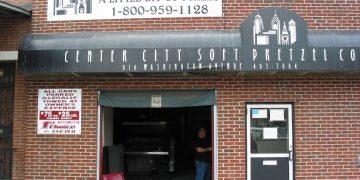




There are foods that feed you, and then there are foods that define you. In Philadelphia, the soft pretzel is the latter. It is not a snack. It is not a side item. It is a cultural artifact, warm and salted, passed between generations the way other families pass down jewelry or stories. And at the top of that tradition — battered by time, tested by fire, and still standing on Washington Avenue — is Center City Pretzel Philadelphia, the city’s oldest surviving soft pretzel bakery, still knotting dough by hand the way it always has.
This is the story of that bakery, that family, and the knot of history, community, and carbohydrates that makes a Philadelphia pretzel unlike anything else on earth.

What Makes a Philadelphia Soft Pretzel Different
Before we talk about Center City Pretzel Co. specifically, let’s set the record straight on what we’re dealing with here. A Philadelphia soft pretzel is not a mall pretzel. It is not the oversized, butter-slicked thing you get at a stadium kiosk. It is something altogether more humble — and more honest.
The classic Philly soft pretzel is baked flat and figure-eight style. It is dense, chewy, lightly golden on the outside, and tender — almost pillowy — within. The salt on top is coarse. The mustard on the side is sharp, tangy, and non-negotiable. There is no butter bath. There is no cinnamon sugar. There are no gimmicks.
The history of pretzels in Philadelphia goes back at least to the 1820s, when a street vendor named Daniel Christopher Kleiss was recorded selling them on city streets. The shape itself has older, European roots — pretzel historians generally agree that the form has its origins in Christianity, where the three holes were said to represent the Father, Son, and Holy Ghost, and the bread was distributed to the poor as both food and spiritual supplement.
By the time Philadelphia’s German immigrant community had fully settled into South Philly neighborhoods in the 19th century, pretzels had become embedded in the city’s daily rhythm — sold from carts, bought by the dozen, eaten on stoops before work. The soft pretzel was working-class food in the best possible sense: cheap, satisfying, and everywhere.
Center City Pretzel Co. is the living continuation of that tradition.
The Origin Story — Tony Tonelli and the Italian Market
Center City Pretzel Co. was founded as a family-owned operation in Philadelphia’s Italian Market since 1981 — a neighborhood already legendary for its old-world food culture, its open-air stalls, and its uncompromising standards. Founder Tony Tonelli was a baker. He wasn’t trying to build a brand or disrupt an industry. He was making pretzels the way pretzels should be made: simply, carefully, and by the thousands.
The recipe is almost shockingly minimal. The pretzels are made with just spring wheat flour, yeast, water, and salt. That’s it. No dough conditioners, no preservatives, no list of unpronounceable additives. Center City Pretzel Co. proudly claims to be the only all-natural soft pretzel bakery in the tri-state area. In an era where food labels read like chemistry textbooks, that distinction carries real weight.
The pretzels are baked in a hundred-plus-year-old, 50-foot, 500-degree tunnel oven nicknamed “The Beast,” and the results are exactly what you’d expect from a machine that has been perfecting its work for over a century: golden brown on the outside, soft and yielding on the inside, with that characteristic chew that no amount of factory replication has ever quite matched.
The facility is kosher certified, nut-free, dairy-free, and the pretzels are vegan. This happened not because of a marketing pivot, but simply because the recipe never required anything else. Clean food doesn’t always need a manifesto. Sometimes it’s just what you’ve always done.
A Family Business, In Every Sense of the Word
Tony Tonelli built Center City Pretzel Co. over four decades. He built it for his family, and eventually, he handed it to them. His daughter Erika Tonelli Bonnett spent 17 years working under her father before officially taking the reins. She wasn’t a business school graduate stepping into a corner office. She was a daughter who had grown up watching her father bake, had learned the rhythms of the oven, and understood that the product wasn’t just flour and yeast — it was identity.
Then Tony Tonelli passed away in 2021.
The loss of a founder is always hard. The loss of a father, harder still. And before Erika had time to fully find her footing, the universe handed her something worse.
In September 2022, an electrical fire destroyed the shop’s dough extruder — the machine that forms the thousands of figure-eight-style pretzels baked there daily — and damaged an electrical panel. The bakery closed. What Erika thought would be a matter of months stretched into something far more harrowing.
The electrical elements had to be pulled out and replaced. Then there were supply chain issues in the aftermath of Covid, with parts difficult to find and, when found, often already committed to other jobs. The oven belt rusted from disuse. All of the plumbing failed after the pipes burst from sitting idle through a Philadelphia winter. The roof, a classic South Philly flat, had to be replaced entirely after standing water damaged it through multiple cold seasons.
Erika described the 18 months of closure as the darkest period of her life. She searched eBay and Google for replacement parts. She watched an insurance process drag on with no resolution in sight. She dealt with public skepticism as reopening dates came and went. And on top of all that, the grief of losing her father remained fresh, woven into every part of the struggle to save what he built.
“If she sold this business, part of my father was gone — again — and I couldn’t let that happen,” Erika said. So she didn’t sell. She kept going. She sourced parts, rebuilt systems, replaced plumbing and roofing and electrical panels. She dug into reserves she didn’t know she had. She came from strong stock, as she put it, and she proved it.
The Reopening That Brought Philadelphia to Washington Avenue
Center City Pretzel Co. reopened its garage storefront at 816 Washington Ave. on April 1, 2024 — 18 months after the fire first closed its doors.
The response from Philadelphia was something between a celebration and a homecoming.
Lines formed daily — and early, like 5 a.m. — stretching the length of Washington Avenue. Customers gushed about the smell of pretzels baking, fathers introduced their sons to the pleasure of knotted dough for the first time, longtime neighbors recalled being able to get fresh pretzels after midnight, and buyers debated whether to buy three or thirty.
“It’s been overwhelming and humbling,” Erika said. “People have expressed excitement in so many different ways — tears that haven’t been mine, flowers, cards, phone calls — everyone telling us repeatedly what we mean to them, whether it’s our South Philly block or Philadelphia in general.”
This is the part of the story that transcends the food. People don’t cry over pretzels. They cry over what pretzels mean — the Catholic school recess where you spent 35 cents on three of them, the Sunday morning before an Eagles game, the grandfather who used to buy a bag from a cart and eat them walking back from the Italian Market. Center City Pretzel Co. is not just a bakery. It is a vessel for those memories, and when it closed, Philadelphians felt something absent from the city that no other pretzel could replace.
The bakery was named Best of Philly 2024, which, given the circumstances of the year, felt like the city itself casting a vote of confidence and gratitude.
The Product — What You Actually Get at Center City Pretzel Co.
Walk up to 816 Washington Ave. on a weekday morning, and here’s what the experience looks like. The bakery operates out of an industrial space with a garage-style front. The hours run Monday through Friday from 6 to 11 a.m., and Saturday from 6 to 10 a.m. It is closed on Sundays. Come early, because they bake until they sell out, and they do sell out.
The range of pretzel formats is broader than you might expect: rolls, braids, minis, nuggets, Old Fashioned style, letters and numbers, sticks, and classic figure-eights. The tagline on the website — “If you can dream it, we can pretzel it” — is only half tongue-in-cheek. This is a bakery that thinks in dough.
The experience of actually buying a pretzel here is gloriously low-frills. There is no seating area. Just a large mustard dispenser on the counter. You come in, you order, you dip if you want, you leave. The prices remain startlingly affordable, keeping faith with the working-class roots of the product.
The mustard pairing is its own conversation. The mustard used is made with mustard bran, mustard seed, water, distilled vinegar, salt, and turmeric — clean, sharp, and exactly the right counterpoint to the salt and chew of the pretzel. Many regulars swear by Keller’s mustard alongside, another South Philly institution finding its natural companion.
There are no pre-orders. They bake pretzels all day, and once they’re sold out, that’s it. Any order of 40 or more pretzels is priced at wholesale. Less than that goes at retail. This is how it has always worked, and the system suits the bakery’s character perfectly: honest, direct, no-nonsense.
More Than a Local Legend — Center City Pretzel Goes National
Center City Pretzel Co. has been featured in Philadelphia Magazine and Bon Appétit. It has a national profile thanks in part to a feature in Vice’s “Munchies” video series, and has long been the preferred pretzel for Eagles watch parties and office orders across the Philadelphia region.
Now, the reach extends well beyond the city limits. Through platforms like Goldbelly, Center City Pretzel Co. ships nationwide, delivering Philly-style soft pretzels straight from the oven to doorsteps across the country. For ex-Philadelphians living in cities where the soft pretzel is a mystery, this is not a small thing. It is a direct line back to home.
Gift boxes are available through retailers like Pennsylvania General Store, complete with 15 soft pretzels, coarse salt, Heinz mustard packets, and reheating instructions. The instructions matter because these pretzels are built for freshness. They freeze well, but they are at their absolute best warm from the oven, in the hand, on Washington Avenue, with mustard running down your wrist and the smell of South Philly baking in the morning air.
The wholesale side of the business remains central to how Center City Pretzel Co. operates. Schools, offices, Eagles fans, catering operations — the bakery has fed Philadelphia institutions for over four decades. This isn’t a trendy artisan operation that discovered the soft pretzel a few years ago. It is the source, the original, the real thing.
The Philadelphia Pretzel as Cultural Identity
To understand why Center City Pretzel Co. matters so deeply to the city, you have to understand what the soft pretzel means to Philadelphia in the first place.
This is not a city that embraces food trends with particular enthusiasm. Philadelphia has its classics — the cheesesteak, the hoagie, the water ice, the soft pretzel — and it defends them with a ferocity that tourists sometimes find puzzling and locals find entirely reasonable. These foods are not nostalgic curiosities. They are ongoing, daily acts of identity.
Among the pretzel factories historically recommended for touring, Center City Pretzel Co. has long been among the still-extant institutions that connect the city to its deep pretzel history. When the New York Times once surveyed Philadelphia pretzel bakeries worth visiting, Center City Pretzel Co. was on the list. It has always been on the list. It is the kind of place that gets mentioned not because it is flashy, but because it is true.
The soft pretzel also carries a specifically working-class history in Philadelphia that makes it personal. It was sold from street carts. It was eaten by dockworkers and schoolchildren alike. It was the food you ate when you didn’t have much money but wanted something real. That history is baked into every pretzel that comes out of The Beast.
One customer review captures it simply: “I’ve been eating these pretzels every day in Catholic school as a kid for recess. As an adult, the texture, flavor and consistency is still there.” That consistency — across decades, across generations — is the whole point.
Visiting Center City Pretzel Co. — What You Need to Know
If you’re planning a trip to Center City Pretzel Philadelphia, here is everything you need to visit successfully:
Address: 816 Washington Ave, Philadelphia, PA 19147 — in the Bella Vista/Passyunk Square neighborhood, a short walk from the famous 9th Street Italian Market.
Hours: Monday through Friday, 6 a.m. to 11 a.m. Saturday, 6 a.m. to 10 a.m. Closed Sunday.
What to order: The classic figure-eight soft pretzel with mustard. If you’re buying for a group or a party, order in bulk — 40 or more gets you the wholesale price, which makes them extraordinarily affordable.
What to bring: Cash helps. A bag with handles is smart if you’re buying more than a dozen. Arrive early — this is not a place with a predictable “we’ll always have plenty” inventory. When they’re out, they’re out.
What to expect: An industrial space, a garage-style front, a mustard dispenser, and zero pretension. The staff is known for being genuinely warm. The pretzels come out of a tunnel oven older than most people’s grandparents, and they taste like it — in the best possible way.
Dietary notes: The facility is nut-free, dairy-free, and kosher certified. The pretzels are vegan. This is rare in the pretzel world, and it matters if those things matter to you.
Can’t make it in person? Order through the bakery’s website at centercitypretzel.com, or through Goldbelly for nationwide shipping. Uber Eats also offers local delivery in Philadelphia.
The Legacy That a Fire Couldn’t Destroy
The story of Center City Pretzel Co. is ultimately the story of what happens when something is genuinely worth saving. Not every business that closes comes back. Most don’t. The ones that do usually have something that goes beyond product quality — they have meaning. They occupy a place in the community’s sense of itself that cannot be filled by a reasonable substitute.
Erika Tonelli Bonnett described the 18-month closure as a traumatic experience, a dark place she had never gone before in her life. And yet she did not sell. She rebuilt, part by part, eBay search by eBay search, until the 50-foot tunnel oven roared back to life and the first batch of pretzels came out of The Beast and landed in the hands of people who had been waiting a year and a half for exactly that moment.
Flowers came. Cards came. Tears came that weren’t hers. People told her what Center City Pretzel Co. meant to them, whether it was their South Philly block or Philadelphia in general.
That is the measure of a real institution. Not its revenue, not its social following, not how many times it’s been featured in national media. The measure is whether its absence leaves a genuine hole in the lives of the people it serves. By that measure, Center City Pretzel Co. is not just a bakery. It is a cornerstone.
The pretzel is simple. Three ingredients. Salt on top. Mustard on the side. It has been made this way in Philadelphia for over two hundred years, and on Washington Avenue specifically for over four decades. It will, if Erika Tonelli Bonnett has anything to say about it, continue to be made this way for the decades ahead.
Some things don’t need to be reimagined. They just need to keep going.
Center City Pretzel Co. is located at 816 Washington Ave, Philadelphia, PA 19147. Hours: Monday–Friday 6–11 a.m., Saturday 6–10 a.m. Phone: (215) 463-5664. Website: centercitypretzel.com


